

Quick Answer: Who Was Chen Hongshou?
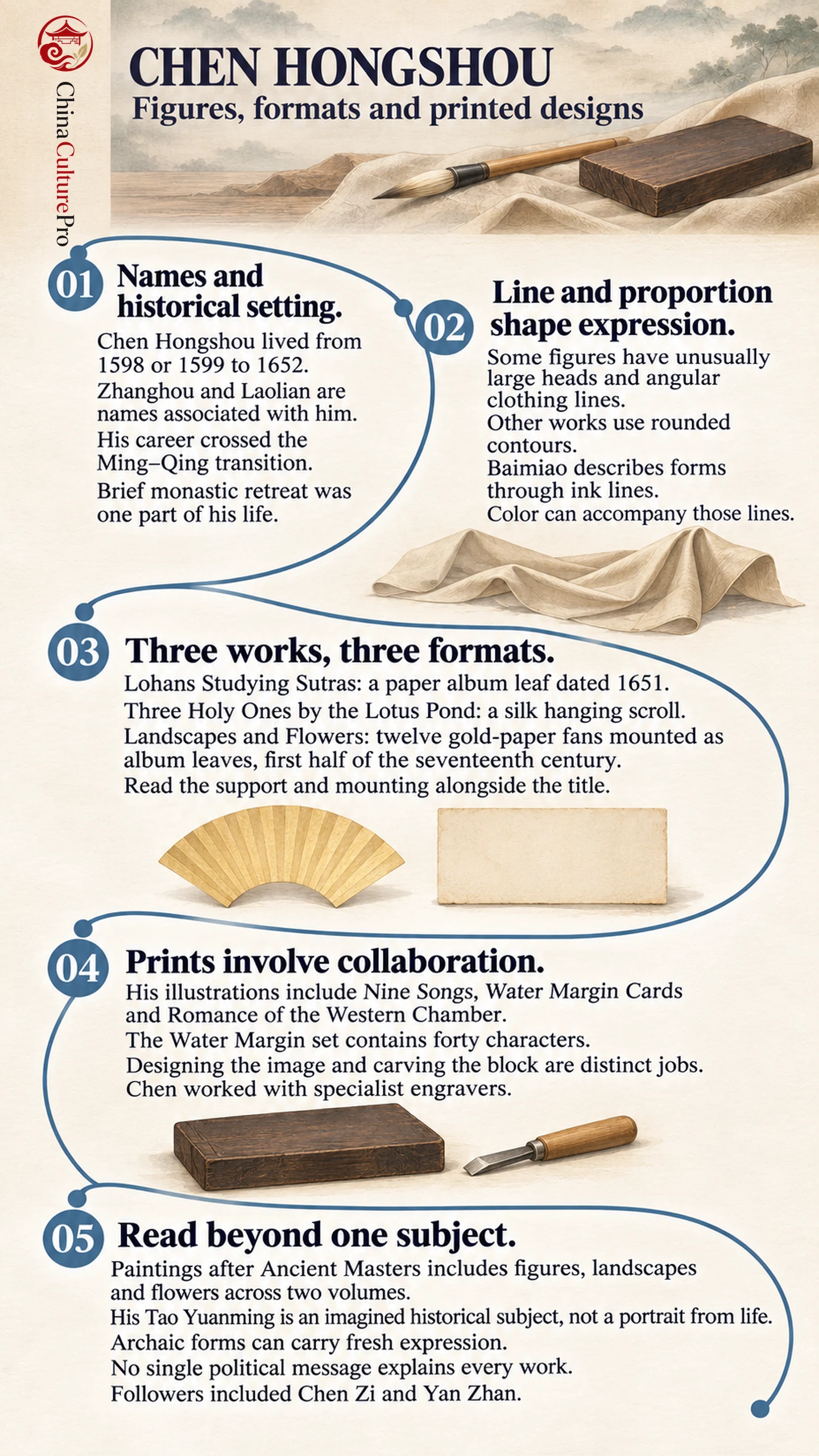
Chen Hongshou (陈洪绶, Chén Hóngshòu; 1598 or 1599–1652) was a Chinese painter and woodblock designer whose career crossed the late Ming dynasty (明朝, Míng Cháo) and early Qing dynasty (清朝, Qīng Cháo). He is especially known for figures that give older pictorial traditions an individual character.[4][6]
- Figures: Unexpected proportions and controlled clothing lines create a deliberately archaic effect.
- Range: His subjects also include landscapes, birds and flowers.
- Other media: He supplied designs for literary woodblock illustrations.[2][3][5]
An old-fashioned appearance does not make a painting a simple copy, and a printed design is a different object from an ink painting.
Chen Hongshou’s people can look both remote and vividly present: faces, clothing and gestures carry much of the effect. Comparing individual paintings with his printed illustrations shows how he adapted older visual languages to different materials, subjects and audiences.
Names and the Ming–Qing Transition
From Zhuji (诸暨, Zhūjì), Zhejiang (浙江, Zhèjiāng), he used the courtesy name Zhanghou (章侯, Zhānghóu) and sobriquet Laolian (老莲, Lǎolián), “old lotus.” His later names included Huichi (悔迟, Huǐchí), associated with belated regret.[1]
The dynastic transition brought warfare and dislocation, and he briefly retreated into Buddhist monastic life. That context helps explain the importance of withdrawal and older cultural models in discussions of his work. It does not establish that every painted figure represents Chen himself or expresses one fixed political message.[6]
How His Figure Painting Creates an Archaic Effect
In his figure painting, altered proportions and emphatic clothing contours draw attention to character rather than ordinary bodily appearance. Manifestations of the Three Holy Ones by the Lotus Pond (莲池应化图, Liánchí Yìnghuà Tú) shows unusually large heads and forceful, angular drapery lines. Its inscription identifies the religious figures; their appearance alone does not provide the whole subject.[2]
Lohans Studying Sutras (品梵, Pǐn Fàn) uses rounded clothing lines for two seated figures absorbed in reading and discussion.[1]
Baimiao (白描, báimiáo) describes forms through ink contours. The sutra-reading figures add blue and ochre accents along those lines: line and color can work together.[1]
Three Works and Their Formats
These works offer three ways to compare scale, support and format.[1][2][4]
| Work | Date and format | Point of comparison |
|---|---|---|
| Lohans Studying Sutras, from Sixteen Views of Dwelling in Seclusion (隐居十六观, Yǐnjū Shíliù Guān) | 1651; an album leaf (册页, cèyè) on paper. | Two figures reading together. |
| Manifestations of the Three Holy Ones by the Lotus Pond | Undated here; a hanging scroll (立轴, lìzhóu) on silk. | Monumental figures and angular contours. |
| Landscapes and Flowers (山水花鸟人物图, Shānshuǐ Huāniǎo Rénwù Tú) | First half of the seventeenth century; twelve folding fans (折扇, zhéshàn) mounted as album leaves, ink and color on gold paper. | Fan-shaped compositions preserved within an album. |
The fan album’s mounting and its fan-shaped compositions describe different aspects of the same objects. Likewise, a broadly dated catalogue entry should not be converted into a precise creation year. Read the medium and format alongside the title.[4]
Woodblock Designs and Literary Illustration
His illustration work included Nine Songs (九歌, Jiǔ Gē), Water Margin Cards (水浒叶子, Shuǐhǔ Yèzi) and Romance of the Western Chamber (西厢记, Xīxiāng Jì). The Water Margin set presents forty characters, rather than the novel’s entire group of 108 heroes.[3]
In woodblock production, designing an image and cutting its block are distinct jobs. Chen worked with specialist engravers, also supplying prefaces or inscriptions.[3]
Reading His Range and Legacy
His range of subjects extends beyond isolated, eccentric figures. The double album Paintings after Ancient Masters (老莲橅古, Lǎolián Mógǔ) contains twenty paintings across its two volumes, including landscapes, figures and flowers. Its small scale offers a different encounter from the large religious hanging scroll.[5]
One leaf portrays Tao Yuanming (陶渊明, Táo Yuānmíng), the earlier poet associated with withdrawal from office. This is an imaginative representation of a historical subject, not a portrait from life. The choice connects learned painting traditions with the pressures of Chen’s own period, without making the two men’s experiences identical.[7]
His followers included Chen Zi (陈字, Chén Zì) and Yan Zhan (严湛, Yán Zhàn).[3] His legacy encompasses the expressive possibilities of archaic forms and the circulation of images through literary printing. Compare gesture, line and material with the inscription and catalogue record. A religious figure and a literary character need not carry the same message.[2][3][6]
FAQs About Chen Hongshou
Are Chen Hongshou and Chen Laolian the same artist?
Yes. Laolian, “old lotus,” was one of his sobriquets. Zhanghou is another name encountered in catalogue entries.[1]
Why do some figures have unusually large heads?
Altered proportions are part of his expressive figure language. They work with clothing contours and gesture rather than indicating an inability to depict ordinary proportions.[2]
Did Chen Hongshou paint only people?
No. Museum collections also preserve his landscapes, flowers and birds, sometimes together in an album.[5]
Did he carve every woodblock himself?
His designs were produced in collaboration with engravers. Image design, block cutting and printing should be distinguished.[3]
Sources
[1] National Palace Museum. Lohans Studying Sutras, from Sixteen Views of Dwelling in Seclusion
[2] National Palace Museum. Manifestations of the Three Holy Ones by the Lotus Pond
[3] Shanghai Museum. Chen Hongshou and Cui Zizhong exhibition introduction
[4] Metropolitan Museum of Art. Landscapes and Flowers
[5] Cleveland Museum of Art. Paintings after Ancient Masters: Volume 1
[6] BAMPFA. Repentant Monk exhibition announcement
[7] Cleveland Museum of Art. Paintings after Ancient Masters: Portrait of Tao Yuanming