

Quick Answer: Who Was Chen Duxiu?
Chen Duxiu (陈独秀, Chén Dúxiù, 1879–1942) was an editor, educator and political organizer. He founded Youth Magazine (青年杂志, Qīngnián Zázhì), later titled New Youth (新青年, Xīn Qīngnián), and became dean of letters at Peking University (北京大学, Běijīng Dàxué). He helped found and became the first leader of the Chinese Communist Party (中国共产党, Zhōngguó Gòngchǎndǎng).[1][2][6]
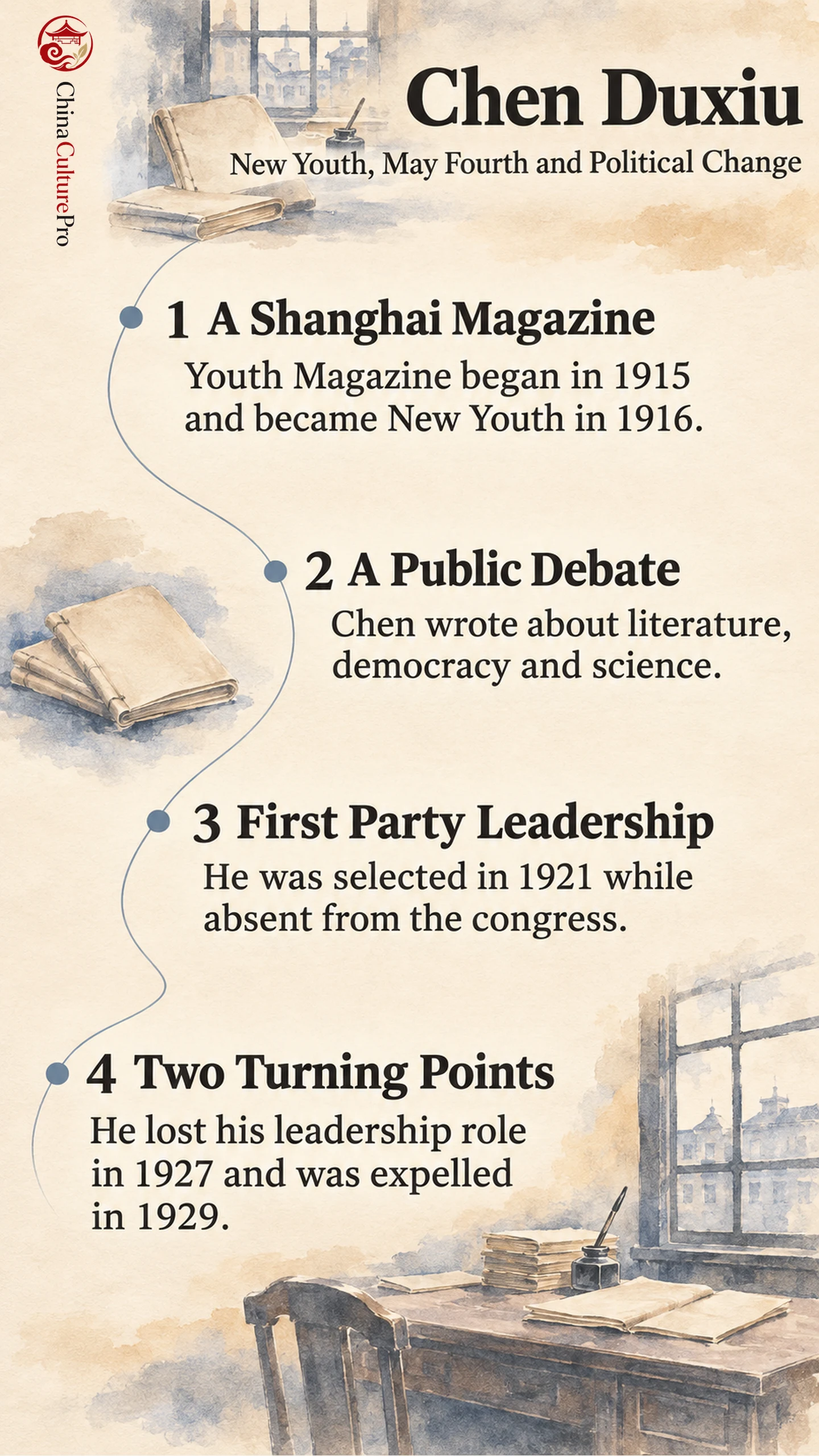
- Publishing: The magazine began in Shanghai in 1915 and took the name New Youth in 1916.[2]
- Writing: His early essays addressed young readers, literary change and the place of science and democracy in public life.[3][4][5]
- Politics: He was chosen to lead the new party in 1921, lost his leadership role in 1927 and was expelled in 1929.[6][7][9]
The magazine’s early issues, the protests of 1919 and the party’s founding in 1921 belong to the same period of change. Each had its own participants and purposes.
One way to follow Chen Duxiu’s career is to start with the publication dates on three essays. In 1915 he addressed young people directly. In 1917 he argued about what literature should do, and in January 1919 he answered critics of his magazine. The essays make it possible to read his influence as a series of public arguments before turning to his later role in a political party.[3][4][5]
How Youth Magazine Became New Youth
The first issue appeared in Shanghai in September 1915. Chen’s opening essay, Call to Youth (敬告青年, Jìnggào Qīngnián), asked young people to think and act with independence, to test ideas and to pay attention to the wider world. The publication took its new title with its second volume in 1916.[2][3]
In 1917, under Cai Yuanpei (蔡元培, Cài Yuánpéi), Chen took up the position of dean of letters. The magazine’s editorial activity shifted to Beijing and drew in other writers linked to the university. It became a venue for debate in the New Culture Movement (新文化运动, Xīn Wénhuà Yùndòng).[1]
The move brought the magazine closer to a university community. It began as a Shanghai publication addressed to a generation. The Peking University period brought the editor into contact with scholars and writers who could use its pages for their own arguments and experiments.
What Chen Argued About Literature and Public Life
In February 1917, Chen published On Literary Revolution (文学革命论, Wénxué Gémìng Lùn). He acknowledged Hu Shi (胡适, Hú Shì) and proposed a literature that could reach more readers, attend to social experience and use language with greater directness. It was a polemic about the audience and materials of literary writing as much as a statement about style.[4]
A work such as Lu Xun’s (鲁迅, Lǔ Xùn) Diary of a Madman (狂人日记, Kuángrén Rìjì), published in the magazine in 1918, shows how a writer could use the venue for fiction.[1]
Read the essay for its program and the story for what a writer did with a narrative voice.
Chen’s January 1919 reply to the magazine’s critics personified democracy and science as two gentlemen. The article uses the device to tie a number of disputes about the journal to two principles it claimed to defend. Reading the reply beside the 1917 essay shows that the arguments about literary language were part of a broader disagreement about public life.[5]
From May Fourth to the First Party Leadership
The May Fourth Movement (五四运动, Wǔsì Yùndòng) took its name from student protests in 1919. A journal founded in 1915 helped create a setting for the arguments that surrounded those protests. The immediate protest concerned the postwar settlement over Shandong. Students organized it and made demands of their own.[1]
Chen went on to help form the Chinese Communist Party, with Li Dazhao (李大钊, Lǐ Dàzhāo) among the other central early figures. The first congress in 1921 selected Chen for leadership even though he did not attend. This distinction keeps the story of founding an organization separate from the list of people who took part in one meeting.[6][7][8]
Some writers associated with the period continued in other directions. Compare Bing Xin and the newspaper that carried her work with the venue for Lu Xun’s early vernacular fiction. His later The True Story of Ah Q appeared in newspaper installments. The period offers more than one route into modern Chinese literature.
What Changed After 1927
Chen was removed from party leadership during the crisis of 1927. The party’s own chronology dates his suspension to July, in a reorganization of the central leadership.[9] He remained a member until he was expelled in 1929.[7]
The government of the Nationalist Party (国民党, Guómíndǎng) arrested him in 1932. He left prison in 1937 and died in Jiangjin in 1942.[7]
That later chronology is part of Republican China’s history. It also helps keep the editor of 1915, the party leader of 1921 and the former leader of the 1930s in their respective settings.
FAQs About Chen Duxiu
When did Chen Duxiu found New Youth?
He founded the magazine in Shanghai in September 1915 under the title Youth Magazine. It was renamed New Youth in 1916.[2]
Was Chen Duxiu at the party’s first congress in 1921?
No. He was selected for leadership at the founding congress while absent from the meeting.[7][8]
What did Mr. Democracy and Mr. Science refer to?
Chen personified democracy and science in his 1919 defense of New Youth. He used the two figures to describe principles the magazine claimed to support.[5]
Sources
[1] Peking University. Peking University Before and After May Fourth
[2] Academy of Chinese Studies. Rise of the New Culture Movement
[3] Chen Duxiu. Call to Youth
[4] Chen Duxiu. On Literary Revolution
[5] Chen Duxiu. A Defense of New Youth Against Its Critics
[6] Lee Feigon, Princeton University Press. Chen Duxiu, Founder of the Chinese Communist Party
[7] Osaka University. Chen Duxiu: Modern Chinese Writers Dictionary
[8] People’s Daily, Party History Channel. Chen Duxiu and Li Dazhao at the Time of the First Congress
[9] People’s Daily, Party History Archive. Reorganization of the Central Leadership in 1927