

Quick Answer: Who Was Bao Zheng?
Bao Zheng (包拯, Bāo Zhěng, 999–1062) was a Northern Song (北宋, Běi Sòng) official remembered for his directness and resistance to privileged interests. The historical Bao inspired the figure known as Bao Gong (包公, Bāo Gōng), or Judge Bao, in later storytelling and theatre.[1][2]
- Career: He governed local jurisdictions, served as a censor and held senior fiscal and court posts.[1]
- Kaifeng: In the capital, he was credited with allowing complainants to present grievances more directly.[1][3]
- Legend: The judge’s famous cases and painted face took shape in literary and performance traditions.[2][5][6]
His recorded career and the later stories answer different questions about how people imagined justice.[1][2]

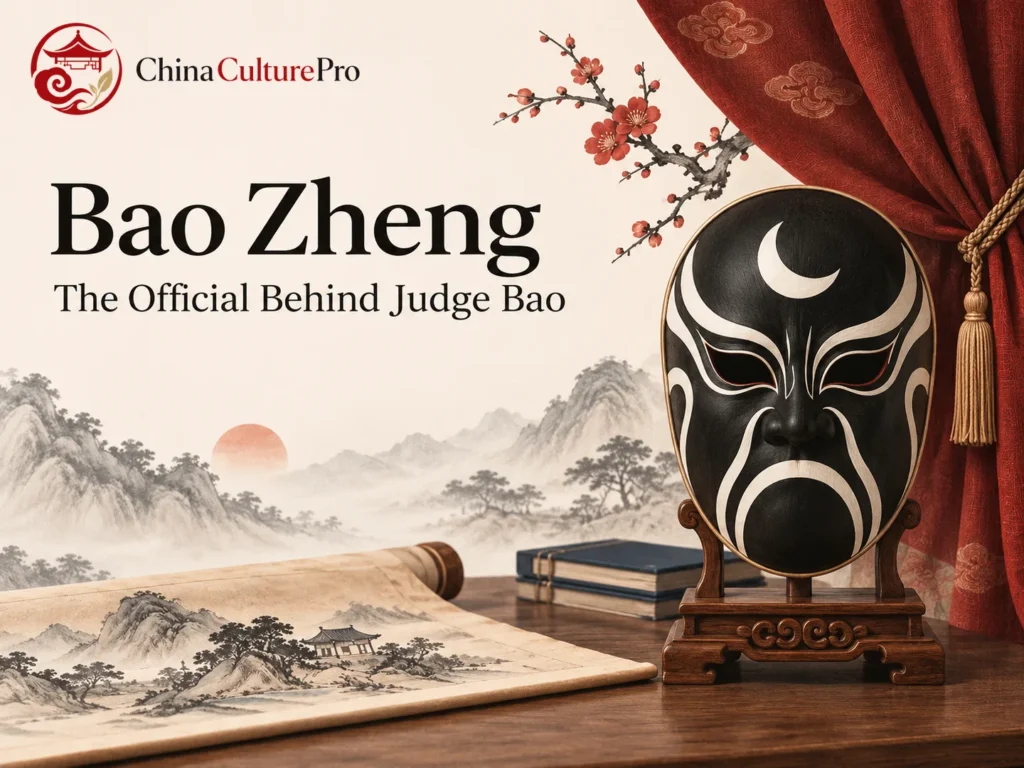
The image of an official with a crescent on his forehead makes Judge Bao recognizable in later performance traditions. To understand why the image stuck, start with the responsibilities Bao actually held, then follow the character into later drama. His life illustrates how the public reputation of Chinese historical figures can outlast the institutions in which they worked.
Bao Zheng’s Career Beyond the Courtroom
Bao came from Hefei in present-day Anhui and earned the jinshi (进士, jìnshì) qualification through the imperial examinations. His biography presents his entry into active service as delayed by care for his parents and mourning after their deaths. He later served as magistrate at Tianchang and prefect at Duanzhou, offices that combined local administration with hearing disputes.[1]
At the Song court, Bao’s work reached well beyond criminal cases. His assignments included censorial oversight, fiscal administration and a diplomatic mission to the Khitan. He challenged appointments and submitted proposals on issues such as military readiness and government procurement. The range is typical of a career in which scholar-officials could move among local, regional and central posts.[1]
The official history also preserves disagreement about him. After Bao criticized men who had held a senior finance post, he was selected to fill it. Ouyang Xiu objected that taking the office made his earlier criticism look self-serving. Bao temporarily withdrew. The objection is useful evidence of the scrutiny that even an official praised for his integrity could face.[1]
How the Song History Builds His Reputation
The History of Song (宋史, Sòng Shǐ) relates a change Bao made in Kaifeng, where he was appointed prefect in 1057. It says he opened the main gate and let complainants state their cases directly. The point is procedural. A hearing could depend on whether the person bringing a grievance could reach the official without an intermediary controlling the account.[1][3]
The biography also preserves short stories selected to illustrate his character. In one, a man reports that his ox’s tongue has been cut out. Bao tells him to slaughter and sell the animal, then accuses the man who denounces the slaughter of having caused the injury. The biography says the man admits it. In another, he restricts the collection of Duanzhou inkstones to the tribute quota. The first episode emphasizes inference, while the second concerns the use of a public obligation to procure gifts for influential people.[1]
The official biography’s episodes are accounts preserved in a later history. They can be read alongside material evidence. In 1973 excavators at the Bao family burial site in Hefei recovered his epitaph, which records his career, death and burial. An inscription adds a different kind of witness to the record, even though its commemorative purpose also shapes what it says.[8]
How Judge Bao Became a Literary Character
Judge Bao circulated in vernacular stories, ballad narratives and plays in the centuries after Bao Zheng’s death. The surviving versions do not establish a single path from one genre to all the others. Some ballad stories give the judge cases in which powerful families can obstruct justice, raising a question the audience can recognize across versions: how much independence does a judge have when the accused has protection?[2]
The Qing novel Three Heroes and Five Gallants (三侠五义, Sānxiá Wǔyì), first published in 1879, gives figures such as Zhan Zhao room to act alongside the magistrate. The partnership allows pursuits and investigations to unfold away from the formal hearing.[4]
A familiar opera example is the case of Chen Shimei (陈世美, Chén Shìměi). In the story, Qin Xianglian (秦香莲, Qín Xiānglián) seeks justice after Chen repudiates his family and marries a princess. Bao’s ruling supplies the dramatic answer to a question about rank and accountability. The case belongs to the stage tradition, while the ox episode is an anecdote in the historical biography. Keeping the source of each story visible is a practical way to read history and legend together.[1][5]
The Painted Face and Crescent
In Peking opera, Judge Bao is a painted-face role, often shown with a black-and-white design. The crescent is a recognizable mark in some depictions, including a carved mask by Li Jiyou from 2004. One tradition connects it to the judge’s ability to hear cases in the underworld. That reading belongs to the character’s folklore and helps explain how justice could be imagined reaching beyond the ordinary court.[6][7]
A costume or carved face can therefore tell a reader how a particular tradition wanted its audience to recognize the judge. The historical career is documented through a different set of sources, including official accounts and the epitaph. A modern representation can be studied precisely by asking what kind of object it is and when it was made.[1][7][8]
FAQs About Bao Zheng
Was Judge Bao a real person?
Judge Bao is based on Bao Zheng, a Northern Song official who lived from 999 to 1062. Later writers and performers developed him into a recurring character.
Was Chen Shimei a real case of Bao Zheng’s?
The surviving drama presents Chen Shimei as a literary case. The historical biography supplies no basis for treating that plot as a documented trial.
What does Bao Gong mean?
Bao Gong is an honorific often rendered as Lord Bao. Bao Zheng is his personal name, and Judge Bao is a common English label for the figure in stories.
Sources
[1] History of Song. Volume 316: Biography of Bao Zheng
[2] Wilt L. Idema and Guanwen Wu. The Nature of Crime and the Role of the Judge: Judge Bao in Ballad-Stories
[3] Academy of Chinese Studies. Lord Bao
[4] Susan Blader. Tales of Magistrate Bao and His Valiant Lieutenants
[5] Hong Kong Leisure and Cultural Services Department. Chinese Opera Festival: The Case of Killing Chen Shimei
[6] Princeton University East Asian Studies Program. Peking Opera Roles
[7] China Intangible Heritage Industry Alliance. Judge Bao (Wood-Carved Facial Make-Up)
[8] Anhui Commission for Discipline Inspection and Supervision. Hefei’s Bao Qingtian