


Quick Answer: How Do Baijiu and Vodka Differ?
Baijiu (白酒, báijiǔ) and vodka are distilled spirits. Baijiu is a Chinese spirit whose aroma depends heavily on its fermentation and style. Plain vodka is made to reduce the flavors carried over from its raw materials and fermentation.[1][2][3][4]
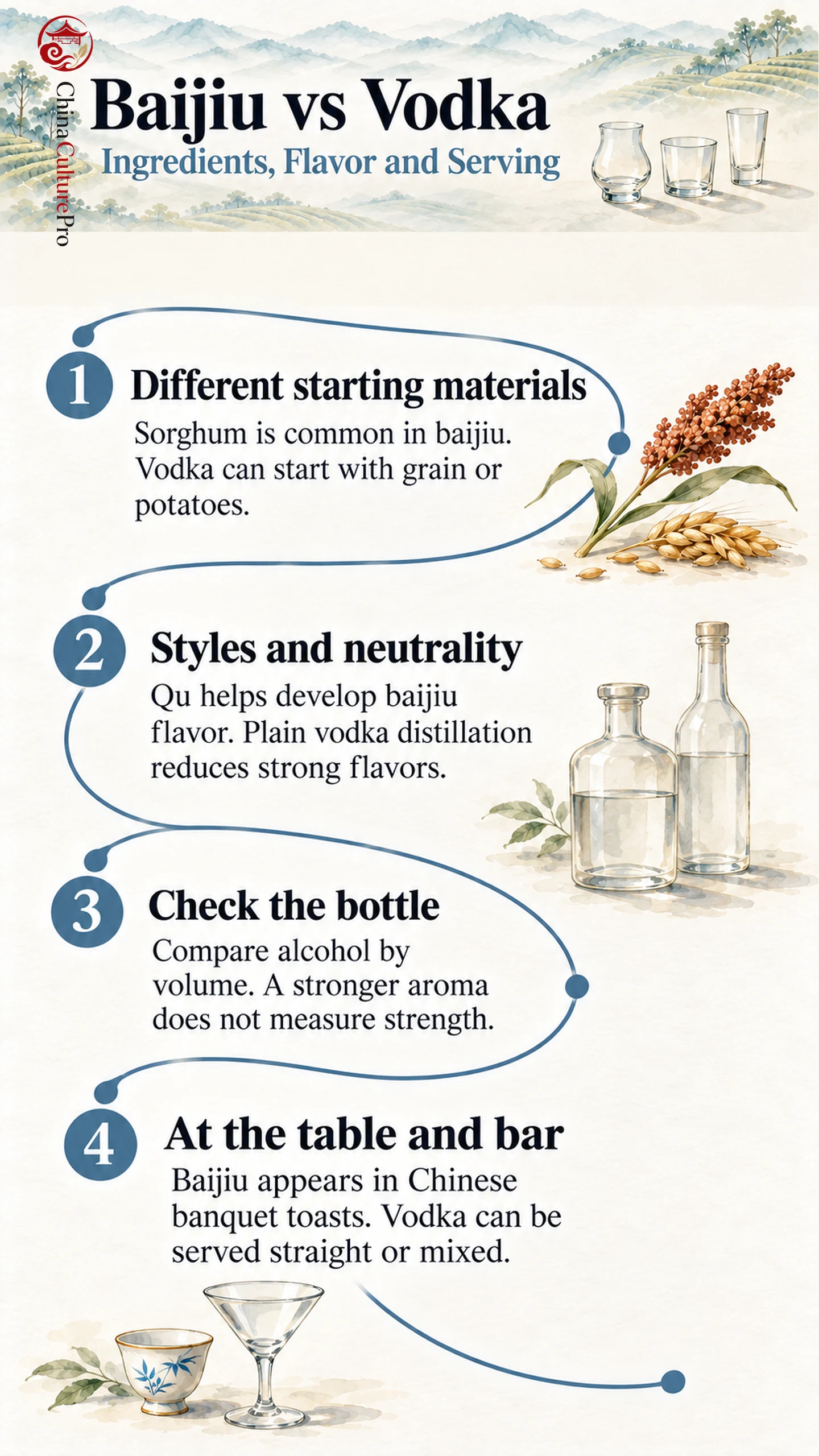
- Base: Sorghum is common in baijiu. Vodka can start with grain, potatoes or other agricultural ingredients.[1][3][4]
- Production: Traditional baijiu uses a starter called qu (曲, qū). Vodka’s category standards emphasize a much more neutral distillate.[1][2][3][4]
- Serving: Baijiu has a place in Chinese banquet toasts. Vodka can be served straight or used as a cocktail base.[5][6][7]
For alcohol strength, compare the ABV on the two bottles. Clear color tells you little about the aroma or the alcohol content.[1][3][4]
A clear spirit can be strongly aromatic. A light-smelling one can still have a high alcohol content. In a banquet or a mixed drink, you may notice the aroma before you know the strength.
Baijiu and Vodka at a Glance
| Feature | Baijiu | Plain vodka |
|---|---|---|
| Common starting materials | Sorghum, rice and other grains, depending on style.[1][2] | Fermented agricultural ingredients such as cereals or potatoes.[3][4] |
| Production emphasis | Fermentation with qu and distillation preserve the character of the chosen style.[1][2] | Distillation reduces flavors from the raw material and fermentation.[3][4] |
| What to check on a bottle | The aroma style and alcohol by volume.[1] | The alcohol by volume and whether the label describes plain or flavored vodka.[3][4] |
Why the Two Spirits Smell and Taste Different
In many traditional forms of baijiu, qu helps turn grain starch into sugars and supports fermentation. Many styles work with a solid grain mixture, while rice-aroma baijiu is an example that can use a partly liquid process. Ingredients and fermentation conditions contribute to differences between sauce-, strong-, light- and rice-aroma baijiu. Those labels describe sensory styles. On Chinese shelves you may also encounter products from time-honored Chinese brands such as Xinghuacun, a Shanxi name associated with light-aroma baijiu. The heritage designation describes a brand, while the aroma label describes a style.[8] See the guide to baijiu aroma types for the differences between them.[1][2]
Plain vodka is made by distilling fermented material to reduce the character of that material and its fermentation by-products. Charcoal treatment is allowed under the vodka standards discussed here. Plain vodka can still have sensory differences from bottle to bottle. A plain spirit can still have a perceptible flavor, but a sauce- or strong-aroma baijiu can change the profile of a mixed drink substantially.[1][3][4]
What the ABV on a Bottle Tells You
Alcohol by volume, or ABV, measures how much of the drink is pure alcohol by volume. The U.S. standard puts plain vodka in the neutral spirits class, bottled at a minimum of 40% ABV. In the EU, the standard minimum for vodka is 37.5% ABV. These are thresholds for their respective markets.[3][4]
Baijiu bottles have their own stated strength. A “light-aroma” label refers to a flavor category and does not give an ABV. For a same-size pour, more alcohol by volume means more alcohol in the glass. Read the bottle before comparing.[1][3][4]
How Serving Traditions Differ
Baijiu often appears in small glasses with food at a Chinese banquet. A toast may include ganbei (干杯, gānbēi), a phrase that literally refers to emptying the cup. Actual behavior varies by group and occasion. The small glass makes sense in a meal built around successive toasts.[5][6]
In parts of Eastern Europe, vodka has traditionally been served chilled and straight, sometimes with food. It is widely used as a base in mixed drinks, where its relatively restrained flavor gives the other ingredients more room.[3][4][7]
FAQs About Baijiu and Vodka
Is Vodka Always Made From Potatoes?
Vodka can come from cereals, potatoes or other suitable agricultural materials. The base depends on the producer and the rules relevant to the label.[3][4]
Is Baijiu Stronger Than Vodka?
Some baijiu has a higher ABV than some vodka. Compare the specific bottles. A stronger smell does not measure alcohol content.[1][3][4]
Can You Substitute Baijiu for Vodka?
A strongly aromatic baijiu changes the flavor of a drink designed around plain vodka. Compare the spirit’s style and ABV before making that substitution.[1][2][3]
Sources
[1] Yanning Dou, Marko Mäkinen and Janne Jänis. High-Resolution Mass Spectrometry-Based Chemical Fingerprinting of Baijiu, a Traditional Chinese Liquor
[2] Jun Wei and colleagues. Basic Flavor Types and Component Characteristics of Chinese Traditional Liquors: A Review
[3] European Union. Regulation (EU) 2019/787, Annex I
[4] U.S. Alcohol and Tobacco Tax and Trade Bureau. 27 CFR § 5.142: Neutral Spirits or Alcohol
[5] Cheung Kong Graduate School of Business. CKGSB Knowledge, Winter 2023
[6] Nicholas Loubere. Gānbēi: Navigating Chinese Drinking Culture During Empirical Fieldwork
[7] Jacopo Mazzeo. The Craft and History of Vodka
[8] Ministry of Commerce of China. Xinghuacun in the Time-Honored Brands Digital Museum