
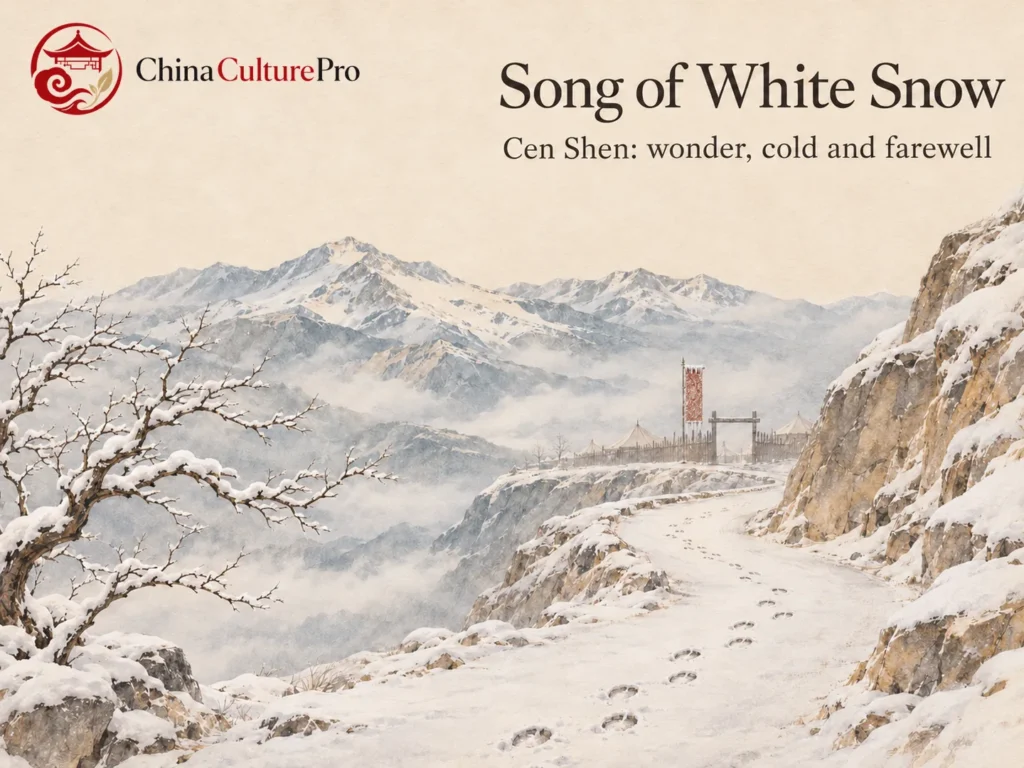

Quick Answer: What Connects the Snow and the Farewell?
Cen Shen (岑参, Cén Shēn) makes snow the thread of White Snow Song Sending Official Wu Back to the Capital (白雪歌送武判官归京, Bái Xuě Gē Sòng Wǔ Pàn Guān Guī Jīng). Wonder at the landscape becomes the felt cold of camp life, then the setting for a friend’s departure.
- Start with surprise: Snow-covered trees resemble pear blossoms.
- Enter the camp: Clothing and weapons reveal how difficult the cold is.
- Stay for the ending: The guest disappears around the road; hoofprints remain.
The poem is both a snow poem and a farewell. Reading only its famous blossom comparison misses the departure that gives the landscape its emotional direction.
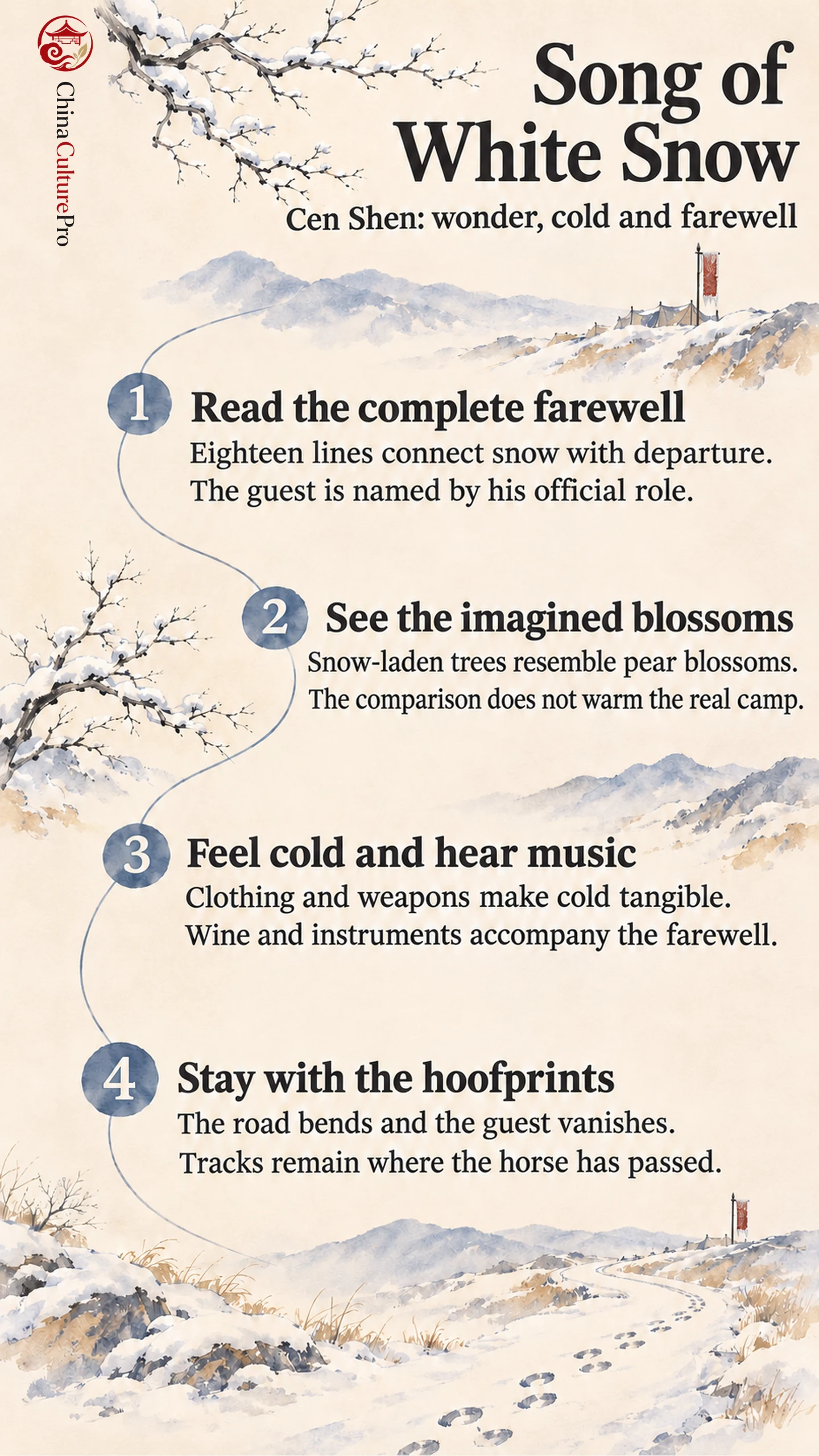
The snow changes its role as the poem unfolds. It can look beautiful, penetrate shelter, stiffen a flag and preserve the marks of someone leaving. Follow those changes rather than reducing the whole work to either cheerful scenery or simple sadness.
Read the Full Farewell Poem in Chinese and English
The table gives all eighteen seven-character lines in nine couplets, with an original, unrhymed English rendering. [1]
The place names below are Luntai (轮台, Lún Tái) and Tianshan (天山, Tiān Shān). Three musical names also appear: huqin (胡琴, Hú Qín), pipa (琵琶, Pí Pá) and Qiang flute (羌笛, Qiāng Dí). Keeping their names avoids silently substituting a modern European ensemble. The title addresses Wu by his official role; his personal identity is not securely known. [2]
| Chinese couplet | Plain English rendering |
|---|---|
| 北风卷地白草折,胡天八月即飞雪。 | North wind sweeps the ground, snapping pale grass; in the frontier’s eighth month snow already flies. [1] |
| 忽如一夜春风来,千树万树梨花开。 | Suddenly, as if spring wind had come overnight, thousands upon thousands of trees bloom with pear flowers. [1] |
| 散入珠帘湿罗幕,狐裘不暖锦衾薄。 | Snow drifts through beaded curtains, wetting silk hangings; fox fur gives no warmth, brocade quilts feel thin. [1] |
| 将军角弓不得控,都护铁衣冷难着。 | The general cannot draw his horn bow; the protector’s iron armor is cold and hard to put on. [1] |
| 瀚海阑干百丈冰,愁云惨淡万里凝。 | Across the desert, immense ice lies crisscrossed; gloomy clouds congeal over vast distances. [1] |
| 中军置酒饮归客,胡琴琵琶与羌笛。 | Headquarters sets out wine for the homebound guest: huqin, pipa and Qiang flute. [1] |
| 纷纷暮雪下辕门,风掣红旗冻不翻。 | Evening snow falls thick at the camp gate; wind tugs a red flag frozen stiff. [1] |
| 轮台东门送君去,去时雪满天山路。 | At Luntai’s east gate I see you off; snow fills the Tianshan road as you leave. [1] |
| 山回路转不见君,雪上空留马行处。 | Mountains turn, the road bends, and you vanish; on the snow remain only your horse’s tracks. [1] |
See Why Snow Becomes Pear Blossoms
The opening’s sudden comparison matters. It is as if spring has arrived: snow-laden branches become a flowering orchard in the imagination. The poet has changed how the scene is perceived without changing its actual temperature. [2]
Notice the movement between the first two couplets. Wind initially breaks grass; a moment later, the same landscape seems to blossom. That imaginative leap allows delight to exist alongside severity. The phrase about thousands of trees enlarges the vision rather than counting an orchard. [1]
The eighth month belongs to the traditional calendar, so it should not automatically become Gregorian August. Nor does the poem establish a present-day forecast for anyone traveling through the region.
Feel the Cold before Hearing the Farewell Music
The next couplets bring the body back into view. Wet hangings, inadequate warmth, an undrawable bow and uncomfortable armor turn cold into specific impediments. The great expanses of ice and cloud then widen the scene again. [1]
At headquarters, wine and instruments gather people around the departing guest. The Chinese musical instruments guide and pipa guide provide context for those names.
The frozen red flag creates another striking contrast: wind pulls, yet the fabric cannot flutter. Movement and stillness work together throughout the poem, from flying snow to fixed ice. [2]
For another snowy military scene, compare Lu Lun’s Song of the Frontier. Here the central human event is a farewell rather than an intended pursuit.
Follow the Guest until Only Hoofprints Remain
Luntai and Tianshan locate the departure in the frontier world. Historical Tang Luntai should not be casually pinned to the modern county of the same name; its precise location remains debated within the Ürümqi region and surroundings. [3]
The ending narrows attention from a vast landscape to a winding road, then to tracks. The friend has passed out of sight, but the snow keeps traces of his passage. This is the same snow that looked like blossoms near the beginning, now made intimate by absence. [1]
Pause after the final image rather than adding an explanation that the traveler arrived safely. The poem leaves us with the person watching the road. Explore Chinese friendship and farewell poems for other ways poets hold a departure in view, and Tang poetry for the wider tradition.
FAQs About Cen Shen’s Song of White Snow
Are the pear blossoms real flowers?
They are a comparison for snow-covered trees. The apparent spring scene is an imaginative transformation of the snowy landscape.
Is this a four-line regulated poem?
No. It is an eighteen-line, seven-character song poem with changing rhymes, not a four-line quatrain.
Who is Official Wu?
Wu is the departing official named in the title. His personal name and biography are not securely established; a precise identity would exceed the available evidence.
Sources
[1] Cen Shen, via Wikisource. A Song of White Snow Sending Official Wu Back to the Capital
[2] Commercial Press Hong Kong, via Chinese Classical Literature Close Reading. White Snow Song: Notes, Commentary and Context
[3] Xinhua Daily Telegraph. Where Was Tang-Dynasty Luntai?