


Quick Answer: What Does Du Mu’s Qinhuai Poem Mean?
Night Mooring on the Qinhuai River (泊秦淮, Bó Qín Huái) by Du Mu (杜牧, Dù Mù) turns a riverside song into a warning about forgetting political failure. The Qinhuai River (秦淮河, Qín Huái Hé) scene belongs to Nanjing.
- The scene: Mist, cold water, moonlit sand and a nearby wine house.
- The allusion: A song associated with a fallen court is still performed.
- The criticism: The singer’s words lead toward a wider question about pleasure and historical memory.
The poem’s accusation is a literary judgment. It does not prove what an individual performer knew or make singers responsible for a dynasty’s collapse.
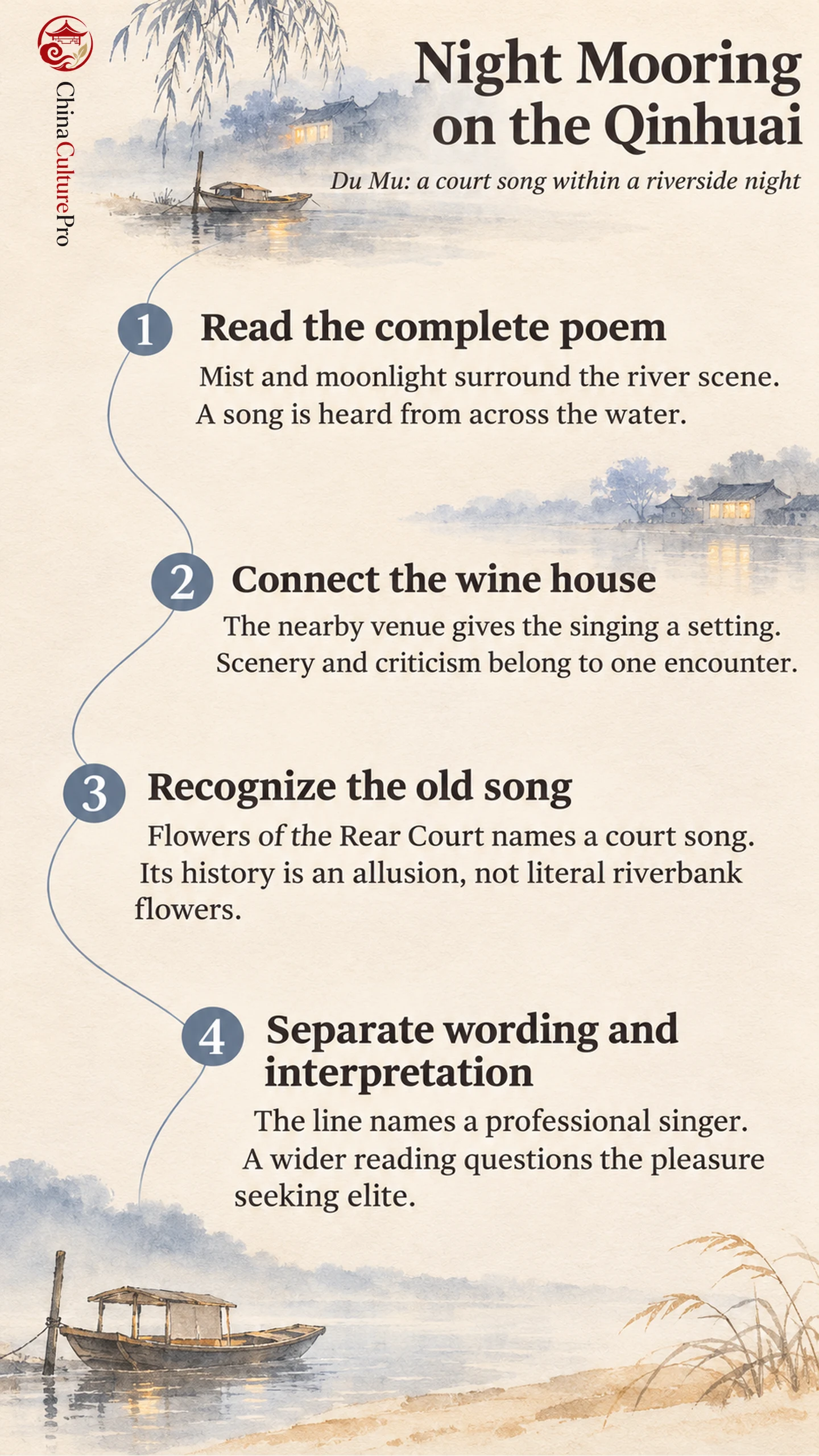
The poem asks the reader to hear more than a pleasant tune. Its final song title carries an earlier court into the present night, bringing immediate pleasure into contact with an uncomfortable historical memory.
Read the Four Lines beside the Qinhuai River
Du Mu was a ninth-century Tang poet, distinct from the earlier Du Fu. The river runs through Nanjing, an earlier imperial capital. [2]
In the original, the final words name Houting Hua (后庭花, Hòu Tíng Huā), rendered here as Flowers of the Rear Court. The table gives the complete poem with an original, unrhymed English rendering. [1]
| Chinese line | Plain English rendering |
|---|---|
| 烟笼寒水月笼沙, | Mist envelops cold water; moonlight envelops the sand. [1] |
| 夜泊秦淮近酒家。 | At night, a boat moors on the Qinhuai near a wine house. [1] |
| 商女不知亡国恨, | The singing woman does not know the grief of a fallen state; [1] |
| 隔江犹唱后庭花。 | Across the river, she still sings Flowers of the Rear Court. [1] |
The English singular is a rendering choice; the Chinese does not require an exact count of singers. The Tang poetry guide places this short form in its wider literary setting.
See How the Opening Leads toward the Singing
The first line repeats the action of enveloping: mist covers water while moonlight covers sand. The second line locates the boat near a wine house, connecting the waterside atmosphere to a place where singing can be heard. [2]
Read that connection before splitting the poem into scenery followed by a moral. The wine house belongs to the route by which sound enters the scene. Without it, the final song would feel less firmly placed.
The four seven-character lines make a quatrain; the Chinese regulated verse guide explains the formal background. Here, the small number of lines makes each transition matter: atmosphere, location, voice and remembered history.
Recognize the Court Song behind the Flowers
The shorter song title refers to Yushu Houting Hua (玉树后庭花, Yù Shù Hòu Tíng Huā), associated with Chen Shubao (陈叔宝, Chén Shūbǎo), the last ruler of the Southern Chen. Later usage made the title an emblem of music associated with a fallen state. It is not simply a description of flowers growing beside the river. [3]
This association explains why the choice of song troubles the listener. Its continued performance makes the earlier court’s memory present within the night. The Chinese dynasties timeline helps separate the earlier Chen setting from Du Mu’s Tang world.
For the literary mechanism, see Chinese literary allusions. The title does not interrupt the scene with a history lesson; it asks the reader to supply the relevant memory.
Read the Criticism beyond the Singer
The third line directly mentions a professional singer: shangnü (商女, shāngnǚ). In this context, the word does not mean a merchant’s daughter. [2]
A broader critical reading directs the satire toward the powerful people who enjoy such entertainment while neglecting public affairs. The performer’s work and the governing elite’s responsibility should not be treated as the same thing. This reading distinguishes the named figure in the line from the wider social target of the poem. [4]
Keep the distinction visible when translating. Replacing “singing woman” with “corrupt officials” would erase the poem’s actual wording. Reading only a rebuke to an ignorant singer would miss the force of the historical allusion. Explanation can connect the two levels while preserving both.
The Chinese classic books guide helps evaluate editions with notes. Look for one that identifies the song and explains the interpretive step, rather than silently rewriting the line as its commentary.
FAQs About Night Mooring on the Qinhuai River
Does shangnü mean a merchant’s daughter?
Not here. The established contextual meaning is a woman who performs songs professionally.
What does still add to the last line?
It connects the current performance with the remembered court song. The music continues while the poem asks whether its historical warning has been understood.
Is the song itself said to have caused a dynasty’s fall?
The allusion uses court entertainment as an emblem of political failure. It should not be turned into a literal claim that one song alone caused a state to collapse.
Sources
[1] Du Mu, via Wikisource. Mooring on the Qinhuai
[2] Chinese Classical Literature Close Reading. Mooring on the Qinhuai: Notes and Commentary
[3] Ministry of Education, Education Encyclopedia. Houting Hua
[4] Gao Yuanxing, via Sanxiang Discipline Inspection Website. Night Mooring on the Qinhuai