

Quick Answer: What Are the Origins of Chinese New Year?
Chinese New Year, called Spring Festival (春节, Chūnjié), developed gradually from older ways of marking seasonal and annual renewal. Its history has three connected strands:
- Early roots: Harvests, offerings and relationships with ancestors and deities helped shape the cultural background of the year’s transition.
- Calendar decisions: Han reforms made the first month the beginning of the year, an important milestone rather than the invention of every New Year custom.
- Accumulated traditions: Door decorations, festive sounds, social visits and modern broadcasts entered the celebration through different historical processes.
There is no documented single founder or precise birthday for the complete festival in its present form.
Chinese New Year history is often reduced to a monster story or a list of customs said to be thousands of years old. The evidence tells a more varied story: agricultural concerns, changing calendars, household practices and newer forms of celebration developed at different times.
How Old Is Chinese New Year?
The festival has ancient roots, but its age depends on what is being dated: agricultural beliefs, an officially designated year beginning, or a recognizable collection of customs. Those are different historical questions.
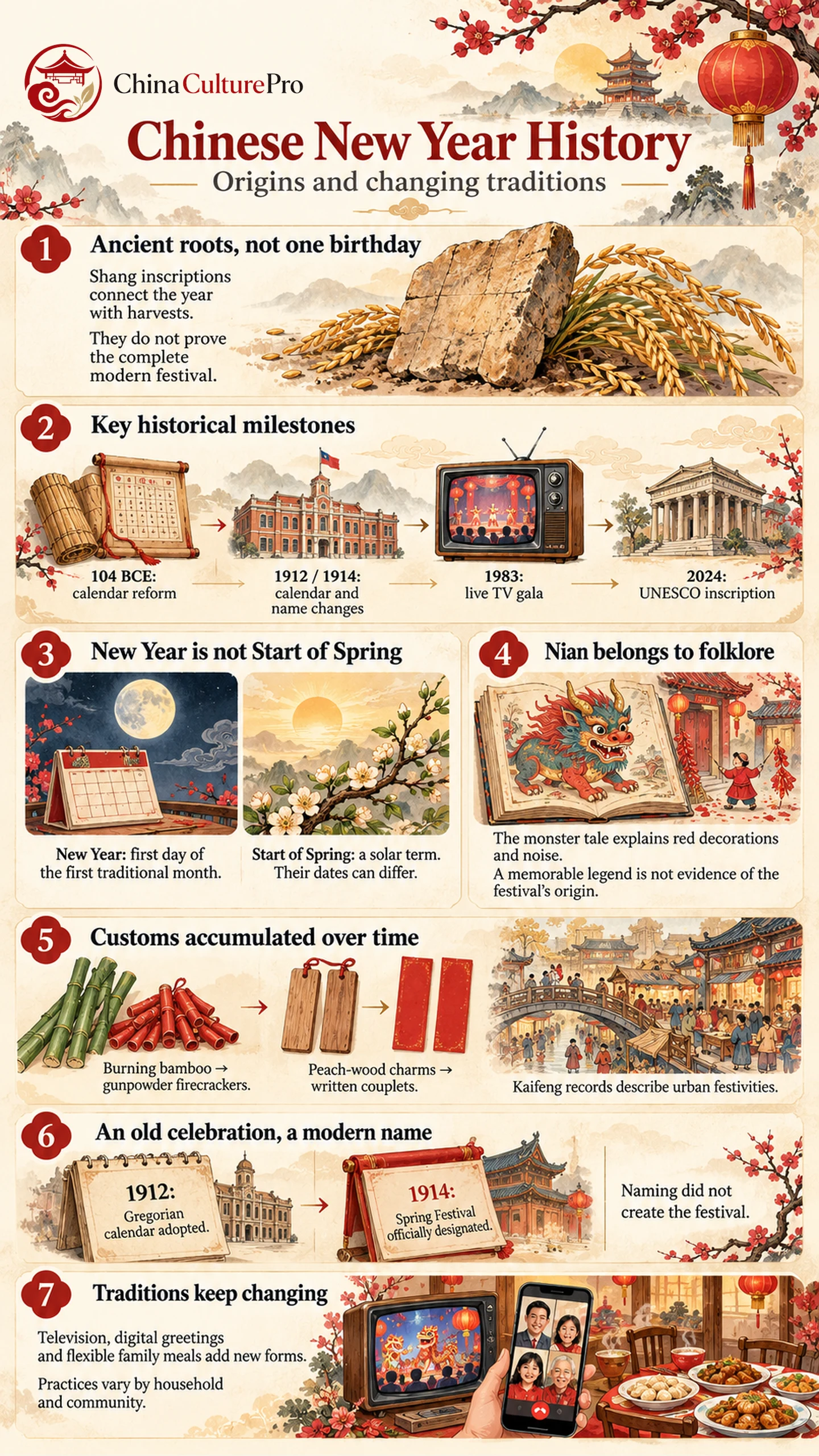
Shang-dynasty oracle inscriptions, more than 3,000 years old, already contain nian (年, nián), the character now meaning “year.” A divination bone in China’s National Museum bears shounian (受年, shòunián), an expression associated with receiving a good harvest. The early character combines a person with grain, connecting the idea of a year with an agricultural cycle.[1]
This is concrete evidence of ancient concern with crops and recurring time. It does not, by itself, establish that the inscription describes a New Year’s Eve ceremony. Still less can it demonstrate that written doorway wishes and family visits already existed together.
Claims that Chinese New Year is exactly 3,500 or 3,800 years old therefore need qualification. A modern festival overview describes the result of that history; early inscriptions illuminate only part of its background. The surviving evidence supports gradual development more securely than one founding date.
A Timeline of Chinese New Year History
These milestones concern different things: agricultural ideas, calendar rules, social practices, an official name and new media. Read them as changes in the festival’s history, rather than successive dates on which the whole celebration was invented.
| Period or date | Historical development | What it does not establish |
|---|---|---|
| Early agricultural societies and Shang evidence | Harvest concerns and annual cycles form part of the background; Shang inscriptions contain the character for “year.” | A complete modern festival or a precisely dated founding ceremony.[1] |
| 104 BCE | Under Emperor Wu, the Han Taichu calendar (太初历, Tàichū lì) reform made the first month the year’s beginning. | That all subsequent customs originated under one emperor.[2] |
| Medieval through late imperial periods | Written records document changing doorway practices, festive sounds, greetings and urban entertainment. | A single date when every region adopted the same customs.[5][6][7] |
| 1912 and 1914 | Gregorian calendar adoption was followed by official use of Spring Festival for the traditional New Year. | That the older celebration disappeared or began in 1914.[8] |
| 1983 | CCTV’s live Spring Festival Gala became a major television milestone. | That New Year performances had no earlier history.[9] |
| 2024 | Spring Festival social practices entered UNESCO’s Representative List of intangible cultural heritage. | A new festival or a worldwide compulsory holiday.[11] |
How Did the Calendar Shape the Festival?
Earlier calendar arrangements did not always place the year’s opening in the same month. The Han reform matters because it changed the official framework within which the annual transition was observed.
The Book of Han (汉书, Hànshū), compiled in the first and early second centuries CE, records the decision in its Annals of Emperor Wu: in the first Taichu year, corresponding to 104 BCE, the calendar was corrected and the first month made the year’s beginning. This is evidence for a calendar decision, rather than an account of someone creating the entire festival.[2]
The traditional Chinese calendar, commonly called nongli (农历, nónglì), combines lunar months with the solar seasonal cycle. New Year’s Day is the first day of its first month. Start of Spring (立春, lìchūn) belongs to the solar terms. They can fall on different dates: in 2018, Start of Spring was February 4 and New Year’s Day February 16.[3]
Is the Nian Story Real History?
The Nian monster (年兽, niánshòu) belongs to folklore. In a popular telling, a frightening creature threatens people at the year’s turn, and red decorations and loud noises help drive it away. The story offers a memorable explanation for familiar festive objects; museums continue to retell it in educational celebrations.[4]
A legend and a historical record answer different questions. The story can show how people explain customs, but it cannot establish when those customs first appeared. The ancient character for “year” is not evidence that the monster existed, or that the familiar tale was already told in Shang times.
Nor does identifying the story as folklore make it culturally unimportant. Stories help families transmit festival memories and give children a narrative to recognize. Their cultural role remains meaningful without treating a supernatural creature as a real animal or claiming that red paper and noise provide actual protection.
How Did Familiar New Year Customs Develop?
From Burning Bamboo to Gunpowder Firecrackers
The sixth-century Jingchu Suishiji (荆楚岁时记, Jīngchǔ Suìshí Jì), a record of seasonal customs by Zong Lin, describes people rising at cockcrow on the first day and making bamboo crack in the courtyard to repel harmful spirits. It preserves a historical belief and a sound-making practice, not proof of supernatural protection.[5]
The material distinction matters: heated bamboo splits noisily without gunpowder. By the Song period, paper-wrapped gunpowder firecrackers were part of this later development, retaining a connection with festive sound.[5] Treating both as identical modern fireworks conceals that change. A surviving description also establishes that a practice was recorded by that time; it does not identify its first inventor.
From Peach-Wood Charms to Spring Couplets
Peach-wood charms, or taofu (桃符, táofú), belonged to traditions of guarding doorways. Guardian names and images on wood formed part of the background to spring couplets (春联, chūnlián), which express wishes through paired lines of writing.[6]
Later historical accounts credit the tenth-century ruler Meng Chang with placing auspicious paired lines on peach boards. The attribution illustrates the link between doorway objects and written blessings; it does not establish a first inventor. As materials and practices changed, written wishes gained different forms and audiences. For their present-day meanings, the New Year symbols guide addresses a different question from their origins.
Family Visits and Urban Celebrations
The Dongjing Menghua Lu (东京梦华录, Dōngjīng Mènghuá Lù), written in the twelfth century by Meng Yuanlao, recalls life in Northern Song Kaifeng. Its sixth volume describes New Year greetings from early morning, temporary stalls, goods for sale, places for singing and dancing, and crowded streets.[7]
This gives the history a specific social setting: a capital with shops, entertainment venues and public festivities alongside formal observances. It does not show that entertainment replaced religion, or that every village celebrated like Kaifeng. The text describes remembered life in one city; its scope should remain attached to that evidence.
Why Is It Called Spring Festival Today?
The words “Spring Festival” are older than their present use as the name of the traditional New Year. Earlier Chinese usage could refer to the spring season; it was not invariably a precise synonym for Start of Spring. An Eastern Han example concerns a lack of rain in spring, rather than a New Year celebration.[1]
The modern distinction became especially useful after the Republic adopted the Gregorian calendar in 1912. January 1 became the official civil year beginning, while people continued to observe their familiar traditional New Year. Yuandan (元旦, Yuándàn), an older expression for a year’s first day, acquired its modern association with January 1.
In 1914, the Beijing government approved the designation Spring Festival for the traditional New Year. The change helped distinguish celebrations within two calendar frameworks; it did not create the older practices.[8]
Three dates therefore need to stay separate: an early appearance of the words, official adoption of their modern festival meaning, and the much longer development of the celebration. None alone tells us when every associated custom began. Administrative terminology can change faster than household habits.
How Have Modern Celebrations Changed?
Television added a new shared setting to the festival evening. In 1983, CCTV’s Spring Festival Gala, commonly called Chunwan (春晚, Chūnwǎn), was broadcast live nationwide. This was a landmark in the history of the annual television gala, not the beginning of New Year entertainment: earlier stage performances and recorded programs already existed.[9]
Communication and meal arrangements have changed too. In Singapore Chinese practice, electronic greetings through messaging platforms have become common, and some families use catered meals or restaurants. These are documented community examples, rather than evidence that every Chinese household has abandoned cards, visits or cooking at home.[10]
The meaningful historical change is an expansion of available forms. A greeting can travel electronically while retaining its purpose of maintaining a relationship; a family meal can move venues without losing its significance. Different generations and households combine these choices differently.
In 2024, Spring Festival social practices were inscribed on UNESCO’s Representative List of the Intangible Cultural Heritage of Humanity. The listing recognizes living practices transmitted through families, communities and learning. It marks international recognition and safeguarding, rather than a starting point for the festival itself.[11]
FAQs About Chinese New Year History
Who Invented Chinese New Year?
No single inventor can be identified. Chinese New Year developed through agricultural life, calendar decisions and changing social practices. Attributing the entire celebration to one emperor turns a long history into an unsupported founding story.
Is the Nian Monster a Historical Creature?
No. Nian is a legendary creature used in stories explaining New Year customs. A tale’s cultural importance does not make it evidence for a real animal, a historical attack or the festival’s exact origin.
Did Chinese New Year Begin in 1914?
No. The 1914 official naming belongs to the history of the term Spring Festival in its modern role. People had observed the traditional New Year long before that administrative distinction was introduced.
Is Chinese New Year the Same as the Start of Spring?
No. Chinese New Year begins on the first day of the first traditional calendar month. Start of Spring is a solar term. The two dates may be close, but they mark different things.
Sources
[1] National Museum of China. 春节的历史渊源
[2] Book of Han. 卷六:武帝纪
[3] Hong Kong Observatory. What year is it today?
[4] Museum of Chinese in America. Lunar New Year Family Festival
[5] China Intangible Cultural Heritage Digital Museum. 烟火爆竹制作技艺(萍乡烟花制作技艺)
[6] Palace Museum. 皇宫里的门神
[7] Meng Yuanlao. 东京梦华录,卷六
[8] Xiao Fang, China Intangible Cultural Heritage Digital Museum. 春节的历史演变与民俗传承
[9] Inter-Asia Cultural Studies. Between the past and the future: the rise of nationalist discourse at the 1983 CCTV Spring Festival Gala
[10] Singapore Chinese Cultural Centre, Culturepaedia. Chinese New Year
[11] UNESCO. Spring festival, social practices of the Chinese people in celebration of traditional new year