

Quick Answer: What Are the Chinese Symbols for Longevity?
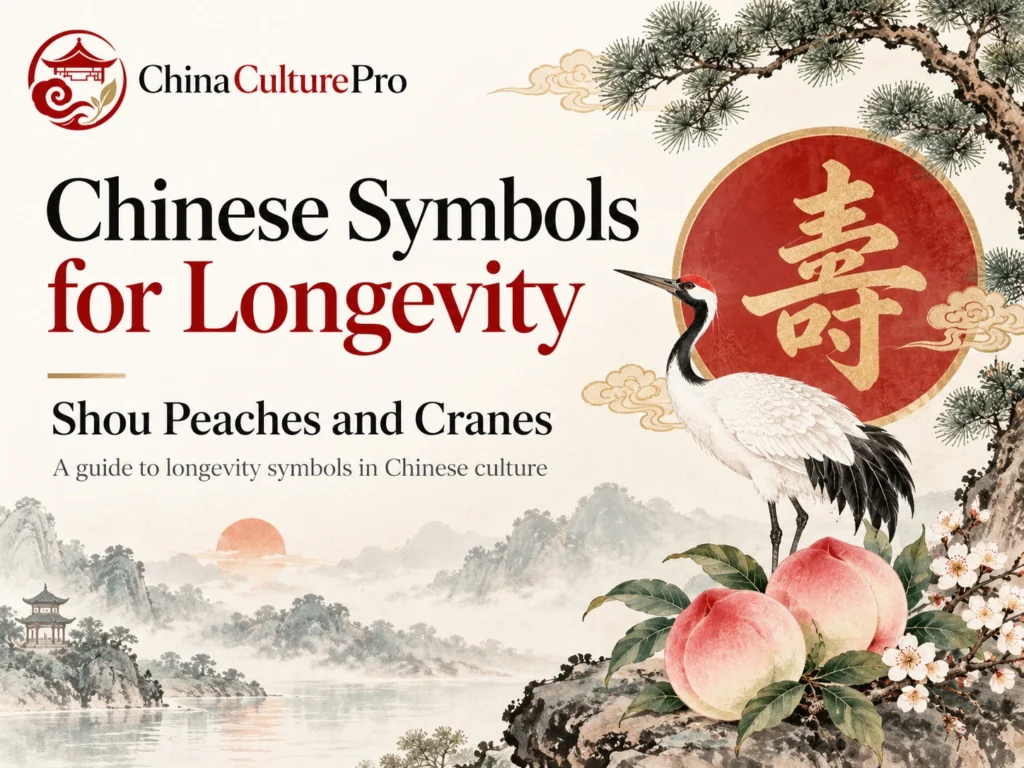
The main Chinese character for longevity is Shou (寿/壽, shòu). Familiar images include peaches, pine trees, cranes and the longevity deity. They belong to four broad groups, each offering a different way to express a wish for long life.[1]
- Written wishes: Shou characters and birthday phrases state the blessing directly.
- Natural motifs: Plants, animals and fungi suggest endurance or evoke stories about long life.
- Legendary figures: Deities and immortals connect longevity with traditional religious and folk imagery.
- Combined designs and birthday objects: Several motifs, or the form of a celebratory food, make the wish more specific.
These are cultural wishes, not promises of longer life. Ordinary longevity is different from mythical immortality; an image’s meaning depends on its companions, inscriptions and setting.
You may see these designs on ceramics, embroidery or an older relative’s birthday decorations. Decide whether you want writing, a natural motif or a figure from folk belief. For other intentions, consult Chinese symbols by meaning.
Chinese Longevity Symbols at a Glance
This is an editorial selection, not an official set of “ten longevity symbols.” Use the final column to avoid treating an isolated detail as a complete message.
| Symbol | Recognition clues | Association | Reading limit |
|---|---|---|---|
| Shou (寿/壽, shòu) | Circular, square or calligraphic character | Direct wish for long life | Stylized forms can be difficult to read. |
| Peach (桃, táo) | Fruit, leafy branch or offering | Immortal-peach mythology | Blossoms may describe a spring scene. |
| Pine (松, sōng) | Evergreen needles and branching trunk | Endurance and long life | Also an image of moral integrity. |
| Crane (鹤, hè) | Long legs and neck; often beside pine | Immortal imagery and longevity | Official badges can indicate rank. |
| Turtle (龟, guī) | Shelled reptile | Endurance and longevity | Shape alone does not identify a birthday gift. |
| Deer (鹿, lù) | Often an antlered animal | Immortal company; wordplay on official prosperity | Companions determine the emphasis. |
| Lingzhi (灵芝, língzhī) | Fungus with a curved cap | Immortal imagery | A fungus, not a flowering plant. |
| Shouxing (寿星, Shòuxīng) | High forehead, beard, staff and peach | Longevity deity | An elderly figure is not automatically Shouxing. |
| Bat (蝙蝠, biānfú) | Flying bat; sometimes grouped around Shou | Blessings through wordplay | Longevity comes from the accompanying theme. |
| Cat and butterfly (猫蝶, māo dié) | Both creatures in one composition | Wordplay wishing an advanced age | A butterfly alone can have other meanings. |
How Is Longevity Written in Chinese?
Shou and Changshou: Long Life, Not Immortality
Shou has meanings relating to long life, age and birthdays. Changshou (长寿/長壽, chángshòu) is the fuller word for longevity. For a design intended to say “long life,” either can be appropriate, but a single decorative Shou character works differently from a complete greeting addressed to someone.[1][2]
Keep nearby wishes separate. Long life does not by itself mean good health, safety or good fortune. A birthday message may combine these hopes, yet they remain different ideas. Likewise, living to an advanced age is different from becoming an immortal in a religious story.
Both simplified 寿 and traditional 壽 express the same word. Choose the form that fits the surrounding writing, then check that any stylization remains legible. The dedicated Shou symbol guide covers the character’s forms and history in greater depth.
Stylized Shou and Birthday Wishes
Decorative Shou characters may be rounded into medallions or arranged within square outlines. A “hundred Shou” composition gathers variations of the character; its title should not replace counting the actual forms. These arrangements make writing part of the ornament rather than simply placing a label beside an image.[5]
A familiar expression is Shou bi Nanshan (寿比南山, shòu bǐ nánshān), wishing longevity comparable to the Southern Mountain. Its textual antecedent is a comparison in the ancient Book of Songs; the later birthday idiom should be distinguished from that earlier poem.[3]
It is often paired with Fu ru Donghai (福如东海, fú rú dōnghǎi), wishing blessings as vast as the Eastern Sea.[4] Together, the phrases express two complementary wishes: abundant blessings and a long life. For a greeting or inscription, keep the whole expression intact rather than selecting an unfamiliar decorative character only because it looks attractive.
Why Do Peaches, Pine and Lingzhi Suggest Long Life?
Peaches and the Queen Mother of the West
The longevity association of peaches draws on stories of the Queen Mother of the West, Xiwangmu (西王母, Xīwángmǔ). Her orchard’s extraordinary peaches belong to the world of immortals. Later decorative uses can turn that mythic fruit into an ordinary wish for someone to enjoy many years.[5]
The goddess need not appear for a peach to carry a longevity association. A fruit beside Shou writing, bats or birthday figures gives a clearer reading than a peach seen alone. Conversely, a flowering peach branch may describe the season, and an orchard may evoke a literary retreat or an immortal realm. Identify the scene before choosing among those possibilities.
The distinction is between the story represented and the object carrying it: a painted immortal peach is an artistic reference, not evidence that real fruit grants immortality.
Pine and Lingzhi: Endurance and Immortal Imagery
A pine tree keeps its needles through winter, making it a useful image of endurance. In a longevity composition, that persistence suggests a long life. In another setting, the same tree may praise integrity or steadfastness. Ren Yi’s 1885 hanging scroll Cranes, Pine Tree, and Lichen (Metropolitan Museum of Art, 1988.324.1) combines long-life emblems with a striking composition. Its artistic purpose extends beyond a conventional birthday picture.[15]
Lingzhi belongs to traditional immortal imagery. A porcelain ink palette shaped like the fungus (Asian Art Museum, B60P2051), dated to the Qianlong period (1736–1795), turns that association into an object for a writing desk. The cap’s resemblance to the head of a wish-granting scepter adds another visual connection.[6]
Resemblance does not make every curled outline a fungus. Look for a stem and cap, and check the catalogue’s identification. The motif does not establish any medicinal property or effect.
Which Animals Can Symbolize Longevity?
Cranes and Tortoises: Cultural Images of Long Life
Cranes beside pine, peaches or immortals often help establish a longevity theme. Their role comes from cultural associations and the surrounding scene. A bird in a naturalistic study need not carry the same message.
An official textile offers a particularly clear contrast. A nineteenth-century Qing crane badge (Metropolitan Museum of Art, 30.75.980), embroidered and embellished with beads, identifies the first civil rank. Its institutional purpose takes priority over a general longevity association; the bird does not turn the badge into a birthday decoration.[7]
Turtles and tortoises also evoke endurance and long life in Chinese art. Their imagery can overlap with divination and cosmological ideas, so the object’s function matters.[14] A turtle-shaped writing implement and a turtle in a birthday picture may share a cultural association while doing very different jobs. Examine the material, accompanying signs and inscription before calling either a birthday gift.
Deer and Butterflies: Why Context Changes the Reading
A deer accompanying a longevity deity or appearing in an immortal landscape can contribute to a long-life theme. Elsewhere, deer (鹿, lù) makes a pun on official prosperity (禄, lù). Neither reading automatically outranks the other: the surrounding figures and words establish which meaning is relevant.
Butterflies likewise have several associations. They can suggest spring, beauty or a love story, and the butterfly word can also participate in wordplay about advanced age.[5] A cat-and-butterfly composition is a familiar longevity combination, explained below. It is not the only possible old-age reference. For either animal, interpreting a cropped photograph without its companions can give an incomplete picture of the original message.
Who Are Shouxing and Magu?
Shouxing is the longevity deity, also called Shoulao (寿老, Shòulǎo). His enlarged forehead, beard, staff and peach are useful identifying clues. He belongs to the Fu Lu Shou (福禄寿, Fú Lù Shòu) grouping of blessings, official prosperity and longevity. Those three figures express related hopes, rather than three versions of the same wish.
An eighteenth-century porcelain Shoulao figure (Metropolitan Museum of Art, 14.40.212) holds a peach and has the characteristic prominent cranium; Shou characters decorate his jacket. The combination identifies him more securely than age or a beard alone.[8] The same Chinese word Shouxing can also refer conversationally to the person celebrating a birthday. That usage does not identify the person as a deity.
Magu (麻姑, Mágū) is a female immortal associated with longevity offerings. Images may show her with peaches or lingzhi, although attributes vary. A Qing jade carving (Asian Art Museum, B60J119), dated 1800–1911, combines Magu with a peach tree and a deer carrying peaches.[6]
Avoid identifying every peach-bearing woman as Magu. An inscription, distinctive attributes or a catalogue identification should support the name; when evidence is missing, describe the visible figure without assigning an identity.
How Do Symbols Combine Into Complete Longevity Wishes?
The Five Blessings (五福, wǔfú) provide one route from a general blessing to a more specific combined design. The bat’s name supplies the central pun: 蝠 (fú) sounds like 福 (fú), the word for blessings. Read the complete object before counting: a cropped border or unseen reverse may conceal an essential element.[6]
| Combination | Required elements | Wish expressed | Reading limit |
|---|---|---|---|
| Wufu pengshou (五福捧寿, wǔfú pěngshòu) | Five bats surrounding Shou or a peach | Five blessings gathered around longevity | One bat does not establish this named composition. |
| Songhe yannian (松鹤延年, sōnghè yánnián) | Pine and crane together | Enduring life | Either motif alone can carry other associations.[10] |
| Maodie (耄耋, màodié), pictured through cat and butterfly | Cat and butterfly together | Longevity into advanced old age | Not evidence of the recipient’s exact age.[9] |
| Three Abundances (三多, sānduō) | Finger citron, peach and pomegranate | Blessings, long life and descendants | A mixed wish, not exclusively longevity.[6] |
In the cat-and-butterfly pun, cat (猫, māo) resembles 耄 (mào) in sound but differs in tone; butterfly (蝶, dié) matches 耋 (dié). The distinction matters when explaining the wordplay. The descendants theme in the Three Abundances reflects historical family ideals, rather than a requirement for modern families.
How Are Longevity Symbols Used in Birthday Celebrations?
Long-Life Noodles and Peach-Shaped Birthday Foods
Long-life noodles, Changshou mian (长寿面, chángshòu miàn), translate the wish into food: the length of the noodles suggests a long life. They are associated with birthday celebrations, but preparation and eating customs vary among families and regions.[11]
Birthday peaches, Shoutao (寿桃, shòutáo), can mean fresh peaches or peach-shaped foods made from flour.[12] A steamed peach-shaped bun, a real peach and a painted immortal peach are different things, even when they share a longevity theme. There is no universal rule requiring every birthday serving to consist of one unbroken noodle. Breaking or biting a noodle does not determine someone’s lifespan.
Birthday Gifts, Textiles and Household Decoration
Shou hangings, pine-and-crane pictures, peach-shaped objects and embroidered textiles can carry birthday wishes. Consider how the recipient relates to the imagery: a simple written greeting and a picture of an immortal may suit different preferences.
Decoration alone does not prove that an antique object was commissioned for a particular birthday. A design could circulate more widely as a desirable auspicious ornament. Court gifts also belong to their own institutional setting, rather than establishing rules for every household. In contemporary jewelry or tattoos, an older motif may acquire a personal meaning; its historical appearance does not automatically transfer an imperial or religious function to the new design.
Two Worked Examples: A Vase and a Turtle-Shaped Object
A Kangxi Vase with Immortals and Peaches
- Visible facts: The Metropolitan Museum of Art’s Vase with Immortals Offering the Peaches of Longevity, 14.40.331, is Qing Kangxi-period porcelain (1662–1722) with overglaze enamels. Its scene includes Xiwangmu among clouds, peaches and immortals on the neck, including Shoulao.[13]
- Contextual evidence: Several recognizable longevity figures and offerings appear together, establishing a theme more clearly than an isolated fruit would.
- Reasonable reading: This porcelain decoration draws on immortal stories to express longevity and auspicious wishes. Such imagery suited display at birthday receptions.[13]
- What remains unknown: The imagery does not establish a particular birthday commission, the intended recipient’s age or imperial ownership. Those conclusions would require evidence beyond the painted scene.
A Sui–Tang Turtle-Shaped Object
- Visible facts: The Metropolitan Museum of Art’s “Inkstone” and cover in the shape of a turtle, 2003.82a, b, is Chinese earthenware dated to the sixth–seventh century. Its shell bears the Eight Trigrams, Bagua (八卦, bāguà).[14]
- Contextual evidence: Turtle imagery carries associations of endurance and longevity; the trigrams add a cosmological dimension.
- Reasonable reading: The object connects a long-lived animal with cosmological signs. Its proposed writing-desk role adds a practical setting that differs from the vase’s narrative scene.
- What remains unknown: Shape and decoration cannot establish a birthday purpose, a particular ritual or protective effectiveness. Its long-life associations do not make it equivalent to the peach-offering vase.
How to Choose a Chinese Longevity Symbol for a Gift or Design
- Define the wish: Decide whether you mean long life, wellbeing or a broader blessing. If the image includes immortals, consider whether you want that narrative or religious background as part of the message.
- Choose the form: Use writing for a direct greeting, natural motifs for a visual association, or a recognizable figure for a story-based design. Match the complexity to the recipient and the size of the finished piece.
- Check the whole composition: Count the bats, identify accompanying plants and read any characters. For named combinations, confirm the necessary elements. For figures, verify the identity instead of relying on a single attribute.
- Preview the finished design: Check character forms, orientation and legibility at the final size. A correct reference can become unclear when cropped, mirrored or simplified. Keep any personal modern interpretation distinct from the older cultural meaning.
FAQs About Chinese Symbols for Longevity
What Is the Chinese Character for Longevity?
Shou, written 寿 in simplified Chinese and 壽 in traditional Chinese, means longevity. Changshou (长寿) is the fuller word for a long life. Shou differs from Fu, which means blessings.
Why Do Peaches Symbolize Longevity?
Their association draws on stories of the Queen Mother of the West’s extraordinary peaches. Decorative peaches later became familiar birthday wishes. This cultural meaning does not imply that real peaches extend life.
Do Cranes Always Mean Long Life?
No. A crane may support a longevity theme beside pine or immortals, identify an official rank on a badge, or appear in a bird study. Read its setting and companions.
Is Longevity the Same as Immortality?
No. Longevity means a long life, whereas immortality belongs to ideas about escaping death or becoming immortal. Mythic imagery can inspire ordinary birthday wishes without making those concepts interchangeable.
Can a Chinese Longevity Symbol Be Used in a Tattoo?
Yes, as personal artistic expression. Check the character, orientation, figure’s identity and complete motif combination. A modern tattoo’s intended meaning should be distinguished from an antique object’s original purpose.
Sources
[1] Ministry of Education, Taiwan. 壽 — Concise Mandarin Chinese Dictionary
[2] Ministry of Education, Taiwan. 長壽 — Concise Mandarin Chinese Dictionary
[3] Ministry of Education, Taiwan. 壽比南山 — Dictionary of Chinese Idioms
[4] Ministry of Education, Taiwan. 福如東海 — Concise Mandarin Chinese Dictionary
[5] The Metropolitan Museum of Art. Longevity in Chinese Art
[6] Asian Art Museum. Hidden Meanings in Chinese Art — Exhibition Placards
[7] The Metropolitan Museum of Art. Rank badge with crane (30.75.980)
[8] The Metropolitan Museum of Art. God of Longevity (Shoulao) (14.40.212)
[9] Ministry of Education, Taiwan. 耄耋 — Revised Mandarin Chinese Dictionary
[10] Palace Museum. 松鹤延年 — Motif Definition
[11] Ministry of Education, Taiwan. 長壽麵 — Revised Mandarin Chinese Dictionary
[12] Ministry of Education, Taiwan. 壽桃 — Concise Mandarin Chinese Dictionary
[13] The Metropolitan Museum of Art. Vase with Immortals Offering the Peaches of Longevity (14.40.331)
[14] The Metropolitan Museum of Art. “Inkstone” and cover in the shape of a turtle (2003.82a, b)
[15] The Metropolitan Museum of Art. Cranes, Pine Tree, and Lichen (1988.324.1)