
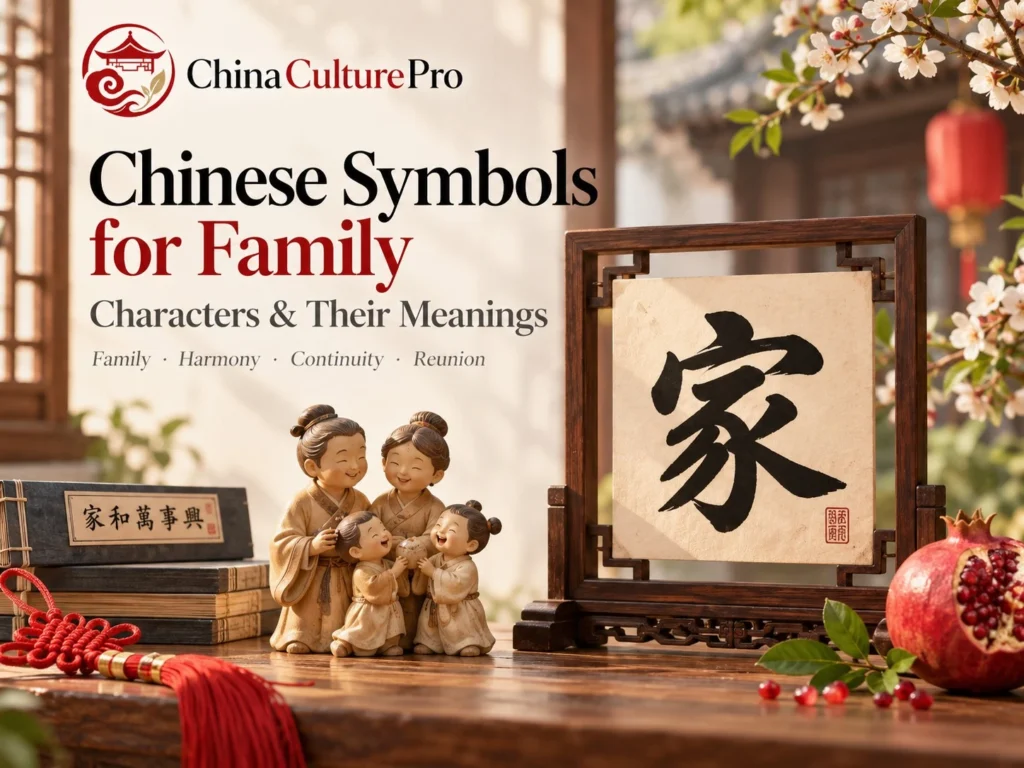

Quick Answer: What Are the Chinese Symbols for Family?
Jia (家, jiā) is the central Chinese character for home and family. Other words and images express particular family relationships or wishes, rather than providing interchangeable translations of “family.”
- Written expressions: Chinese words distinguish the family unit, its members and a wider ancestral lineage.
- Harmony and care: Characters, sayings and selected floral or folk images express affection, respect and harmonious living.
- Family continuity: Many-seeded fruit and children-at-play scenes carry traditional wishes for descendants.
- Reunion: Festival foods and the full moon can evoke relatives gathering together.
These meanings depend on context. They do not guarantee family happiness, children or protection.
A family symbol can name the people you love, celebrate life together or recall a reunion. Start with that intended message before choosing the lettering or image. Across Chinese symbols and meanings, an attractive design may suggest marriage, descendants or a religious tradition to another reader.
How Is Family Written in Chinese?
Jia: One Character for Home and Family
Jia is pronounced with a high, level first tone. Its meanings include the home where relatives live and the people of a household. It is therefore broader than a label for either a physical building or an ancestral bloodline. The standard character is 家 in both simplified and traditional Chinese.[1]
In regular script, it has ten strokes: 宀, mián, the roof component, sits above 豕, shǐ, meaning pig. The familiar “pig beneath a roof” explanation helps a beginner remember the shape, but should not be presented as the only established account of its creation.
The classical dictionary Shuowen Jiezi (说文解字, Shuōwén Jiězì) analyzes it through the roof component and an abbreviated phonetic element associated with 豭. That is a recorded historical analysis, not a reason to assume every graphic component has only a literal meaning. Earlier scripts and variant forms also differ from modern lettering.[1]
Jiating, Jiaren and Jiazu: Which Word Do You Mean?
Choose the word according to whether you mean a home, a household, its people or an extended family line. These related words overlap, but their emphasis differs.
| Word | Main meaning | Useful context |
|---|---|---|
| Jia: 家, jiā | Home or family | A broad title or a message about belonging. |
| Jiating: 家庭, jiātíng | Family as a shared living unit | Discussing family life or different family structures. |
| Jiaren: 家人, jiārén | Family members | Speaking about the people you care for. |
| Jiazu: 家族, jiāzú | Relatives linked through common ancestry | Discussing lineage, heritage or generations of relatives. |
A family unit can be formed through marriage, blood relationships, adoption or cohabitation. It is not limited to one historical model or to biological parenthood.[2]
For a personal message, 我爱我的家人, wǒ ài wǒ de jiārén, means “I love my family members.” 我爱我家, wǒ ài wǒ jiā, expresses love for one’s home or family more broadly. The complete wording communicates the object of affection better than an isolated mark.
Names such as 父母, fùmǔ, for parents; 兄弟姐妹, xiōngdì jiěmèi, for siblings; and 子女, zǐnǚ, for children specify relationships. They are ordinary vocabulary, not separate pictorial emblems. See Chinese character symbols for the wider distinction between writing and symbolic use.
Chinese Family Symbols at a Glance
This is a selection guide, not an official set of eight family symbols. First decide which aspect of family life you want to express.
| Name | Type | Family-related meaning | Context or limit |
|---|---|---|---|
| Jia: 家, jiā | Written character | Home, household or family | A broad word; the surrounding message makes it more precise. |
| He: 和, hé; Jia He Wan Shi Xing: 家和万事兴, jiā hé wàn shì xīng | Character and saying | Harmony within the household | He alone also has meanings outside family life. |
| Xiao: 孝, xiào | Ethical concept | Care and respect for parents | Concerns intergenerational responsibility, not every family relationship. |
| Fu: 福, fú | Blessing character | Good wishes for a household | A general blessing, not a synonym for family. |
| Lotus: 莲花, liánhuā; lily: 百合, bǎihé | Floral images | Harmony or a happy union | Identify the flowers and context; a lotus can also carry religious meanings. |
| Hehe Immortals: 和合二仙, Héhé èrxiān | Folk figures | Harmony and reunion | A particular traditional belief context, not a generic family logo. |
| Pomegranate: 石榴, shíliu; Hundred Boys: 百子图, bǎizǐ tú | Fruit and narrative motifs | Descendants and a flourishing family line | Historical emphasis on sons does not define modern families. |
| Full moon; mooncakes: 月饼, yuèbǐng; tangyuan: 汤圆, tāngyuán | Festival images and foods | Relatives reunited | Meaning comes from the occasion and sharing, not roundness alone. |
Which Symbols Express Family Harmony, Care and Blessings?
Harmony concerns living together; care concerns relationships; blessings express broader good wishes.
Fu wishes a household well, while also expressing blessings in other settings. The Fu symbol guide explains its broader use.[5]
He and Jia He Wan Shi Xing: Harmony in the Household
In a family-themed inscription, He emphasizes accord and harmonious relations. It is useful when the intended message is about how people live together, rather than naming who belongs to the family. Without that setting, the character does not necessarily refer to a household.
Jia He Wan Shi Xing is a proverb commonly rendered “When the family is harmonious, all affairs prosper.” It presents domestic harmony as a foundation for flourishing. The saying is recorded in a late Qing–early twentieth-century novel. This is a documented use, not proof of the proverb’s first invention.[3]
The fuller phrase makes the household theme explicit on calligraphy or a family gift. Read it as a cultural ideal and a hopeful message, rather than a formula guaranteeing financial success. An inscription expresses a wish; it cannot settle disagreements by itself.
Xiao: Care and Respect for Parents
Xiao concerns serving parents well and treating them with respect. It belongs to an ethical discussion of family responsibilities, especially the relationship between generations. It is not the Chinese word for “family,” nor a general decorative promise of good luck.[4]
For a contemporary message, it can emphasize affection, attentive care and consideration for parents or elders. Translating it only as “obedience” leaves out those dimensions. Equally, a single character cannot tell a reader how a particular household negotiates responsibilities or what every person ought to do.
Choose Xiao when respect for parents is central to the message. For a greeting to the whole family, a phrase about harmony or reunion may express the intended relationship more directly.
Lotuses, Lilies and the Hehe Immortals
One name for lotus is 荷, hé, which sounds the same as He, “harmony.” In an appropriate family or marriage composition, that wordplay helps the flower express harmonious relationships. Lotus imagery in Buddhist art or a botanical painting may have a different role.[5]
The lily’s name supports associations with a happy, lasting union. This is a name-based association, not strict homophony with an entire blessing phrase. The Ming painting Flowers and Rocks, held by the Cleveland Museum of Art, combines lilies, peonies and flowering pomegranate. Its motifs carry different wishes; the lily contributes harmony and unity. The accession number is 1915.116.[6]
The Hehe Immortals are a different kind of image. In later folk tradition, the pair came to be identified with the monks Hanshan and Shide and associated with marital harmony and family fulfillment. A Qing bamboo-root carving in the National Palace Museum collection, cataloged on its Southern Branch website as 故雕000107, shows one figure holding a lotus and another leaning on a round box.[7]
The lotus and box reinforce the harmony theme through their names. Their role as protectors belongs to traditional belief, while the carving’s observable features help identify that particular subject. They do not establish a universal symbol for every family.
Which Motifs Express Descendants and Family Continuity?
Descendant imagery reflects a historical wish for the family line to continue. It expresses one family-related theme, not a definition of family itself.
Pomegranates and Many-Seeded Fruit
A pomegranate’s numerous seeds make it a visual wish for many descendants. The association is reinforced by the sound shared by 籽, zǐ, “seed,” and 子, zǐ, “child” or “son.” These are different written characters.
An eighteenth-century Qing agate carving of pomegranates in the Metropolitan Museum of Art, accession 02.18.887, illustrates the fruit’s connection with sons expected to continue the family line. That historical male-heir emphasis should remain visible when interpreting the object.[8]
A modern design can adapt the motif to growth or family continuity without making reproduction a requirement. The wider pomegranate symbolism guide explains how the surrounding composition changes its reading.
In the Three Abundances (三多, sānduō), pomegranate joins peach and Buddha’s-hand citron to express wishes for descendants, longevity and blessings. A single fruit does not represent the complete three-part combination, even when its individual association is recognizable.[5]
Children at Play and the Hundred Boys Motif
The Hundred Boys motif expands the broader theme of children at play into an auspicious image of a flourishing family. The labels are related, but not exact synonyms: a scene with a few children need not be a Hundred Boys composition.
A nineteenth-century Qing embroidered hanging in the Metropolitan Museum of Art, accession 30.75.33, depicts 250 boys engaged in games and other activities. It demonstrates that “hundred” names a theme of abundance rather than imposing an exact count of one hundred figures. Such hangings often decorated wedding celebrations.[9]
The games and setting also give the picture narrative interest. Observe the complete scene before assigning its subject; a cropped detail may show only one activity. Its traditional wish for male descendants is part of its historical meaning. Neither the number of boys nor the wedding association identifies a specific owner, proves the occasion for this particular hanging or sets a modern expectation about family size.
How Do Reunion Foods Express Family Togetherness?
Tuanyuan (团圆, tuányuán) means reunion: people coming together again. Festival imagery connects that gathering with the idea of completeness, often through rounded forms and shared food.
At the Mid-Autumn Festival (中秋节, Zhōngqiū Jié), the full moon evokes the wish for relatives to be reunited. Mooncakes shared among family members connect the food with that occasion. The point is the relationship between the moon, gathering and sharing, not a rule that every circular cake means “family.”[10]
Tangyuan are glutinous rice balls associated with reunion in Lantern Festival (元宵节, Yuánxiāo Jié) celebrations. Their roundness and the similarity between tāngyuán and tuányuán support the association; the words are not identical in pronunciation.[11]
These examples suit a design about meeting again or remembering relatives at a distance. They communicate something different from pomegranates’ descendant theme. Regional foods, family practices and festival settings vary, so identify the actual occasion before using a food as a symbol. The guides to Mid-Autumn Festival and Lantern Festival explain those settings in more detail.
Are Wedding Symbols and Chinese Knots General Family Symbols?
Wedding images can celebrate the formation of a family, but they do not represent all family relationships. Double Happiness (囍, xǐ) is strongly associated with marriage celebrations. Paired mandarin ducks (鸳鸯, yuānyāng) can express conjugal harmony. Neither automatically conveys affection between siblings or care for a parent.[5]
Chinese knotting (中国结, zhōngguó jié) is a craft tradition containing different forms. A Tongxin knot (同心结, tóngxīn jié) evokes united hearts, often in romantic or marital contexts; the Buddhist Endless Knot (盘长, páncháng) has a distinct religious background. A modern knot design may suggest connection, but its color or interlacing alone does not establish one fixed family meaning.
Read the knot’s name, shape and explanation together. The Chinese knot guide helps distinguish those forms. For an everyday family greeting, clear wording may communicate more accurately than an unfamiliar object whose intended association needs explanation.
How to Choose a Chinese Family Symbol for a Gift or Design
- Define the message and recipient: Decide whether you mean the family as a whole, affection for its members, respect for parents, descendants or reunion. Consider whether the recipient is an elder, a sibling or an entire household.
- Choose words or imagery: Use a character or full phrase when clarity matters most. Choose a flower, figure or narrative motif when the recipient understands its cultural setting. A personal sentence can clarify an image’s intended meaning.
- Verify the complete content: Check characters, pronunciation and the relationship named by the phrase. For pictures, identify companion elements and the full composition. A family-harmony design should not accidentally introduce a wedding or descendant theme that the recipient did not expect.
- Check the actual design: Review the final lettering, orientation and readability on the intended gift, wall decoration or keepsake. For engraving or a tattoo, have a competent Chinese reader check the finished artwork, not only the typed words. Keep simplified and traditional forms consistent when using a longer phrase.
A modern interpretation is possible, but explain it as your chosen meaning when it differs from a documented traditional association.
FAQs About Chinese Symbols for Family
What Is the Chinese Character for Family?
The central character is 家, jiā, which can mean home or family. Use 家人 for family members, 家庭 for the family unit and 家族 when ancestral lineage is the emphasis. The intended meaning determines the choice.
Is 家 the Same in Simplified and Traditional Chinese?
Yes. The standard character is 家 in both scripts. Calligraphy and fonts may change its appearance without changing the word. Historical variants exist, so verify an unfamiliar decorative form before using it in a design.
Which Chinese Symbols Express Family Unity?
He and the saying Jia He Wan Shi Xing can express household harmony. Lotuses, the Hehe Immortals and reunion imagery may also fit particular contexts. There is no single standard picture that means family unity everywhere.
Does a Pomegranate Symbol Mean Every Family Should Have Children?
No. It records a traditional wish for descendants, shaped by historical family values. It neither defines which relationships count as family nor requires anyone to have children. A contemporary wearer can explain a different personal interpretation.
Can 家 Be Used in a Family Tattoo?
Yes, as a written design. Its meaning includes both home and family, so confirm that this breadth matches your intention. Check the complete artwork for accurate strokes, orientation and wording before committing to a permanent design.
Sources
[1] Ministry of Education. 家 — Dictionary of Chinese Character Variants
[2] Ministry of Education. 家庭 — Concised Mandarin Chinese Dictionary
[3] Ministry of Education. 家和萬事興 — Revised Mandarin Chinese Dictionary
[4] Ministry of Education. 孝 — Concised Mandarin Chinese Dictionary
[5] Asian Art Museum. Hidden Meanings in Chinese Decorative Motifs
[6] Cleveland Museum of Art. Flowers and Rocks
[7] National Palace Museum, Southern Branch. 竹雕和合二仙
[8] The Metropolitan Museum of Art. Pomegranates
[9] The Metropolitan Museum of Art. Hanging with Children at Play
[10] ChinaCulture.org. Mid-Autumn Festival: A Time for Reunion
[11] ChinaCulture.org. Lantern Festival