

Quick Answer: What Does the Leiwen Thunder Pattern Mean?
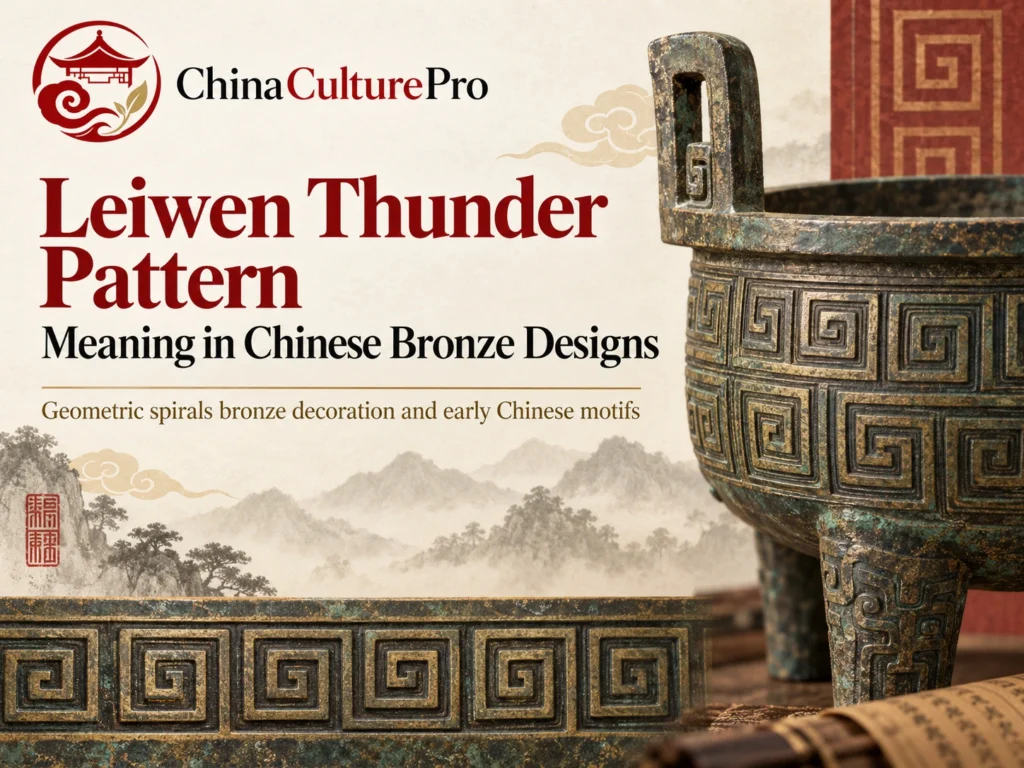
Leiwen (雷纹, léi wén), or “thunder pattern,” is a geometric design of repeated angular spirals, especially familiar from early Chinese bronzes.[1]
- Name: A conventional thunder-related label, not a literal picture of lightning.
- Appearance: Squared turns and recurring spiral units, with variations in scale and density.
- Setting: Often a background beneath larger designs on Shang and Zhou vessels.
- Meaning: Its original significance remains uncertain; later interpretations require their own context.
Leiwen’s visible decorative role is clearer than its original symbolic message. The name alone does not establish thunder worship or protective power.[2]
A small spiral beneath an animal face and a broad border around a vase can look surprisingly alike. Understanding leiwen begins with the complete object. This guide develops the distinctions introduced in our Chinese patterns and motifs guide, focusing on form, context, and evidence.
What Is Leiwen and What Does Its Name Mean?
The Chinese name combines léi, “thunder,” with wén, “pattern” or “marking.” Thunder pattern is the usual English rendering. The term identifies a geometric ornament rather than a scene showing a storm.
Look for repeated lines that turn inward or back upon themselves, commonly forming squared spirals. Some cover a surface densely; others occupy a band. Thickness, spacing, and connections between units vary, so there is no single drawing that every example must match.
A familiar naming convention distinguishes rounded cloud spirals, Yunwen (云纹, yún wén), from squared thunder spirals. Actual bronze decoration can mix curved and angular turns, making the distinction less tidy than a diagram suggests.[3]
For identification, follow the repeated unit and examine its surroundings. A cropped corner may conceal whether you are seeing an independent spiral, a continuous border, or part of a larger figure.
Why Is Leiwen Common on Shang and Zhou Bronzes?
Leiwen belongs to the elaborate surface decoration of many Shang and Zhou ritual vessels. On a bronze decorated with an animal mask, often called Taotie (饕餮, tāotiè), the larger image may rise above a finer field of spirals. The ground fills surrounding spaces and makes the main figure easier to distinguish.[2][3] Ground here means the decorated field behind the larger motif, rather than an empty or undecorated surface.
These vessels were part of elite ceremonial life, including offerings associated with ancestors. Their importance came from the whole object: material, workmanship, ownership, inscriptions, and use. A geometric background should therefore be read within that setting, without assuming it independently names the recipient of a sacrifice.[2]
The decoration was also integrated into manufacture. Designs could be cut into a ceramic model, into sections of the casting mold, or both, then transferred to the bronze during casting. Fine spirals were not necessarily engraved into finished metal.[2]
The motif was not confined to bronze. A Shang white-pottery vessel in the Palace Museum collection has angular and thunder-pattern decoration on its body. This ceramic example shows why “leiwen” identifies ornament, not a material or one exclusive vessel type.[4]
What Does Leiwen Mean—and What Remains Uncertain?
Leiwen has a recognizable visual function, but no securely established universal symbolic translation for its earliest uses. Its repetition organizes a surface, while its small scale can contrast with larger figures. That is an observable relationship, even when the maker’s intended message cannot be recovered.
The thunder-related name supplies a second level of interpretation. Cloud and thunder ornament has been explained as an abstraction of natural phenomena.[3] However, that explanation does not document a specific naming event or prove that every spiral represented a lightning bolt. Nor does it establish one shared belief among all communities using the design.
A third level concerns ancient religious meaning. Early bronze imagery has received decorative, mythological, and religious interpretations, but its precise significance remains debated.[2] Ideas about rain, farming, or thunder deities need specific evidence before they can explain an individual leiwen pattern.
Two shortcuts obscure that distinction. Calling the design a proven thunder-god emblem goes beyond the evidence; calling it meaningless because its symbolism is uncertain also goes too far. We can describe how the ornament works and the ceremonial world of its vessel while leaving its original message unresolved.
Leiwen vs. Yunleiwen, Huiwen and the Greek Key
These names help identify related-looking designs, but do not create four perfectly separate categories. Compare the repeated unit, its placement, and the catalogue’s terminology.
| Term | Visual clue | Typical context | Interpretive limit |
|---|---|---|---|
| Leiwen | Repeated squared or angular spirals | Early bronze grounds; later archaistic decoration | The name does not establish a fixed religious meaning |
| Yunleiwen (云雷纹, yún léi wén) | Rounded, squared, or mixed spirals | Cloud-and-thunder decoration on early bronzes | A collective term; both shapes need not be clearly separable.[3] |
| Huiwen (回纹, huí wén) | Angular meander, often organized as a border | Furniture frames and ceramic or textile borders | Related to earlier thunder ornament; later auspicious readings are context-specific.[5] |
| Greek key / meander | Repeating right-angled line | Greek art and later classical designs | Similar geometry does not prove identical meaning or direct borrowing.[6] |
Huiwen’s later associations include enduring prosperity: in Suzhou folk usage, its continuous ornament has been described as wealth and distinction without an end.[5] That reading does not automatically explain a Shang bronze ground.
Nor should the terms be used as a dating rule: a label such as “meander” can describe appearance across different periods. Greek key is useful for comparing geometry, but leiwen should retain its Chinese object context. Similarity alone cannot settle whether particular traditions interacted or developed separately.
How Was Leiwen Reused in Later Chinese Art?
A later object can deliberately evoke ancient bronze decoration. The Qianlong-period porcelain vase G 2185 at the Guimet Museum, dated within 1736–1795, uses stylized kui dragons (夔龙, kuí lóng) in shallow relief over a leiwen ground. Flowers, butterflies, and lotus-related decoration appear elsewhere on the vessel.[7]
Here, the combination of an ancient-looking ground and raised figures survives in a different material and decorative setting. The example belongs within the wider variety of Chinese porcelain patterns, where an older design can acquire a new role through a change of medium.
Archaistic means referring to older styles. It does not make this Qing porcelain a Shang ritual bronze, or demonstrate unchanged beliefs across the intervening centuries. Its decoration can invite recognition of antiquity without revealing the original meaning of each borrowed motif.
A Worked Example: Reading the Yayi Jia
The Yayi jia at the Asian Art Museum in San Francisco, accession B61B11+, is a large Shang bronze of the jia (斝, jiǎ) wine-vessel type. It provides a specific object against which to test an interpretation.[8]
- Visible facts: Animal masks and small dragons stand in relief against a spiral leiwen ground. The handle includes a horned creature holding a bird.
- Contextual evidence: The vessel is reportedly from near Anyang. Its inscription is read as “Yayi” and probably represents a clan sign.
- Supported reading: The contrast between raised figures and smaller spirals establishes layers of decoration. The inscription offers a different kind of evidence from the background pattern.
- Limits: The exact meaning of the handle’s creature-and-bird combination is unknown. Although vessels of this type served wine-related rituals, this unusually large, heavy example may have been intended more for display.[8]
Here, the inscription has a proposed reading, while the spirals have an identifiable position within the decoration. Those are different kinds of evidence. Recognizing the pattern does not resolve the object’s uncertain provenance or intended use.
How Should You Interpret or Use a Leiwen Pattern?
Start with the object and work toward an interpretation:
- Establish the context: Check the documented period, material, and purpose. Distinguish an early vessel from a later archaistic work or modern design.
- Examine the whole surface: Locate the main image, background, and borders. Look beyond a cropped photograph.
- Inspect accompanying evidence: Note neighboring figures, inscriptions, and the arrangement of repeated units.
- Compare the catalogue: Check the object’s recorded name and explanation rather than assigning a label from resemblance alone.
- State the interpretation’s limits: Separate what you can see from historical explanations, later folk readings, and personal associations.
These steps support cultural understanding, not authentication or valuation. For a modern border, textile, or tattoo, describe what the designer has borrowed and what meaning has been added. A new personal interpretation can be valid as design intent without becoming evidence of an ancient belief.
FAQs About the Leiwen Thunder Pattern
What Does Leiwen Literally Mean?
Leiwen means “thunder pattern”: léi is thunder and wén is pattern or marking. The name describes an established category of ornament; it does not itself document the beliefs of its earliest makers.
Is Leiwen the Same as Huiwen?
They are related terms with overlapping visual features. Leiwen commonly describes early spiral grounds, while Huiwen often names angular meander borders. The distinction depends on the object and catalogue, rather than a strict ancient-versus-modern division.
Is the Chinese Thunder Pattern the Same as the Greek Key?
No. Their angular geometry may look similar, but the names belong to different artistic contexts. Appearance alone cannot establish shared symbolism, a common origin, or direct borrowing between the examples being compared.
Does Leiwen Symbolize Good Luck or Protection?
Some later related ornament carries auspicious associations, but these should not be assigned to every early leiwen design. A decorative blessing is a cultural expression, not evidence that the pattern provides protection or changes fortune.
Sources
[1] Palace Museum. 云雷纹
[2] Asian Art Museum. Ancient China: From the Neolithic Period to the Han Dynasty
[3] Academia Sinica, Museum of the Institute of History and Philology. 雲紋,雷紋,雲雷紋
[4] Hong Kong Palace Museum. 凝土为器──故宫博物院珍藏陶瓷
[5] Palace Museum. 回纹
[6] The Metropolitan Museum of Art. The Greek Key and Divine Attributes in Modern Dress
[7] Musée national des arts asiatiques–Guimet. Vase à décor archaïsant
[8] Asian Art Museum. Ritual wine vessel (the so-called Yayi jia)