
Quick Answer: What Do Mandarin Ducks Symbolize in Chinese Culture?
In Chinese culture, mandarin ducks most often symbolize an affectionate and harmonious marriage, but that is not their only meaning. Their role changes with the period, object, composition, and cultural system. The broader guide to Chinese animal symbolism uses the same context-first method.
- Marriage and partnership: Paired ducks in later wedding art can express affection, fidelity, harmony, and the wish that a couple remain together.
- Companionship and kinship: Early literary works could use mandarin ducks for brothers, friends, valued companions, or the pain of separation.
- Official rank: On a Qing rank badge, the mandarin duck identifies a seventh-rank civil official rather than a romantic relationship.
- Natural beauty: Ducks in a waterscape may simply form a bird-and-flower subject without carrying a wedding message.
Fertility, wealth, and supernatural “love luck” are not automatic meanings. Traditional fidelity imagery is a cultural ideal, not proof that real mandarin ducks always mate for life or that an image can change a relationship.
A pair of mandarin ducks in a Ming court painting and a single mandarin duck on a Qing official’s badge can look related while doing completely different cultural work. The painting may celebrate a happy marriage through flowers and visual wordplay. The badge identifies a civil-service rank. Neither image can be decoded accurately from the bird alone.
The same caution applies to poetry, porcelain, embroidery, tattoos, and modern ornaments. Mandarin ducks, 鸳鸯/鴛鴦 (yuānyāng), developed several meanings across Chinese history. Reading them begins with the date, medium, surrounding motifs, inscription, and purpose of the object—not with a universal definition copied from a symbol dictionary. The larger guide to Chinese symbols and meanings explains why this distinction matters across animals, plants, characters, and objects.
Why Mandarin Ducks Became Symbols of Love and Marriage
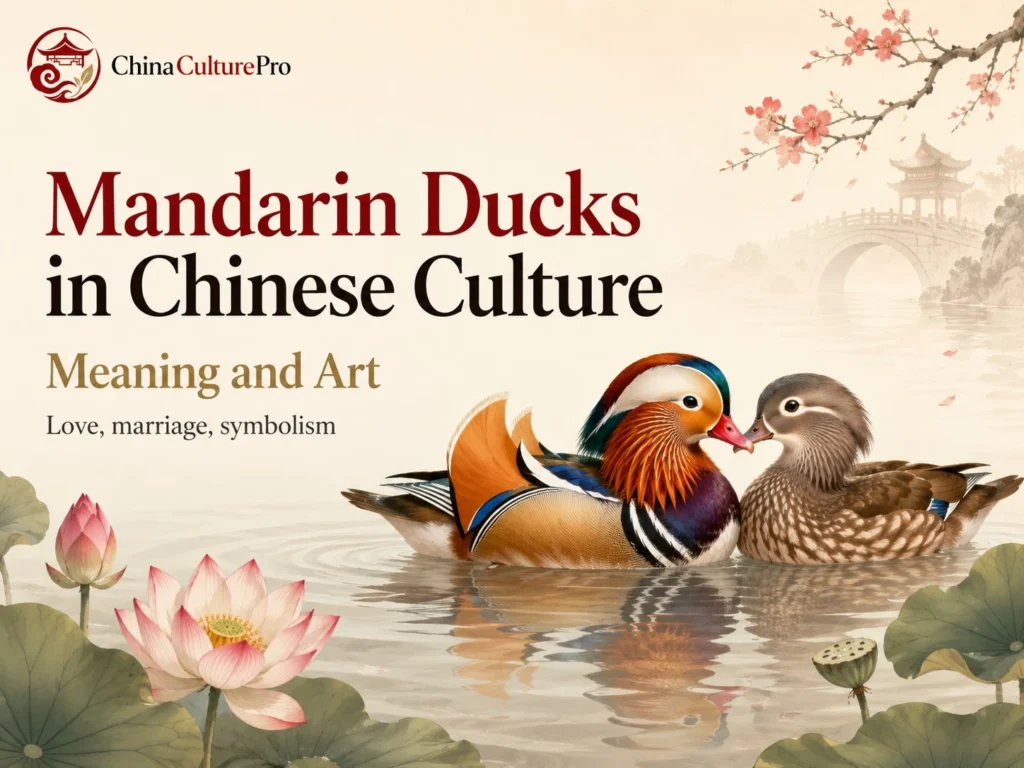
Mandarin ducks were well suited to artistic ideas about pairing. A breeding male has conspicuous orange “sail” feathers, a crest, and bold bands of color, while the female is mostly gray-brown with a pale eye stripe. Their strong visual contrast makes the two birds easy to present as complementary partners. Observations of pairs swimming, resting, and courting together encouraged writers and artists to turn animal behavior into an image of human companionship.
Traditional literature and decorative art then enlarged that observation into an ideal: the two birds were imagined as inseparable companions who remained faithful through life. In later Chinese symbols for love, a paired composition could therefore express conjugal affection, fidelity, and a harmonious household. The symbol describes what people hoped a marriage would become; it is not a biological report about every duck.
Free-living mandarin ducks can form strong seasonal pair bonds, and some pairs may breed together in more than one season. They do not, however, necessarily remain with one mate for life.[1] This difference does not make the traditional symbol meaningless. It shows that symbolism is a human interpretation of selected behavior, not a zoological rule. Nor does the motif itself guarantee affection, fertility, or a successful marriage.
How Mandarin Duck Symbolism Changed Across Chinese History
Mandarin ducks did not carry one stable message from antiquity to the present. Their literary meanings included kinship, companionship, longing, and romantic pairing before later decorative traditions made marriage the dominant popular reading. A late imperial wedding object should not be used to define every earlier poem, and an early poem should not erase the mature marriage imagery of Ming and Qing art.
Early Poetry: Companionship, Brothers, and Separation
Early medieval poets could use mandarin ducks to describe bonds beyond husband and wife. In a poem associated with Cao Zhi, the birds appear in a passage contrasting chosen alliances with the natural bond between blood relatives: “Mandarin ducks naturally befriend their kind,” but kinship remains innate. The surrounding lines concern brothers rather than a wedding.[2]
Other early works used paired or solitary mandarin ducks for close companions, like-minded people, and separation. A lone bird calling for a partner could convey the absence of a valued counterpart without specifying romantic love. These examples make “mandarin duck equals spouse” too narrow for early literature. They do not prove that the bird never represented male-female affection; they show that the image was already flexible and had to be read through the poem’s speaker, relationship, and circumstances.
From Tang Love Poetry to Ming–Qing Wedding Art
Tang poetry gave the romantic reading one of its most memorable formulations. In Lu Zhaolin’s “Ancient Meaning of Chang’an,” the speaker wishes to become mandarin ducks rather than envy immortals, and the birds come and go together.[3] The verse did not suddenly invent every association between paired birds and lovers, but it helped make the mandarin-duck couple a durable literary image of devoted love.
Over later centuries, that image moved easily into Chinese symbolic art. Ming and Qing painters, ceramic decorators, and textile makers placed paired ducks in lotus ponds or among flowers suited to wedding wishes. On Chinese wedding symbols, the pair became a concise visual hope for affection, cooperation, and continuity. Its historical popularity records a social ideal; it does not tell us how every real marriage functioned.
Mandarin Duck Motifs and Pairings in Chinese Art
A companion flower or institutional setting can narrow the meaning more precisely than the ducks themselves. The pairings below are interpretive starting points supported by known objects, not automatic formulas for every waterscape.
| Composition | Likely reading | Context or evidence | Interpretation limit |
|---|---|---|---|
| Paired mandarin ducks | Partnership, conjugal affection, or harmonious marriage | Common in later wedding painting, porcelain, and textiles | A naturalistic pair is not automatically a wedding wish. |
| Mandarin ducks and lotus | Marital harmony within a peaceful pond setting | On an early eighteenth-century Five Relationships vase, ducks beside lotuses represent husband and wife.[4] | The composition does not automatically mean “may you soon have children.” The separate history of lotus symbolism depends on its own context. |
| Mandarin ducks, hibiscus, and cassia | A happy marriage plus the rebus 夫荣妻贵/夫榮妻貴, “prosperous husband, honored wife” | Lü Ji’s late fifteenth-century painting, object 2005.494.2, uses the birds and flowers as a wedding-appropriate message.[5] | The full saying belongs to the combined composition, not to one duck or one flower. |
| Mandarin ducks within a Five Relationships design | The husband-wife relationship as one part of an ordered social system | The same porcelain vase uses five bird pairs for ruler-official, father-son, husband-wife, sibling, and friend relationships.[4] | The ducks represent only one relationship; they do not explain the complete vessel alone. |
| One mandarin duck | Natural observation, compositional balance, longing, or a missing companion | The reading depends on the inscription, posture, and rest of the scene | A single bird is not a fixed warning of loneliness, divorce, or bad luck. |
Medium also matters. A wedding scroll can make the marriage wish explicit, while Chinese porcelain patterns may combine several rebuses around one vessel. In Chinese embroidery, the ducks may be part of a larger field of flowers, auspicious borders, or regulated dress. Identify the complete object before translating any one motif.
Why a Mandarin Duck on a Rank Badge Does Not Mean Romance
On a Qing official’s rank badge, the mandarin duck is an institutional emblem. A surviving late seventeenth- to early eighteenth-century silk tapestry badge assigns it to a seventh-rank civil official. The bird faces a sun disk interpreted as the emperor, within the ordered imagery of clouds and waves.[6]
The badge’s primary job was to make bureaucratic status visible. Its bird should not be read as a statement about the wearer’s marriage, romantic fidelity, or personality. Decorative details around the central bird could add auspicious wishes, but they did not replace its regulated rank function.
| Feature | Wedding-art mandarin ducks | Rank-badge mandarin duck |
|---|---|---|
| Primary purpose | Express a wish for marital harmony | Identify seventh civil rank |
| Typical composition | A pair in water with flowers or wedding rebuses | One central bird facing a sun disk amid regulated badge imagery |
| Correct interpretive system | Marriage and auspicious decorative art | Qing official dress and administrative hierarchy |
This is why the broader history of Chinese symbolism in clothing cannot be reduced to a list of good-luck meanings. Garments could communicate office, status, ritual role, political allegiance, and auspicious wishes at the same time, with one function usually taking priority.
How to Identify and Compare Mandarin Duck Images
Identification matters because “two ducks” is not a cultural category. Artists could depict mandarin ducks, domestic ducks, geese, wagtails, herons, or other waterbirds in pairs. Each species and composition can serve a different narrative.
Mandarin Ducks, Ordinary Ducks, and Other Paired Birds
A breeding male mandarin duck is recognizable by his orange-and-cream crest, bold white eye stripe, reddish face, and two raised orange sail feathers. The female is much less colorful, with gray-brown plumage and a curved pale stripe around and behind the eye.[7] A male-female pair therefore often looks strikingly mismatched in color.
Historical artists did not work as modern field-guide illustrators. They simplified feathers, repeated workshop patterns, changed colors to suit a textile or glaze, and sometimes created idealized birds. Use the body shape, raised wing feathers, eye markings, label, inscription, and object catalogue together. A white bird with long legs is more likely a crane, heron, or egret; a flying migratory bird may belong to a wild-goose theme. Neither should inherit mandarin-duck marriage symbolism merely because two birds appear together.
Chinese Mandarin Ducks and Korean Wooden Wedding Ducks
China, Korea, and Japan all developed local meanings for mandarin-duck imagery, but their objects and customs are not interchangeable. In Chinese art, the marriage motif is especially visible in paintings, porcelain, lacquer, textiles, and other decorated objects. There is no single carved-duck ceremony practiced uniformly across Chinese weddings.
The brightly painted wooden “wedding ducks” commonly described in English are most strongly associated with Korean marriage traditions. Korean records of the groom’s wedding journey include attendants carrying wedding gifts and mandarin-duck figures, confirming their place within that ritual setting.[8] A modern seller may label any paired ornament “Asian wedding ducks,” but responsible interpretation should identify the country, date, material, and ceremony. Shared symbolism of marital harmony does not erase local history.
How to Interpret or Use a Mandarin Duck Symbol Correctly
Use the following sequence when viewing a museum object, choosing wedding imagery, commissioning a tattoo, or adapting the motif for modern design:
- Identify the bird: Look for mandarin-duck body and plumage features rather than assuming every paired waterbird is the same species.
- Check the number without turning it into a code: A pair can support a partnership reading, while a single bird may be naturalistic or narrative. Neither number carries a universal prediction.
- Read the companions: Lotus, hibiscus, cassia, inscriptions, other birds, sun disks, clouds, and waves can move the image toward marriage, a verbal rebus, social relationships, or official rank.
- Identify the carrier and date: A poem, wedding scroll, porcelain vessel, rank badge, Korean wooden figure, and modern pendant belong to different interpretive systems.
- Separate history from adaptation: A contemporary design can use the birds for love, companionship, queer partnership, friendship, or a personal memory. Describe that as a modern choice rather than an unchanged ancient rule. The same distinction is essential when selecting Chinese tattoo symbols.
Several popular claims fail this method:
- A pair does not always mean a wedding. It may be a natural scene or one component of a larger relationship system.
- One duck is not a bad omen. There is no historical rule making it a prediction of separation or marital failure.
- Color, material, and direction are not universal codes. Online claims about rose quartz, jade, bedroom corners, or birds facing a particular way usually belong to modern product marketing.
- Fertility and wealth require evidence from the complete design. Mandarin ducks alone do not promise children, prosperity, or social advancement.
- The image has no demonstrated supernatural effect. It can express a wish or value, but it cannot attract a partner, repair a relationship, induce pregnancy, or alter fortune.
FAQs About Mandarin Ducks in Chinese Culture
Do Mandarin Ducks Really Mate for Life?
Not necessarily. Real mandarin ducks can form strong seasonal pair bonds, and some pairs may breed together across several seasons, but they can also change partners. Lifelong fidelity belongs to the traditional human interpretation of the birds, not an absolute rule of their biology.
Are Wooden Wedding Ducks Chinese or Korean?
Mandarin ducks have long represented marital harmony in Chinese art, but the carved and brightly painted wooden wedding ducks commonly sold under that name are especially associated with Korean wedding traditions. Identify the object’s country and ritual context rather than calling every pair a generic Asian custom.
Can Mandarin Duck Figurines Attract Love in Feng Shui?
A pair of figurines can serve as a personal reminder of partnership or as culturally inspired decoration. Historical Chinese art does not provide one universal rule for material, color, bedroom direction, or placement that guarantees love. A figurine cannot attract a partner, heal a marriage, or change fortune.
What Does a Mandarin Duck Tattoo Mean?
A modern mandarin-duck tattoo can represent affection, commitment, companionship, or a particular relationship. Its meaning comes from the number of birds, companion motifs, artistic source, and wearer’s intention. A rank-badge duck or Korean wedding-duck design carries a more specific historical or cultural reference.
Sources
[1] Munday, C., et al. Environmental and Social Influences on the Behaviour of Free-Living Mandarin Ducks in Richmond Park
[2] Chinese Text Project. Cao Cao and His Sons: Selected Poems
[3] Chinese Text Project. Complete Tang Poems: Ancient Meaning of Chang’an
[4] The Metropolitan Museum of Art. Vase Decorated with Auspicious Animals
[5] The Metropolitan Museum of Art. Mandarin Ducks and Cotton Rose Hibiscus
[6] The Metropolitan Museum of Art. Rank Badge with Mandarin Duck
[7] Animal Diversity Web, University of Michigan. Aix galericulata: Mandarin Duck
[8] National Folk Museum of Korea. Groom’s Wedding Journey