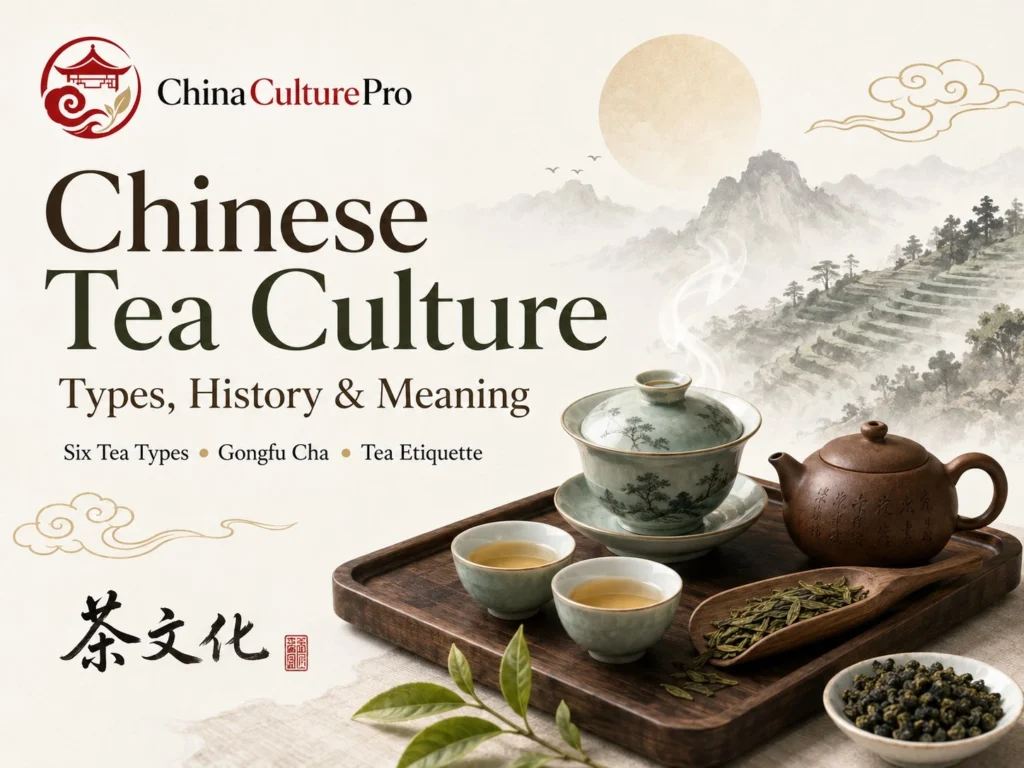

Quick Answer: What Is Chinese Tea Culture?
Chinese tea culture is the complete way of life, craft, etiquette, taste, and social practice that China has built around tea.
It is not only about drinking tea. It includes tea mountains, seasons, picking, processing, brewing, sharing, serving guests, teaware, tea houses, family life, wedding rituals, literati aesthetics, and daily habits.
In Chinese, tea culture is often called Cha Wenhua (茶文化). It covers both the practical side of tea and the cultural meaning behind it. A cup of Chinese tea may be simple daily refreshment, a respectful welcome to a guest, a quiet moment alone, a family ritual, or a refined tea gathering.
Chinese tea culture is also not only a “tea ceremony.” Some tea settings are formal and elegant, but many are ordinary and relaxed. Someone may brew tea carefully with a gaiwan at a tea table. Someone else may brew green tea in a glass cup at home and drink it through the afternoon. Both belong to Chinese tea culture.
| Item | Detail |
|---|---|
| Main Topic | Chinese Tea Culture / 中国茶文化 |
| Core Meaning | Tea as daily life, craft, etiquette, taste, and social practice |
| Main Tea Types | Green, white, yellow, oolong, black, dark tea |
| Key Practices | Brewing, sharing, serving guests, tea etiquette, Gongfu Cha |
| Important Limit | Not only ceremony, not only health benefits |
Key Point: Chinese tea culture is not simply about brewing tea and drinking it. It begins with tea mountains, seasons, picking, and craft, then moves into water, teaware, heat, brewing, hospitality, etiquette, tea houses, family life, and literati aesthetics.
The earlier Chinese culture topics on this site focus on time, destiny, and environment: Chinese Zodiac, BaZi, and Feng Shui. Tea culture opens a more daily side of Chinese tradition. It shows how Chinese people receive guests, slow down, share space, express respect, and turn one leaf into a world of taste and feeling.
Why Tea Matters in Chinese Culture
Tea matters in Chinese culture because it is both ordinary and meaningful.
It is ordinary because people drink it every day. It can appear at home, in the office, at a roadside table, in a tea house, during a meal, after dinner, or during a quiet break.
It is meaningful because tea is also a language of respect, welcome, patience, and social connection.
Tea appears in many Chinese social settings:
- Family hospitality: serving tea to relatives or guests at home.
- Business meetings: using tea to soften the atmosphere before discussion.
- Friendship: meeting to “drink tea” may mean chatting, resting, and spending time together.
- Respect for elders: younger people may offer tea to older family members.
- Weddings: the tea ceremony connects two families through respect and blessing.
- Daily self-cultivation: brewing tea slowly can help a person become quiet, attentive, and patient.
- Regional identity: different provinces, mountains, and tea traditions carry their own taste and local pride.
Tea connects people with people. It also connects people with place.
A cup of Longjing may suggest Hangzhou, spring, flat green leaves, and fresh chestnut-like aroma. A cup of Wuyi Rock Tea may suggest cliffs, roasting, mineral taste, and the phrase “rock bone and floral fragrance.” A cup of Pu’er may suggest Yunnan mountains, aging, storage, and time.
A Chinese tea master might say: tea is not just water for thirst. In many moments, a cup of tea says, “I welcome you,” “I respect you,” or “Let us sit down and speak slowly.”
This flexibility is one of the charms of Chinese tea culture. Tea can be light and casual. It can also be heavy with ritual meaning. It can be served in a wedding hall, at a business table, in a temple, in a scholar’s study, or in a large mug on an ordinary desk.
A Short History of Chinese Tea Culture
Chinese tea culture did not appear all at once. It developed through many centuries of farming, medicine, food, trade, literature, ritual, and changing ways of brewing.
The history is long, but beginners only need a clear outline first.
| Period | Tea Culture Direction |
|---|---|
| Early China | medicinal, food, early drinking |
| Tang | tea literature and mature tea culture |
| Song | whisked tea, competitions, refined aesthetics |
| Ming | loose-leaf brewing and teaware shift |
| Qing | major tea types and regional teas mature |
| Modern China | heritage, global spread, tea houses, lifestyle |
Early China: From Medicine to Drink
In early Chinese tradition, tea was often linked with medicine, food, and health. Stories about Shennong tasting plants are part of the cultural imagination around tea, although the exact historical origin is more complex.
Over time, tea moved from medicinal use and food-like preparation into regular drinking. It became a drink, a habit, and eventually a cultural practice.
Tang Dynasty: Tea Culture Matures
The Tang dynasty was a major turning point. Lu Yu’s The Classic of Tea became one of the most important early tea texts. Tea was no longer only a drink. It became an object of study, taste, technique, and refined living.
Tea drinking among scholars, monks, and elites helped turn tea into culture.
Song Dynasty: Whisked Tea and Aesthetics
In the Song dynasty, tea culture became even more refined. Whisked tea, tea competitions, foam patterns, tea bowls, poetry, painting, and elite taste all became important.
Song tea culture had strong visual and artistic elements. Tea was not only tasted; it was also watched, compared, and appreciated.
Ming Dynasty: Loose-Leaf Tea Changes Drinking
The Ming dynasty brought a major shift toward loose-leaf tea. This changed how tea was brewed and enjoyed.
Instead of earlier compressed tea forms and whisking methods, loose tea brewing became more common. Teaware such as teapots and gaiwans became more important. This shift helped shape drinking habits closer to modern Chinese tea culture.
Qing Dynasty and Later: Regional Teas Develop
In the Ming-Qing period, many tea types and regional styles became more mature. Oolong tea, black tea, Pu’er, and many famous regional teas developed strong identities.
Tea also became part of trade, export, daily urban life, and local pride.
Modern China: Heritage and Daily Life
Today, Chinese tea culture is both heritage and everyday practice. It appears in tea houses, tourism, family life, cultural events, international tea markets, and modern lifestyle spaces.
Chinese tea culture is not a frozen ancient tradition. It has changed again and again: Tang boiling and tea literature, Song whisked tea, Ming loose-leaf brewing, Qing regional teas, and modern tea houses. Tradition in Chinese tea is not static. It is a living practice.
The Six Major Types of Chinese Tea
Chinese tea is usually divided into six major types. These types are not based only on leaf color. They are mainly defined by processing method, oxidation, fermentation, and post-fermentation.
The six major types are:
- Green Tea
- White Tea
- Yellow Tea
- Oolong Tea
- Black Tea
- Dark Tea
Important translation note:
- Chinese Hong Cha (红茶) is called Black Tea in English.
- Chinese Hei Cha (黑茶) is better translated as Dark Tea or Post-Fermented Tea.
- Chinese Qing Cha (青茶) usually refers to Oolong Tea, not “blue tea.”
| Chinese Tea Type | Chinese Name | Basic Processing | Taste Direction | Examples |
|---|---|---|---|---|
| Green Tea | 绿茶 | unoxidized, heat-fixed | fresh, grassy, clear | Longjing, Biluochun, Huangshan Maofeng |
| White Tea | 白茶 | minimal processing | gentle, sweet, light | Baihao Yinzhen, Bai Mudan |
| Yellow Tea | 黄茶 | sealed yellowing step | mellow, soft | Junshan Yinzhen |
| Oolong Tea | 乌龙茶 / 青茶 | partially oxidized | floral, roasted, complex | Tieguanyin, Wuyi Rock Tea, Phoenix Dancong |
| Black Tea | 红茶 | fully oxidized | sweet, malty, warm | Keemun, Dianhong |
| Dark Tea | 黑茶 | post-fermented | earthy, aged, deep | Pu’er, Liu Bao |
Green tea is heat-fixed to stop oxidation. It often tastes fresh, clear, grassy, or chestnut-like. Longjing and Biluochun are famous examples.
White tea is lightly processed, usually through withering and drying. It can taste gentle, sweet, soft, and clean. Baihao Yinzhen and Bai Mudan are well-known examples.
Yellow tea is rare. Its special yellowing step softens the grassy edge of green tea and creates a mellow taste.
Oolong tea is partially oxidized and highly diverse. It may be floral and light, roasted and deep, or mineral and complex. Tieguanyin, Wuyi Rock Tea, and Phoenix Dancong show how wide this category can be.
Chinese black tea is fully oxidized. In Chinese, it is called red tea because of the reddish liquor. It is often sweet, warm, malty, fruity, or honey-like.
Dark tea is post-fermented. It changes through microbial activity, piling, aging, or long storage. Pu’er and Liu Bao are two important examples.
Chinese Tea Is Defined by Craft, Not Just Color
A tea’s color is only the result. Craft is the reason.
The same tea tree leaf can become different tea types through different processing. A fresh leaf may become green tea if heat-fixed early. It may become oolong if partially oxidized. It may become black tea if fully oxidized. It may become dark tea if post-fermented and aged.
This is why Chinese tea culture values craft so deeply. Tea is not only a plant. It is a leaf transformed by season, picking, weather, hand skill, heat, timing, and storage.
| Craft Step | What It Affects |
|---|---|
| Picking | tenderness, grade, season |
| Withering | moisture and aroma base |
| Fixing / Sha Qing | stops oxidation, keeps freshness |
| Rolling | shape and flavor release |
| Oxidation / Fermentation | color, aroma, body |
| Roasting | warmth, depth, stability |
| Aging / Piling | transformation over time |
Picking affects tenderness, grade, and style. A bud-only tea feels different from one bud with one leaf. A spring tea often tastes different from autumn tea.
Withering reduces moisture and begins aroma development. It is important in white tea, oolong tea, and black tea.
Sha Qing means “killing the green.” Heat is used to stop oxidation and preserve freshness. This is especially important in green tea, yellow tea, some oolong processes, and dark tea preparation.
Rolling shapes the leaf and breaks some cells so flavor can release during brewing. Different rolling styles create different leaf shapes and extraction patterns.
Oxidation changes color, aroma, body, and taste. This is one of the main differences between green, oolong, and black tea. Fermentation or post-fermentation is especially important in dark tea and Pu’er.
Roasting can dry, stabilize, deepen, and transform aroma. It is important in many oolong teas, especially Wuyi Rock Tea and some Tieguanyin styles.
Aging changes tea over time. Piling creates accelerated fermentation in some dark teas, such as ripe Pu’er. These processes can create earthy, woody, medicinal, or mellow flavors.
A Chinese tea master might say: do not only memorize tea names. If you want to understand tea, ask why this cup has this aroma, this color, this thickness, and this aftertaste. The answer is usually mountain, season, picking, and craft working together.
This is the beauty of Chinese tea: one leaf carries many variables.
Famous Chinese Teas and Their Regions
Chinese tea is strongly connected to place. Region, mountain, soil, mist, altitude, climate, cultivar, and craft all shape the final cup.
A Longjing from the West Lake area does not taste the same as every flat green tea. A Wuyi Rock Tea is not only an oolong; it carries the rock, roasting, and mountain character of Wuyi. Pu’er is not only dark tea; it carries Yunnan’s large-leaf tea trees, mountain villages, aging, and storage culture.
The table below gives a core-page overview. Each tea can become its own detailed guide.
| Tea | Type | Region | Cultural / Taste Direction |
|---|---|---|---|
| Longjing | Green | Zhejiang | fresh, flat leaf, famous gift tea |
| Biluochun | Green | Jiangsu | curled leaf, floral-fruity aroma |
| Huangshan Maofeng | Green | Anhui | fresh, tender, lightly sweet |
| Baihao Yinzhen | White | Fujian | silver buds, soft sweetness |
| Tieguanyin | Oolong | Fujian | orchid aroma, aromatic |
| Wuyi Rock Tea | Oolong | Fujian | mineral, roasted, rock charm |
| Phoenix Dancong | Oolong | Guangdong | single-bush aroma types |
| Keemun | Black | Anhui | refined aroma, export history |
| Dianhong | Black | Yunnan | golden buds, malty sweetness |
| Pu’er | Dark Tea | Yunnan | aged, earthy, collectible |
| Liu Bao | Dark Tea | Guangxi | aged, mellow, betel-nut aroma |
| Junshan Yinzhen | Yellow | Hunan | rare, mellow, soft |
Longjing, or Dragon Well, is one of China’s most famous green teas. It is known for flat leaves, fresh aroma, and chestnut-like or bean-like sweetness.
Tieguanyin is a famous oolong from Anxi in Fujian. It is often associated with orchid fragrance and lingering aroma.
Wuyi Rock Tea comes from the Wuyi Mountains in Fujian. It is famous for yan yun, often translated as rock charm, combining mineral depth, roasted aroma, and floral notes.
Phoenix Dancong from Guangdong is known for single-bush production and many aroma types, such as honey orchid, almond, fruit, or the well-known Ya Shi Xiang style.
Keemun, or Qimen Hongcha, is a refined Chinese black tea from Anhui. Dianhong from Yunnan is rich, warm, and often malty or honey-like.
Pu’er from Yunnan is one of China’s most famous aged tea traditions. Raw Pu’er and ripe Pu’er are processed differently, but both are linked with aging, storage, and transformation over time.
Liu Bao from Guangxi is a dark tea known for aged depth, mellow body, and a distinctive betel-nut-like aroma in some traditional descriptions.
How Chinese Tea Is Brewed
Chinese tea can be brewed in many ways. It is not limited to formal tea ceremony.
Some people use a glass cup for green tea. Some use a gaiwan to taste many teas. Some use a small teapot and cups for Gongfu Cha. Some use a larger teapot for family or guests.
The right method depends on the tea, the setting, and the purpose.
| Brewing Style | Best For | Character |
|---|---|---|
| Cup Brewing | daily green tea, office drinking | simple, direct |
| Gaiwan Brewing | many Chinese teas | flexible, clean taste |
| Gongfu Cha | oolong, Pu’er, black tea | concentrated, multiple infusions |
| Teapot Brewing | family or guests | warm, shared, practical |
Cup brewing is simple and common. It works especially well for green tea, some white tea, and casual daily drinking. A glass cup also lets the drinker watch the leaves open.
A gaiwan is one of the most flexible Chinese brewing tools. It can brew green tea, white tea, oolong tea, black tea, and Pu’er. The lid helps control aroma and pouring. The wide opening lets the drinker see the leaves and smell the tea clearly.
Gongfu Cha uses more tea, smaller vessels, and shorter infusions. It is especially useful for oolong, Pu’er, dark tea, and some black tea. The purpose is to bring out layers of aroma and taste across multiple infusions.
Teapot brewing is practical for family or guests. A porcelain teapot, clay teapot, or Yixing teapot can be used depending on the tea.
For beginners, the goal is not to perform beautiful movements. The goal is to make the tea taste clean, balanced, and not too bitter. Water temperature, tea amount, and steeping time matter more than ceremony.
For step-by-step brewing temperatures and steeping times, read our How to Brew Chinese Tea guide.
Gongfu Cha and Chinese Tea Ceremony
Gongfu Cha (功夫茶) is often called Chinese tea ceremony in English, but that translation can be misleading if it suggests a fixed religious or theatrical ritual.
Gongfu means skill, effort, time, patience, and practiced control. Gongfu Cha is better understood as skilled brewing.
It is especially associated with Chaozhou, Fujian, Guangdong, Taiwan, and other southern tea regions, though it is now practiced widely.
Gongfu Cha usually uses small vessels, small cups, more tea leaves, and many short infusions. A good oolong or Pu’er may change from one infusion to the next. The first infusion may open aroma. Later infusions may show body, sweetness, aftertaste, roasting, mineral feeling, or aging depth.
Key elements include:
- tea quality
- water temperature
- teaware choice
- leaf amount
- pouring control
- steeping time
- aroma appreciation
- tasting across multiple infusions
- sharing tea in small cups
Gongfu Cha can have ritual beauty. The host may warm the cups, rinse the tea, pour into a fairness cup, serve small cups, and invite guests to smell and taste.
But the goal is not performance. The goal is to serve the tea well.
A Chinese tea practitioner might say: Gongfu Cha is not better because the movements are many. It is better when every movement serves the tea. If the water is wrong, the tea becomes dull. If the pour is too slow, it becomes bitter. If the cup is too cold, fragrance disappears. Real gongfu is not decorative movement. It is bringing out the tea’s proper taste.
To learn skilled brewing with small vessels and multiple infusions, read our Gongfu Cha guide.
Chinese Tea Etiquette and Social Meaning
Chinese tea etiquette is not only about rules. It is about respect, attention, and comfort.
Different regions have different customs, but the spirit is similar: tea is used to welcome, thank, honor, and connect.
| Tea Etiquette | Meaning |
|---|---|
| Offering tea to guests | welcome and respect |
| Serving elders first | hierarchy and courtesy |
| Finger tapping | quiet thanks |
| Not filling too full | comfort and respect |
| Wedding tea ceremony | honoring families and elders |
| Refilling tea | attention and care |
Serving tea to guests is one of the most common Chinese hospitality gestures. The tea may be simple, but the action matters. It says the guest is received and respected.
In family and formal settings, tea is often served to elders or important guests first. This reflects courtesy, order, and respect.
Finger tapping is a quiet way to say thank you when someone pours tea. It is especially common in Cantonese and southern tea settings, though not universal across all of China.
The gesture may be light taps with one or more fingers on the table. It allows the guest to thank the host without interrupting conversation.
A common saying is that tea should be poured about seven-tenths full. A cup filled too full is hot, hard to lift, and uncomfortable for the guest. This is why tea etiquette values comfort, not only appearance.
In a Chinese wedding tea ceremony, the couple offers tea to parents, grandparents, and elders. The ritual expresses gratitude, respect, and the joining of families. Elders often give blessings, red envelopes, or gifts in return.
Tea etiquette is not dead rule-following. It is care. The host brews and pours with attention. The guest receives and responds with attention. Different regions may change the details, but the heart is the same: tea becomes a form of respect.
For guest serving, finger tapping, and wedding tea manners, read our Chinese Tea Etiquette guide.
Tea Sets and Teaware in Chinese Tea Culture
Chinese teaware is not only decoration. It affects temperature, aroma, pouring, sharing, and the feeling of the tea session.
A good teaware choice serves the tea. Expensive teaware is not automatically better.
| Teaware | Best Use | Cultural Note |
|---|---|---|
| Gaiwan | flexible brewing | common for tasting many teas |
| Yixing Teapot | oolong, Pu’er, dark tea | absorbs aroma over time |
| Glass Cup | green tea | shows leaf shape |
| Fairness Cup | sharing tea evenly | balances taste between cups |
| Tea Tray | gongfu setup | manages water and movement |
| Aroma Cup | oolong tea | gathers fragrance |
A gaiwan has a bowl, lid, and saucer. It is one of the most useful tools for Chinese tea. It gives good control over steeping time and lets the drinker see the leaves and smell the aroma.
A Yixing teapot is made from purple clay from Yixing. It is valued for heat retention and its ability to absorb tea aroma over time. It is often used for oolong, Pu’er, and dark tea. However, one Yixing pot should usually be dedicated to one tea category or similar flavor family. Mixing many teas in one pot can confuse aroma.
A glass cup is simple but beautiful for green tea. It lets the drinker watch tea buds and leaves slowly open in water.
A fairness cup, or gong dao bei, helps make the tea taste even for everyone. Instead of pouring directly from the gaiwan or pot into each cup one by one, the brewed tea is first poured into the fairness cup, then shared.
A tea tray is common in Gongfu Cha. It keeps the tea table clean and manages rinse water and movement.
For beginners, a full tea table is not necessary. A gaiwan, a fairness cup, and a few small cups are enough to begin. Teaware should help the tea, not burden the drinker.
To choose a gaiwan, Yixing teapot, fairness cup, or tea tray, read our Chinese Teaware guide.
Chinese Tea Houses and Daily Tea Life
Chinese tea culture is not only found in elegant tea rooms. It lives in ordinary places.
Tea houses, family tables, office desks, morning markets, street corners, and old neighborhoods all carry tea culture.
| Scene | Tea Culture Meaning |
|---|---|
| Sichuan tea house | relaxed public life |
| Cantonese yum cha | tea with dim sum and family gathering |
| Chaozhou Gongfu Cha | daily skilled brewing |
| Jiangnan tea room | refined setting and quiet taste |
| Home cup brewing | ordinary daily tea life |
In Chengdu and other parts of Sichuan, tea houses are part of relaxed public life. People drink gaiwan tea, chat, rest, play cards, listen, and spend time. The atmosphere is often loose and social.
In Guangdong and Hong Kong, yum cha means drinking tea with dim sum. Tea is part of family gathering, weekend meals, and social rhythm. The food matters, but the tea is also central to the experience.
In Chaozhou and nearby regions, Gongfu Cha can be very daily. Small cups and careful brewing may appear not only in formal tea rooms, but also in homes and shops.
In places such as Suzhou and Hangzhou, tea can be connected with gardens, lakes, quiet rooms, and a refined visual setting. The mood may feel more literary and aesthetic.
At home, Chinese tea can be extremely simple. Someone may drink tea after a meal. An older person may brew one pot in the morning. A worker may drink green tea from a glass cup. A family may serve tea when guests arrive.
This is important: real Chinese tea culture is half at the tea table and half in ordinary life.
Some people brew slowly in a Yixing pot. Some people use a large cup for the whole day. Both belong to tea culture. Tea should not be presented as something only scholars, collectors, or wealthy people can understand.
Regional tea houses and everyday public tea life show how tea culture extends beyond formal brewing into ordinary social space.
Chinese Tea and Philosophy: Harmony, Respect, and Calm
Chinese tea culture also carries ideas from Confucian, Daoist, Buddhist, and literati traditions. This does not mean every cup of tea is philosophical. It means tea became a natural place where Chinese ideas could be practiced in daily life.
| Idea | Tea Culture Expression |
|---|---|
| Harmony | sharing tea, balanced taste |
| Respect | serving guests and elders |
| Calm | slow brewing and quiet attention |
| Naturalness | water, leaf, season, mountain |
| Refinement | teaware, poetry, calligraphy, taste |
Tea etiquette often reflects Confucian ideas of respect, order, and proper relationship. Serving elders first, offering tea to guests, and using tea in weddings all show tea as a carrier of courtesy.
Tea also carries Daoist ideas of naturalness, simplicity, lightness, and not forcing too much. A good tea should not feel artificial or heavy-handed.
Tea has long been connected with temples, meditation, and quiet attention. The phrase “tea and Chan are one taste” expresses the connection between tea and mindful awareness.
Scholars and artists connected tea with poetry, calligraphy, painting, incense, flowers, mountains, and conversation. A tea table can become a small space of taste and culture.
Still, tea philosophy should not be made too vague. Drinking tea does not automatically make someone wise. The spiritual side of tea often comes from small practices: paying attention to water, not rushing the pour, serving guests with care, tasting before judging, and staying quiet enough to notice fragrance.
These small disciplines are the inner culture of tea.
Common Mistakes About Chinese Tea Culture
Chinese tea culture is often misunderstood by beginners, especially in English. These are the most common mistakes.
| Mistake | Better Understanding |
|---|---|
| China only has green tea | China has six major tea types |
| All Chinese tea needs boiling water | Different teas need different water temperatures |
| Gongfu Cha is always ceremony | It is skilled brewing, not only ritual |
| Black tea = dark tea | Chinese red tea is English black tea; Hei Cha is dark tea |
| Pu’er means all dark tea | Pu’er is one major dark tea tradition, not the whole category |
| Older tea is always better | Aging suits only some teas |
| Expensive tea is always better | craft, storage, taste, and fit matter |
| Bitter means strong tea | good bitterness should transform |
| Tea culture is only elegant | daily cup brewing is also tea culture |
| Herbal tea is strictly Chinese tea | true tea comes from Camellia sinensis |
Green tea is important, but China also has white, yellow, oolong, black, and dark tea. The range is much wider than many beginners expect.
Different teas need different water temperatures. Delicate green tea can become bitter with boiling water. Oolong and Pu’er often need hotter water.
Gongfu Cha can be beautiful, but it is not only ceremony. It is skilled brewing.
Black tea and dark tea are often confused in English. Chinese red tea is English black tea. Chinese black tea is better called dark tea or post-fermented tea.
Only some teas are suitable for aging, such as Pu’er, some dark teas, and some white teas. Most green teas are valued for freshness.
Price may reflect rarity, region, reputation, age, or hype. It does not always mean the tea suits your taste.
Good bitterness should transform into sweetness, freshness, or aftertaste. Bitterness that stays harsh may come from poor tea, poor storage, or poor brewing.
Tea culture also includes big cups, street tea, family tea, office tea, and everyday tea houses. Elegance is one layer, not the whole culture.
How to Start Learning Chinese Tea Culture
Learning Chinese tea should begin with experience, not with expensive tea or complicated vocabulary.
A beginner can follow a simple path.
- Learn the six major tea types. Start with green, white, yellow, oolong, black, and dark tea. Understand that processing defines the type.
- Taste one or two representative teas from each type. Try Longjing for green tea, Baihao Yinzhen or Bai Mudan for white tea, Tieguanyin or Wuyi Rock Tea for oolong, Keemun or Dianhong for black tea, and Pu’er or Liu Bao for dark tea. Yellow tea can come later because it is rarer.
- Notice aroma, liquor color, taste, aftertaste, and infusions. Do not only ask whether the tea is “good.” Ask whether the aroma is clean, whether the taste is comfortable, whether bitterness transforms, and whether the tea remains pleasant after several infusions.
- Start with simple tools. A glass cup or gaiwan is enough. A full Gongfu tea table is not necessary at the beginning.
- Learn the three basic brewing variables. Water temperature, tea amount, and steeping time control most beginner mistakes.
- Then study region, season, mountain, and craft. Once you taste differences, names and regions become meaningful.
- Do not rush into famous mountains, old tea, or expensive tea. Build a taste foundation first. Expensive tea without experience is easy to misunderstand.
- Later learn etiquette, teaware, tea gatherings, and collecting. Culture becomes richer after the tongue and nose have real memory.
A tea teacher might say: do not learn tea by memorizing names first. Let your tongue and nose build experience. Is the aroma clean? Is the entrance comfortable? Does bitterness open into sweetness? Does the body feel comfortable after drinking? These questions teach more than slogans.
How This Guide Connects to the Chinese Tea Content Cluster
This page is the core page for the Chinese tea culture cluster. It gives the big map; the subpages can go deeper into each tea type, famous tea, brewing method, tool, ritual, and regional practice.
- To compare the six processing categories, read our Chinese Tea Types guide.
- For fresh, unoxidized teas such as Longjing and Biluochun, read our Chinese Green Tea guide.
- For soft, minimally processed teas, read our Chinese White Tea guide.
- For rare mellow teas with a yellowing step, read our Chinese Yellow Tea guide.
- For floral, roasted, and complex partially oxidized teas, read our Chinese Oolong Tea guide.
- To avoid confusing Chinese red tea with dark tea, read our Chinese Black Tea guide.
- For Pu’er, Liu Bao, and post-fermented teas, read our Chinese Dark Tea guide.
- To learn skilled brewing with small vessels and multiple infusions, read our Gongfu Cha guide.
- To learn how to evaluate aroma, mouthfeel, and aftertaste, read our Chinese Tea Tasting guide.
- For guest serving, finger tapping, and wedding tea manners, read our Chinese Tea Etiquette guide.
- To choose a gaiwan, Yixing teapot, fairness cup, or tea tray, read our Chinese Teaware guide.
- For step-by-step brewing temperatures and steeping times, read our How to Brew Chinese Tea guide.
- Wedding tea ceremonies are another important example of tea’s role in family ritual.
- Regional tea houses and everyday public tea life show how tea culture extends beyond formal brewing into ordinary social space.
- Historical trade routes and tea exchange, including the Tea Horse Road, form another important part of Chinese tea culture.
FAQs About Chinese Tea Culture
What is Chinese tea culture?
Chinese tea culture is the way China has built daily life, craft, etiquette, taste, and social practice around tea. It includes growing, picking, processing, brewing, serving guests, using teaware, visiting tea houses, sharing tea, and appreciating tea through aesthetics and manners.
Why is tea important in Chinese culture?
Tea is important because it is both daily and ceremonial. It is served to guests, used in family and wedding rituals, shared in tea houses, enjoyed after meals, and used to create calm conversation. A cup of tea can mean welcome, respect, patience, or friendship.
What are the six types of Chinese tea?
The six major types are green tea, white tea, yellow tea, oolong tea, black tea, and dark tea. They are mainly classified by processing method, oxidation, and fermentation or post-fermentation, not simply by the color of the dry leaf.
Is Chinese tea ceremony the same as Gongfu Cha?
Not exactly. Gongfu Cha is a skilled Chinese brewing method using small vessels, small cups, and multiple short infusions. It can feel ceremonial, but it is not only a fixed ritual. A better translation is skilled brewing or tea made with effort.
What is the difference between Chinese black tea and dark tea?
Chinese red tea is called black tea in English. It is fully oxidized and often sweet, malty, or warm. Chinese black tea is better translated as dark tea. It is post-fermented and includes teas such as Pu’er and Liu Bao.
What is the most famous Chinese tea?
Longjing, or Dragon Well, is often considered one of the most famous Chinese teas. It is a green tea from Zhejiang known for flat leaves, fresh aroma, and chestnut-like sweetness. Other famous teas include Tieguanyin, Wuyi Rock Tea, Keemun, and Pu’er.
What is Gongfu Cha?
Gongfu Cha is a Chinese method of skilled brewing. It usually uses a gaiwan or small teapot, small cups, more leaves, and several short infusions. It is especially common with oolong, Pu’er, dark tea, and some black tea.
What tea is served to guests in China?
It depends on region, season, family habit, and budget. Green tea, oolong tea, black tea, and Pu’er can all be served to guests. The most important point is not always the tea type, but the gesture of offering tea with respect.
What is Chinese wedding tea ceremony?
A Chinese wedding tea ceremony is a ritual where the couple serves tea to parents, grandparents, and elders. It expresses gratitude, respect, and the joining of two families. Elders often give blessings, red envelopes, or gifts after receiving the tea.
What teaware do I need for Chinese tea?
Beginners can start with a gaiwan, fairness cup, and small tea cups. A glass cup is useful for green tea. A Yixing teapot can be added later for oolong, Pu’er, or dark tea. Expensive complete tea sets are not necessary at the beginning.
Is Pu’er tea black tea?
No. Pu’er is usually grouped under dark tea or post-fermented tea, not English black tea. Chinese red tea is English black tea. Pu’er involves aging and fermentation traditions, while black tea is fully oxidized.
How should beginners start learning Chinese tea?
Start by learning the six major tea types, then taste one or two examples from each. Use simple tools such as a glass cup or gaiwan. Focus on aroma, taste, aftertaste, water temperature, tea amount, and steeping time before buying expensive tea or complex teaware.
Final Thoughts
Chinese tea culture is not simply about brewing tea and drinking it.
It begins with tea mountains, seasons, picking, and processing. Then it moves into water, teaware, heat, brewing, hospitality, etiquette, tea houses, family life, and literati aesthetics.
Tea can be elegant and ceremonial, but it can also be ordinary and daily. It can be slowly tasted at a tea table, or brewed in a large cup at home for the whole day.
To understand Chinese tea, you need more than tea names. You need to follow one leaf from the mountain to the cup.
That leaf carries region, season, craft, aroma, taste, etiquette, and human feeling. This is why Chinese tea is not only a drink. It is one of the most natural ways to understand Chinese daily culture.