
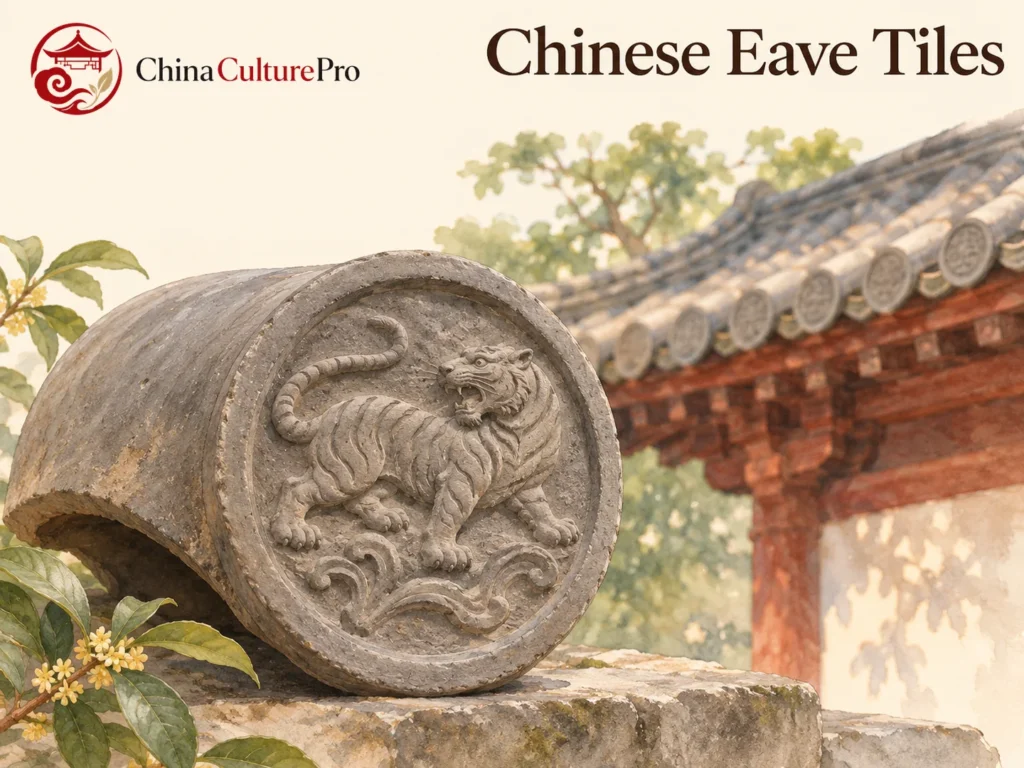

Quick Answer: What Is a Wadang?
A wadang (瓦当, wǎdāng) is the outward-facing end of a cover tile at the eaves of a traditional Chinese roof. The face helps close the cover row and provides a place for an image or inscription. Han examples survive as discs and fragments.[1][2][3][4]
- Location: The face closes the raised cover row.[1][2]
- Decoration: Han faces show animals, clouds and words.[2][3][4][5]
- Neighbor: A drip tile, or dishui (滴水, dīshuǐ), finishes a lower drainage row and can have a hanging lip.[1]
The face is visible from below even when much of the roof slope is out of sight. Follow the raised row uphill to see its place on the roof.[1][2]

At the eave, a small circle at the end of a tile can carry an entire animal or several raised characters. The tile is both an end to the roof row and a surface that presents a design to people below.[1][2][3]
Where a Wadang Sits on the Roof
Many Chinese tiled roofs use shallow concave rows to carry water down and rounded cover tiles over the joins between them. At the edge of the roof, the wadang presents a face on the end of the raised row. This helps shield the end of that row and makes its edge visible from below.[1][2]
A neighboring dishui drip tile belongs to the concave row. Its lip can extend below the end faces of the raised rows. If you can see the roof obliquely, follow one face backward to the half-round cover tile and look for the lower channel beside it. Singapore’s conservation handbook labels both types in a photograph of Wak Hai Cheng Bio.[1]
Han Tile Faces: Animals, Clouds and Words
A Han tile in the Palace Museum shows the White Tiger (白虎, Báihǔ), associated with the west in the group of four directional figures. The 19.3-centimeter ceramic face has a broad rim. The tiger’s body follows the circular field. The size and curve show what the design had to fit, while the museum’s identification gives the animal its directional context.[2]
The round field can also be divided into repeated sections for a cloud design. The University of Michigan Museum of Art records a fragment with an impressed cloud pattern divided into four sections. The center is missing. Enough survives for the museum to identify the arrangement around it.[4]
Text could carry blessings or claims about rule. Hong Kong’s Antiquities and Monuments Office documents examples with inscriptions it translates as a unified Han realm and happiness without end. A Western Han tile in the Palace Museum combines a horse and deer with raised characters. In that example, animals and writing share the same face.[3][5]
What a Detached Tile End Can Tell You
Begin with the surviving edge, material and face. A complete circle can show how the pattern fits its frame. A broken fragment may preserve just enough of a cloud scroll or character to compare with a museum catalog. Excavation or acquisition records can add context that a motif cannot supply by itself.[2][4][5]
Another architectural fitting with a visible decorated face is the pushou door ring holder. With either object, the surface tells only part of the story. The way the face attaches to the building explains its original job.[1][2]
FAQs About Chinese Eave Tiles
Is a wadang the same as a drip tile?
The wadang closes the raised cover row. The dishui is at the edge of the concave drainage row, where a downward lip can shed water.[1]
Why do Han tile ends have characters?
Characters could express a wish for well-being or a statement about the dynasty. Cataloged examples give the text and help a reader distinguish it from a similar-looking design.[3][5]
Are all wadang round?
Circular faces are common in the Han examples discussed here. Look for the part’s relationship to a cover tile when identifying a piece. A fragment may preserve only part of the original outline.[1][2][4][5]
Sources
[1] Singapore Urban Redevelopment Authority. Conservation Technical Handbook, traditional Chinese roof tiles
[2] Palace Museum. Han ceramic tile end with White Tiger motif
[3] Hong Kong Antiquities and Monuments Office. Han tile ends with inscriptions
[4] University of Michigan Museum of Art. Roof tile fragment with a cloud pattern
[5] Palace Museum. Western Han tile end with horse, deer and inscription