

Quick Answer: What Is a Pushou?
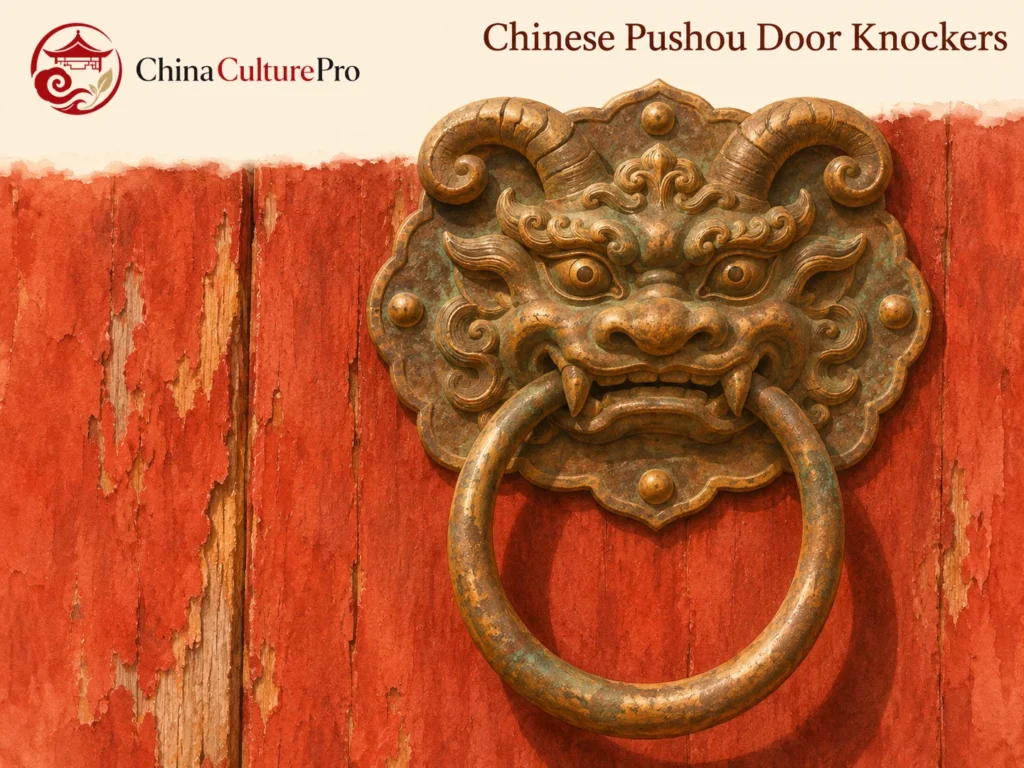
A pushou (铺首, pūshǒu) is the fixed holder for a door ring (门环, ménhuán). Many Chinese examples have a cast metal face that seems to grip the ring in its mouth. A person can use the ring to pull on the door or knock.[1][2]
- Fixed part: A plate or mask is attached to the door leaf.[1][3]
- Moving part: A ring can swing at the point where the plate holds it.[1][2]
- Decoration: Animal faces often carry protective associations, and motifs include more than lions or dragons.[1][2][3]
In a collection, the holder may survive by itself. A carved door image can also depict the same parts without having a working ring.[3][4]

On a wooden door, the ring is the part that moves. Behind it, the eyes, horns and mouth belong to a fixed fitting. The distinction is easier to see when the ring is missing and only the face remains.[1][3]
The Fixed Plate and the Moving Ring
The Palace Museum uses pushou for the base that holds the door ring. Metal examples may be cast in forms that frame the attachment at the mouth of the face. The ring hangs free from that attachment. When it swings back against a door or fitting, it can make an audible knock. It can also provide a place to grip the door leaf.[1][2]
Examine the face itself for mounting points. A museum object can preserve holes where it was attached even after it has been removed from a door. This is a useful way to distinguish a piece of hardware from an image of hardware carved into a door surface.[2][3][4]
What the Animal Face Can Mean
Museum sources associate some animal faces with protection against harm and the hope for good fortune. A broad face, staring eyes or exposed teeth can make the threshold look guarded. The Palace Museum describes beast masks as common and also records forms such as turtles and toads. The National Museum’s collection notes name several other beasts, so the presence of a ring alone gives little basis for identifying an animal.[1][2][3]
Chinese door gods provides another way to read protective imagery at a threshold. A pair of printed figures can be placed on door leaves. A pushou is a fitting that can give a similar protective meaning to the part of the door people touch.[1][2]
An origin story recorded in later literature credits the artisan Lu Ban with inventing the form. The National Museum notes earlier ring-bearing fittings on vessels, including Bronze Age examples. These objects document the motif on containers. The story records one explanation of the motif. The date of the earliest use on a door remains a separate question.[1][2]
Three Museum Objects and What They Show
The Cleveland Museum of Art dates its gilt bronze monster-face holder to the 500s. Three mounting holes survive, including one at the forehead. The catalog identifies a ring formerly held at the mouth. The surviving holes show how the plate was mounted. The mouth is where the museum identifies the missing ring.[3]
The National Museum of China records a gilded bronze fitting from the tomb door of Wang Jian, ruler of Former Shu. Its dragon head holds a ring decorated as two fish around a pearl. This example shows that both the fixed mask and moving ring could carry ornament. Yunnan copperware offers other examples of metal surfaces shaped for a decorative effect.[2]
An Eastern Han stone door leaf in the Palace Museum shows a ring held by an animal face, with a vermilion bird above and a dragon below. The ring in that case is part of a carved representation. The carved scene shows how recognizable the fitting was as an image on a door.[2][3][4]
FAQs About Chinese Pushou Door Knockers
Is the pushou the whole knocker or the ring holder?
In the narrower architectural sense, the pushou is the fixed ring holder. The ring is the moving part of the assembly that can be used to pull or knock.[1][2]
Is every animal face a lion or dragon?
Museum catalogs record several kinds of beasts. Look at the features of the face and the catalog description for the specific object.[1][2][3]
Why do some surviving pushou have no ring?
A ring can be lost while the mounted plate survives. Some examples were decorative forms without a moving ring, and some are carved images of a ring holder.[2][3][4]
Sources
[1] Palace Museum. Pushou, a glossary entry on ring holders
[2] National Museum of China. Gilt bronze ring-bearing pushou from Wang Jian’s tomb
[3] Cleveland Museum of Art. Monster Face: Door Ring Holder
[4] Palace Museum. Eastern Han stone door leaf with a vermilion bird and pushou motif