
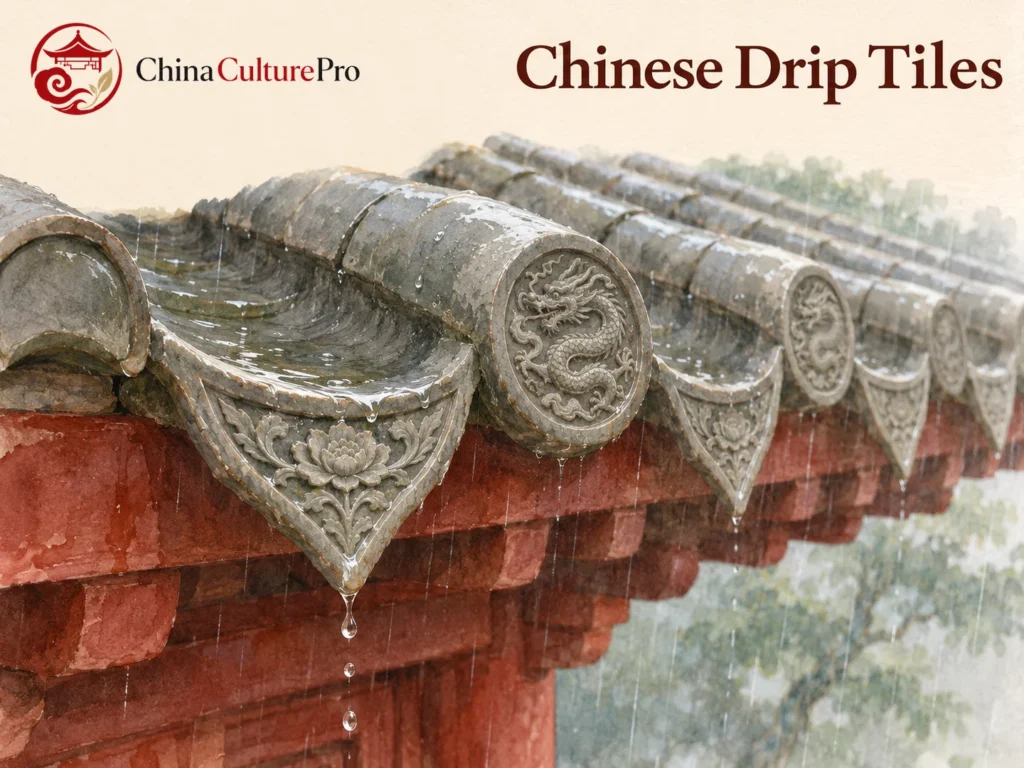

Quick Answer: What Is a Chinese Drip Tile?
A Chinese drip tile, or dishui (滴水, dīshuǐ), is the tile at the bottom of a roof’s drainage row, with a lip that hangs over the eave. Its edge gives the water a place to fall clear of the timber beneath.[1][2][3][4]
- Place: The drip tile usually continues a row of concave tiles carrying runoff down the roof slope.[1][2]
- Shape: Its end can descend to a point or form a shaped pendant lip.[1][3][4]
- Neighbor: A wadang (瓦当, wǎdāng) is the end face of a cover tile. It typically sits over the join between adjacent drainage rows.[2][4]
Follow the tile uphill to see whether it belongs to an open drainage row or a raised cover row.[2][4]

Seen from below, a row of roof ends can look like a row of small ornaments. Some are round faces. Others drop farther below the roof edge. The pattern becomes easier to read once you see the two rows that feed into it.[1][2][4]
Where the Dishui Sits and How It Sheds Water
On many traditional roofs, concave plate tiles, called banwa (板瓦, bǎnwǎ), lie in rows running down the slope. These rows collect and guide rain. Convex cover tiles, called tongwa (筒瓦, tǒngwǎ), run over the joins. At the bottom of a drainage row, a drip tile continues the channel and adds a lip that projects downward at the eave.[1][2][4]
As water reaches the lip, it can fall clear of the edge. This helps limit water running back beneath the roof tiles onto the edge boards or exposed ends of timbers. The Guangzhou conservation guide describes a tip that draws runoff to a point. The water that falls from it can then enter a separate system of courtyard channels and drains.[3][4]
Dishui and Wadang at the Same Eave
| Feature | Drip tile | Cover tile end |
|---|---|---|
| Where it sits | At the low end of a concave drainage row. | At the low end of a convex row that covers a join. |
| What you see from below | A projecting lip or pendant below the main tile line. | An end face, often circular, at the opening of the cover tile. |
| Main role | Helps release water clear of the eave. | Closes and decorates the cover row at the eave. |
The conservation handbook’s photograph of Wak Hai Cheng Bio in Singapore identifies all four parts by name. A complete view of the eave and some of the slope is helpful because a detached decorated fragment may conceal the row it belonged to. Chinese eave tile ends explains the design and historical evidence of the cover tile face.[2][4]
What Historic Drip Tiles Can Tell You
Getty’s vocabulary distinguishes the broad meaning of dishui from a narrower use for a shaped pendant associated especially with Qing buildings. Its account also describes a Song building text’s different terminology for lipped plate tiles. In either case, follow the lowest tile in the drainage row to see how its lip meets the eave.[1]
A Palace Museum study compared Ming and Qing drip tiles recovered during work at the Forbidden City’s Southwest Corner Tower. The selected examples have similar overall shapes but differences in dragon motifs and modeling. The repair context and the recorded tile features together help distinguish the pieces. The roofs of Chinese bell and drum towers offer another context for looking closely at eave details on historic buildings.[3]
FAQs About Chinese Drip Tiles
Is every tile at the eave a dishui?
A dishui finishes the concave drainage row. Other tiles close the raised cover rows. Looking at where each piece joins the tiles above it gives the clearest clue.[1][2][4]
Why does a drip tile hang below the row?
The hanging lip gives water a point from which to drop away from the eave, reducing the tendency for it to run back under the edge.[3][4]
Does every Chinese tiled roof have drip tiles?
Roof treatments vary. The Guangzhou conservation guide records that a roof can have cover tile ends even when it lacks a separate drip tile at the bottom of the drainage row.[4]
Sources
[1] Getty Research Institute. Dishui in the Art and Architecture Thesaurus
[2] Singapore Urban Redevelopment Authority. Conservation Technical Handbook, roof tiles and the Wak Hai Cheng Bio example
[3] Palace Museum. Ming and Qing roof tiles of the Southwest Corner Tower
[4] Guangzhou historical building conservation guidance. Roof tile types and eave fittings