


Quick Answer: Who Was Xiao He?
Xiao He (萧何, Xiāo Hé), who died in 193 BCE, was an early Han chancellor and ally of Liu Bang (刘邦, Liú Bāng). The early histories credit him with securing records from the fallen Qin government and administered the Guanzhong (关中, Guānzhōng) region while Liu fought for control of the empire.[1][4]
- Records: Documents helped the new government understand the territory it was taking over.
- Logistics: His administration sent supplies and replacements to the armies.
- Law: Later tradition credits him with adapting Qin statutes for the Han.
The received histories and excavated legal texts support different parts of that account.
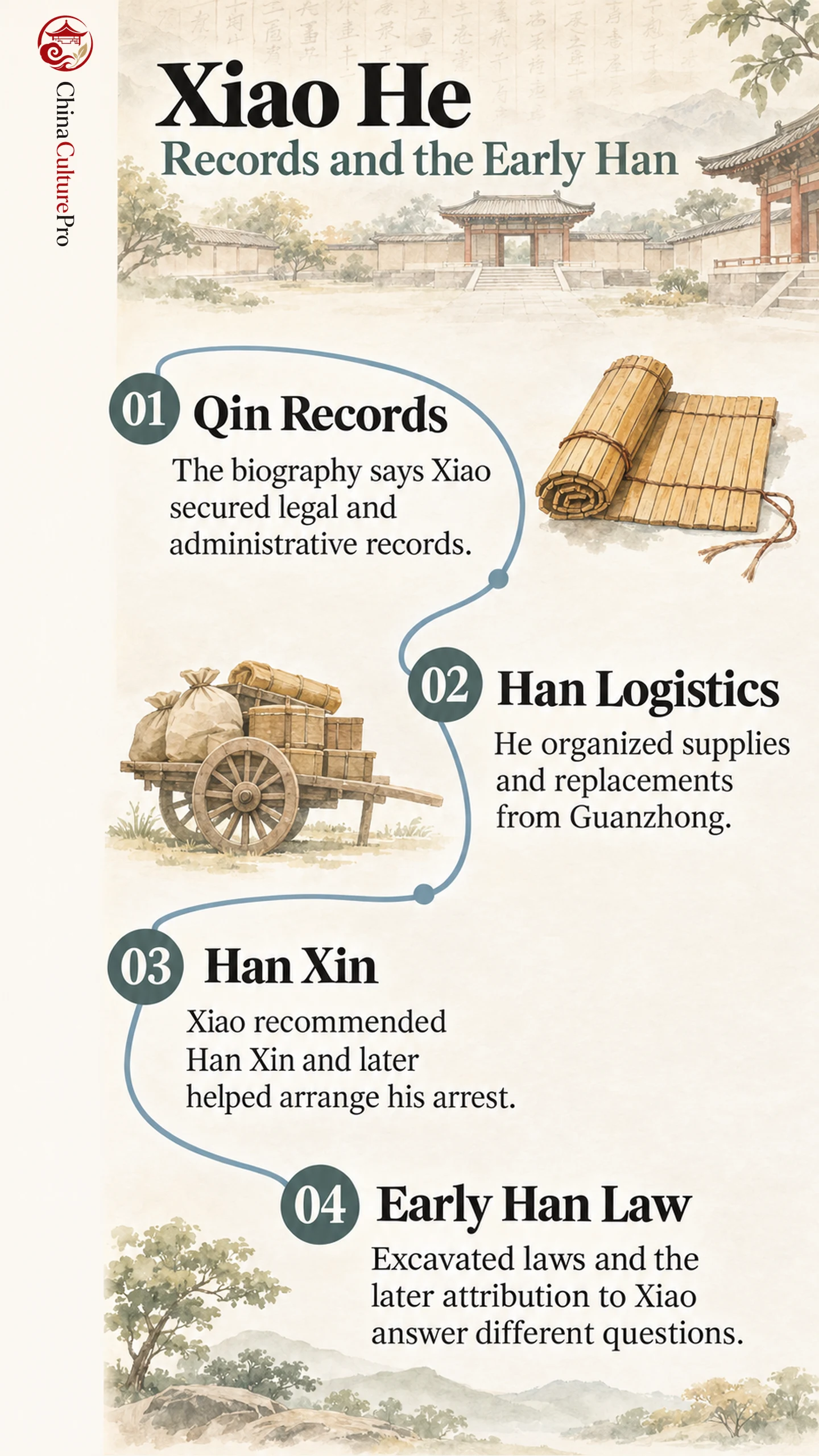
Xiao He’s contribution to the Han began with records, food and people. The armies that founded the dynasty needed all three. His biography makes the work behind the campaign visible, and later legal evidence helps put his reputation as a lawmaker in context.
Why the Qin Records Mattered
Xiao worked as a local official in Pei under the Qin Dynasty and became an early associate of Liu Bang. When Liu’s forces entered Xianyang (咸阳, Xiányáng), the biography contrasts Xiao’s actions with those of officers who went after valuables. It says he secured legal and administrative records from Qin offices.[1]
The historian connects the records to knowledge of population, routes and local conditions. These were different kinds of information. A record of households could help identify available people and resources, while knowledge of routes and barriers could inform decisions about moving them. The biography tells us why the documents mattered without preserving a complete inventory of them.[1]
The sequence matters. Xiao held office under Qin, then worked for Liu as the older regime fell. The information changed hands, and its use changed with it. To a government trying to establish its reach, the value lay in the descriptions of households and places, regardless of which dynasty had first gathered them.[1]
How Xiao He Kept Han Armies Supplied
The founding of the Han Dynasty depended on keeping a base while armies fought elsewhere. During Liu Bang’s struggle with Xiang Yu, Xiao stayed in Guanzhong. The biography records his role in administration, supply and replenishing troops after losses. The picture is of a functioning rear area, with people and resources that had to be counted, organized and moved.[1]
The division of responsibilities also involved discretion. The text says Xiao reported decisions when he could, and acted first when the situation did not allow him to wait. That detail shows how the administration handled decisions when the ruler was away. His wartime office combined authority over local government with responsibility to a ruler on campaign.[1]
The same passage mentions local administrative arrangements and institutions alongside the transport of supplies. Xiao’s work involved creating a government in the rear as well as sending resources to the front. This helps explain why the biography gives a chancellor a central place in the account of a military victory.[1]
Xiao He and Han Xin at Two Different Moments
The Records of the Grand Historian gives the recruitment of Han Xin (韩信, Hán Xìn) its own story. When Han Xin left, Xiao pursued him and argued that Liu Bang should give him high command. The point of the episode is the judgment Xiao made about an officer whose ability had yet to be fully recognized by his ruler.[1][2]
The same history later gives Xiao a role in the commander’s death. In its account of an alleged plot against the court, Empress Lü (吕后, Lǚ Hòu) and Xiao arranged for Han Xin to come to the palace, where he was executed. The accounts give Xiao different roles before and after unification. The later account reports an accusation and an execution. Its narration does not independently verify the private plans it attributes to either man.[1][2]
The Early Han Laws and Their Evidence
The legal treatise in the Book of Han says that Xiao selected suitable provisions from Qin law and formed laws in nine chapters. This is the origin of his association with the Nine-Chapter Code (九章律, Jiǔzhāng Lǜ). This is a later historical account of who assembled the laws.[3][4]
Bamboo legal texts from Zhangjiashan (张家山, Zhāngjiāshān) provide direct evidence for early Han legal categories and practices. Scholars compare them with the received account of the code and with evidence of Qin precedents. Their survival makes it possible to examine continuity across the dynastic change. Identifying a provision in an excavated collection still leaves the question of its author and precise history open.[4]
An example is the category of household statutes. A study of the slips can compare how that category appears in an actual early Han collection and how it is named in the received account. The comparison is evidence about legal organization. Assigning each rule to a single compiler would require a different kind of evidence.[4]
FAQs About Xiao He
Was Xiao He the founder of the Han dynasty?
Liu Bang founded the dynasty and became its first emperor. Xiao He was a leading ally and chancellor who helped organize the government and sustain its armies.
What did Xiao He take from the Qin capital?
The biography says he secured laws and administrative records. It connects them with knowledge of the population, terrain and resources of the former Qin realm.
Did archaeologists find Xiao He’s complete law code?
The Zhangjiashan texts are a surviving collection of early Han legal material. They offer evidence of statutes and their arrangement. An attribution of individual authorship depends on the transmitted history and other evidence.
Sources
[1] Sima Qian, Records of the Grand Historian, chapter 53. Hereditary House of Chancellor Xiao
[2] Sima Qian, Records of the Grand Historian, chapter 92. Biography of the Marquis of Huaiyin
[3] Ban Gu and collaborators, Book of Han, chapter 23. Treatise on Punishments and Law
[4] Li Xueqin and Xing Wen, Asia Major. New Light on the Early-Han Code: A Reappraisal of the Zhangjiashan Bamboo-slip Legal Texts