

Quick Answer: What Is Tibetan Butter Tea?
Tibetan butter tea (酥油茶, sūyóu chá, in Mandarin), often called po cha in English, blends brewed tea, butter and salt. The result is a savory, rich drink rather than a sweet café milk tea. [1]
- Preparation: Churning or mechanical mixing brings the tea and dairy fat together.
- Food context: It can accompany meals and roasted barley foods.
- Hospitality: Repeated refills commonly express welcome and attention to a guest.
Ingredients, strength and serving customs vary between households; one account is not a rule for every Tibetan community. [2][3]

The first surprise in butter tea is usually the salt. Expecting a sweet drink makes its flavor harder to understand. Expecting a warm, savory tea with dairy gives a better starting point. Its place among Chinese drinks also requires a clear regional identity: this is a Tibetan food tradition, with its own household practices and history.
The Ingredients and the Savory Taste
Four components help explain a bowl without turning it into one supposedly authentic formula. [1]
- Tea and water: Brewed tea supplies the base; compressed tea is associated with traditional preparation.
- Butter: Dairy fat adds richness, aroma and a fuller mouthfeel.
- Salt: Salt gives the drink its savory direction.
- Milk, when used: Some preparations add milk; it is not necessary to define every bowl.
Descriptions often say “yak butter,” using yak as a general animal label. Documented Tibetan dairy production includes female yaks and cattle-yak hybrids. Ask about the butter actually used rather than assuming the animal source from the drink’s name. [1][2]
Taste depends on proportions and ingredients. Strong tea can remain perceptible beneath the dairy, while more butter changes the texture and aroma. A small first serving lets you understand that balance. Sweet milk tea is a separate familiar option in Tibetan tea life: it uses sugar and milk, so its resemblance in color should not be mistaken for the same flavor. [5]
Why the Tea Is Churned
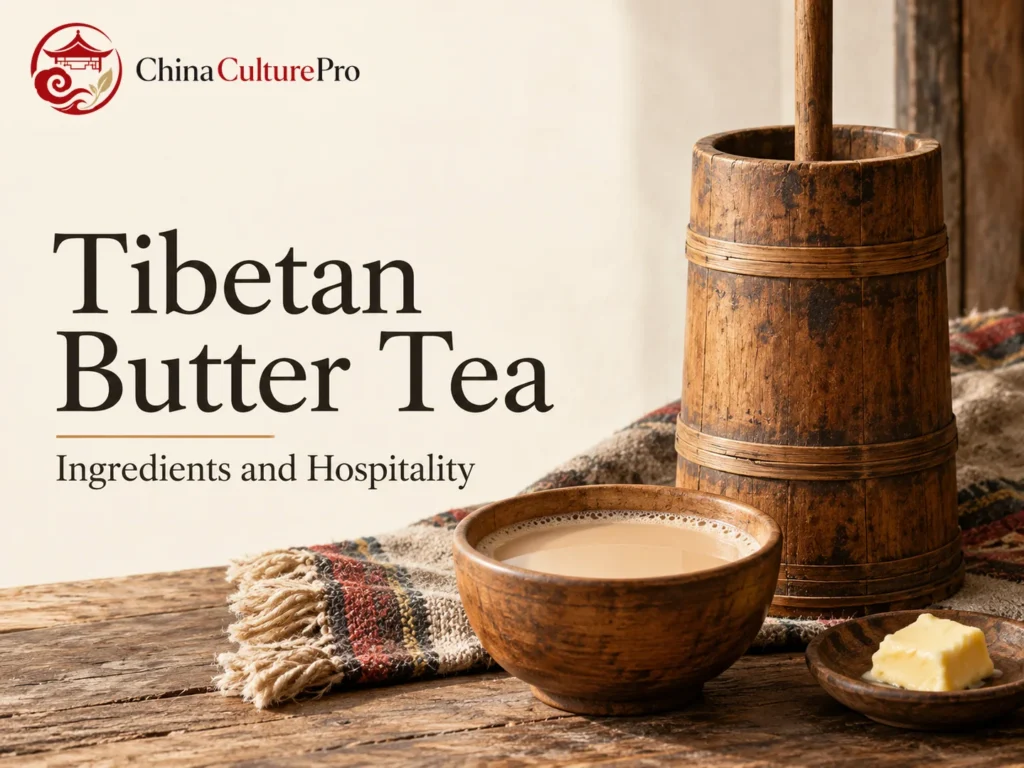
Churning is the operation that makes butter tea more than a cup of tea with an unmixed lump of fat. Traditional descriptions use a tall wooden vessel with a plunger worked up and down. Brewed tea, butter and salt are mixed until the fat is dispersed through the liquid, which is then transferred for serving. [3]
This is different from churning milk to make butter. In butter production, the household obtains a dairy ingredient; in tea preparation, it mixes that ingredient into brewed tea. The two operations can involve similar-looking wooden equipment, which makes loose image captions misleading. A vessel alone is not proof of which operation a photograph shows. [1][2]
Electric mixers are also documented in contemporary households. A modern appliance changes the labor and speed, not automatically the cultural identity of the drink. Nor does a traditional wooden churn guarantee that every household uses identical tea, butter or proportions. [4]
Butter Tea, Tsampa and Everyday Food
Tsampa (糌粑, zānbā, in Mandarin) is roasted barley flour associated with Tibetan foodways. It can be combined with liquid and butter into a dough-like food. Butter tea may be served alongside it or used in preparing the mixture, but the flour and the beverage should not be treated as the same thing. [2]
The distinction matters on a menu. “Butter tea with tsampa” can describe a drink served with a separate food; it need not mean a cup already thickened with flour. Follow the host’s preparation rather than immediately stirring every item into the tea. That leaves room for different household ways of eating.
The pairing also points beyond an isolated recipe. Pastoral households obtain grain through relationships with farming communities, while animals supply dairy products and other goods. Tea, barley and butter therefore bring exchange and household work into the same meal. This is a more useful cultural explanation than reducing the drink to an exotic combination of tea and fat. [2]
What Refilling the Bowl Means
A host may top up a guest’s bowl repeatedly. In documented etiquette accounts, the full bowl communicates hospitality; finishing it immediately can simply invite another refill. Small sips allow conversation and service to continue. [5]
For a guest, considerate behavior matters more than memorizing a number. Thank the host, let the tea cool enough to sip, and follow the people around you. If you have had enough, say so warmly. Some local descriptions suggest leaving a refilled bowl untouched until departure, but an unfamiliar guest should use clear words as well as watching the household’s signals. [3][5]
Do not transfer alcohol-toasting rules to butter tea. Advice about three sips and a cupful may describe drinking alcohol, while tea accounts describe different patterns of sipping and refilling. Nor should an invitation be treated as a requirement to consume a fixed quantity. Asking politely about a family’s way is more respectful than correcting the host from a generic etiquette list.
Tea Trade, Household Work and Modern Change
Tea reached Tibetan communities through exchange networks rather than being an ingredient produced by pastoral households alone. Historical tea-and-horse trade helps explain why compressed tea belongs in the material history of the region. It does not establish that every present-day bowl uses the same tea or follows one origin story. [6]
Within tea culture, butter tea is especially revealing because serving depends on work that is easy to overlook: obtaining tea, producing or buying dairy fat, preparing hot liquid, mixing and attending to refills. Modern tools can reduce one part of that work while the social attention remains.
A careful description therefore names the setting. A household visit, a public tea shop and a large gathering are different contexts. Learn which one you are seeing before treating a bowl, a tool or a serving gesture as a picture of all Tibetan life.
FAQs About Tibetan Butter Tea
Is Tibetan butter tea sweet?
The defining combination is savory tea, butter and salt. Sweet milk tea is a different preparation, even when both drinks look pale and creamy.
Does every bowl contain yak butter?
No. Animal sources and household ingredients vary. Ask what butter is used rather than assuming that the English name identifies it.
Do guests have to finish three bowls?
There is no useful universal quota for every household visit. Follow the host’s signals and communicate politely if you do not want another serving.
Sources
[1] Smithsonian Institution. Butter Tea Churn
[2] Smithsonian Center for Folklife and Cultural Heritage. Lag Zo – Foodways
[3] Shannan Municipal Government. 酥油茶文化
[4] Tibet Department of Culture and Tourism. 〖藏北故事〗寻味藏北,丰富的饮茶文化
[5] ChinaCulture. Tibetan Tea Culture
[6] University of Texas at Austin teaching resource. Tea in Tibet and the Himalayas