


Quick Answer: Who Was Song Yingxing?
Song Yingxing (宋应星, Sòng Yìngxīng; 1587–c. 1666) was a late-Ming scholar and local official best known for Tiangong Kaiwu (天工开物, Tiāngōng Kāiwù), published in 1637. The illustrated work records agricultural and craft production across eighteen subject chapters.[1][2][7]
- Subject: Farming, textiles, ceramics, metals, paper and other material processes.
- Contribution: He organized technical knowledge into explanations and images.
- Evidence: The preface, technical passages and different editions reveal different aspects of the work.[2][3]
Recording a technique does not mean inventing it, and an illustrated account still requires critical reading.
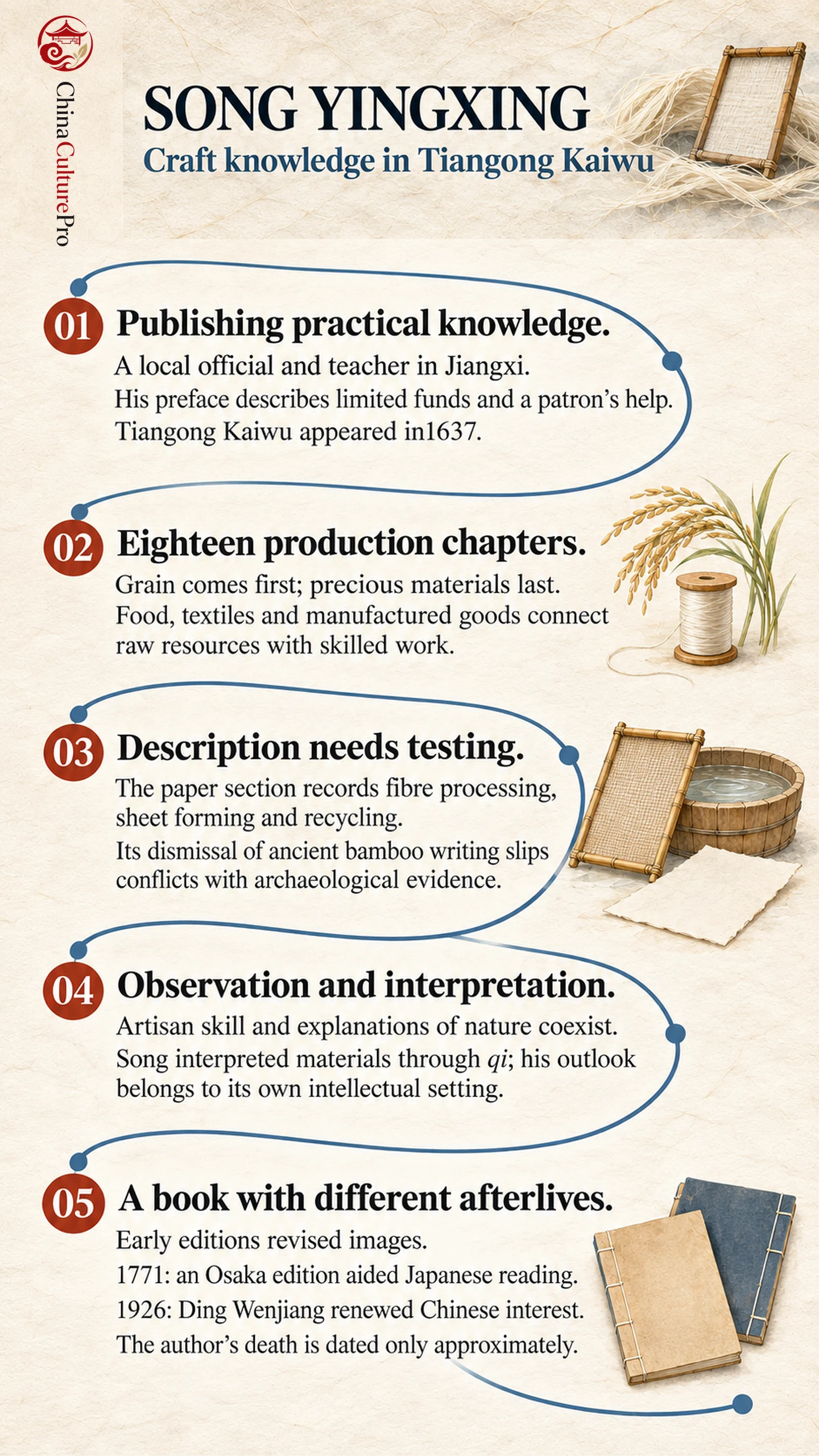
Song Yingxing made the production of ordinary necessities a serious subject for learned readers. His book connects crops, raw materials, skilled labor and finished objects. Its descriptions show how productive knowledge was organized, explained and passed on to readers.
A Local Official and the Publication of 1637
He came from Fengxin (奉新, Fèngxīn) in Jiangxi and worked as an instructor in Fenyi (分宜, Fēnyí) while preparing his major book. He also held local offices beyond that teaching post. These posts placed him within the local administration of the late Ming dynasty.[1][3]
Repeated attempts at the metropolitan civil-service examinations did not bring him the degree he sought. Some scholars connect those journeys with his observations of production, although the link remains a hypothesis for particular travels.[5]
His own preface describes financial constraints on collecting books and consulting collaborators. Tu Shaokui (涂绍煃, Tú Shàokuǐ), addressed by his courtesy name in the preface, supported publication. The prefatory date places the work in 1637. Publication brought together a writer, a patron and the labor of printing.[2][3]
What Tiangong Kaiwu Covers
The eighteen chapters organize connected fields of production rather than a modern alphabetical encyclopedia. The opening places grain cultivation first, while the final chapter addresses pearls and precious materials. The preface explicitly gives staple crops greater value than gold and jade: the arrangement expresses a judgment about material needs.[2]
| Area | Examples in the contents | What the grouping reveals |
|---|---|---|
| Food and agriculture | Grain cultivation, milling, salt, sugar and oils | Production includes growing raw materials and processing them. |
| Textiles and color | Silkworms, weaving, dyeing and pigments | Finished fabrics depend on several related skills. |
| Materials and equipment | Ceramics, casting, forging, paper, boats and carts | Tools and manufactured objects belong to organized production systems. |
The detailed subdivisions move from raw resources to working procedures. Chapters on silk weaving and ceramics connect materials, equipment and the skills needed to make finished goods. The book preserves a selection of practices; it does not prove that every workshop followed one national standard.[2]
A Paper-Making Example and the Limits of the Text
The bamboo-paper section provides a concrete example. It describes preparing bamboo fibers, treating and reducing the material, suspending the pulp, lifting sheets with a screen, pressing and drying. Workers’ handling of the screen helps determine sheet thickness. The description connects changing materials with workers’ control over the finished sheet.[2]
The same section describes washing and reprocessing waste paper. It distinguishes the economics of reuse where fresh bamboo was plentiful from the collection of scraps elsewhere. This evidence gives the history of paper a material and regional dimension, beyond a single invention story.[2]
Yet close description did not make every inference correct. In his discussion of paper materials, Song dismissed the idea that ancient books had been written on cut bamboo slips. Excavated Han wooden and bamboo writing slips, including remains of bound texts, contradict that dismissal. His account can be valuable evidence for contemporary production while unreliable about much earlier writing materials.[2][6]
Craft Knowledge and Explanations of Nature
Observation coexisted with a broader explanation of nature. A published report of historian Dagmar Schäfer’s lecture describes Song’s distinction between artisans’ practical command of machines and his own search for their deeper place in the material world. This was more than a catalogue of devices.[4]
The report uses silk to explain his interest in qi (气, qì), a concept often rendered as material force or vital breath. He sought relationships among materials, processes and natural harmony. Translating that outlook directly into modern physics would obscure the intellectual setting in which he wrote.[4]
His preface also warns readers that the book offers no help in seeking examination success or official advancement. That statement challenges the priorities of learned reading without making him an outsider to educated culture. Practical operations and scholarly interpretation meet within the same work.[2]
Editions, Circulation and Historical Legacy
Surviving editions are evidence in their own right. The Bibliothèque nationale de France’s copy catalogued as Chinois 5563 preserves the dated preface of 1637; Chinois 5564 lacks that date and revises the illustrations. Changes to framing and pictured objects mean that an image’s appearance should be tied to a particular edition, rather than treated as an unaltered view of a workshop.[3]
An Osaka edition appeared in 1771 with marks aiding Japanese reading of the Chinese text. In the twentieth century, renewed Chinese interest included Ding Wenjiang (丁文江, Dīng Wénjiāng) bringing the work back from Japan in 1926. Its reception belongs within the history of printing and circulation, with different readers and editions shaping the book’s afterlife.[5]
Song’s own final years are less securely dated than the book’s publication. Modern research records commonly give an approximate death around 1666, while some accounts use a nearby year or leave the date open. The publication of 1637 supplies a firmer chronological anchor.[1][5][7]
FAQs About Song Yingxing
Did Song Yingxing invent the technologies in Tiangong Kaiwu?
No. The work explains existing productive practices. Its importance lies in recording and organizing knowledge, not in proving that its author invented each process.[2]
Is Tiangong Kaiwu an encyclopedia?
It is often called a technological encyclopedia, but its eighteen chapters follow selected areas of production, not alphabetical entries or comprehensive coverage of all learning.[2][3]
When did Song Yingxing die?
The date is uncertain. Around 1666 is commonly given, but qualified dates are more accurate than presenting that year as securely established.[1][7]
Sources
[1] National Museum of China. Tiangong Kaiwu
[2] Song Yingxing. Tiangong Kaiwu: Contents, Author’s Preface and Selected Paper-Making Sections
[3] Michela Bussotti, Bibliothèque nationale de France and EFEO. Le Tiangong kaiwu
[4] Jesus College, University of Cambridge. Matters of Science: Sound and Silk in 17th Century Ming China
[5] Harvard Journal of Asiatic Studies. June 2023: About the Cover
[6] Museum of the Institute of History and Philology, Academia Sinica. The Life Cycle of Han Dynasty Wooden Slips on the Frontier
[7] Dagmar Schäfer, University of Manchester Research Explorer. The Crafting of the 10,000 Things: Research Record and Abstract