

Quick Answer: How Do Chinese Pottery and Porcelain Differ?
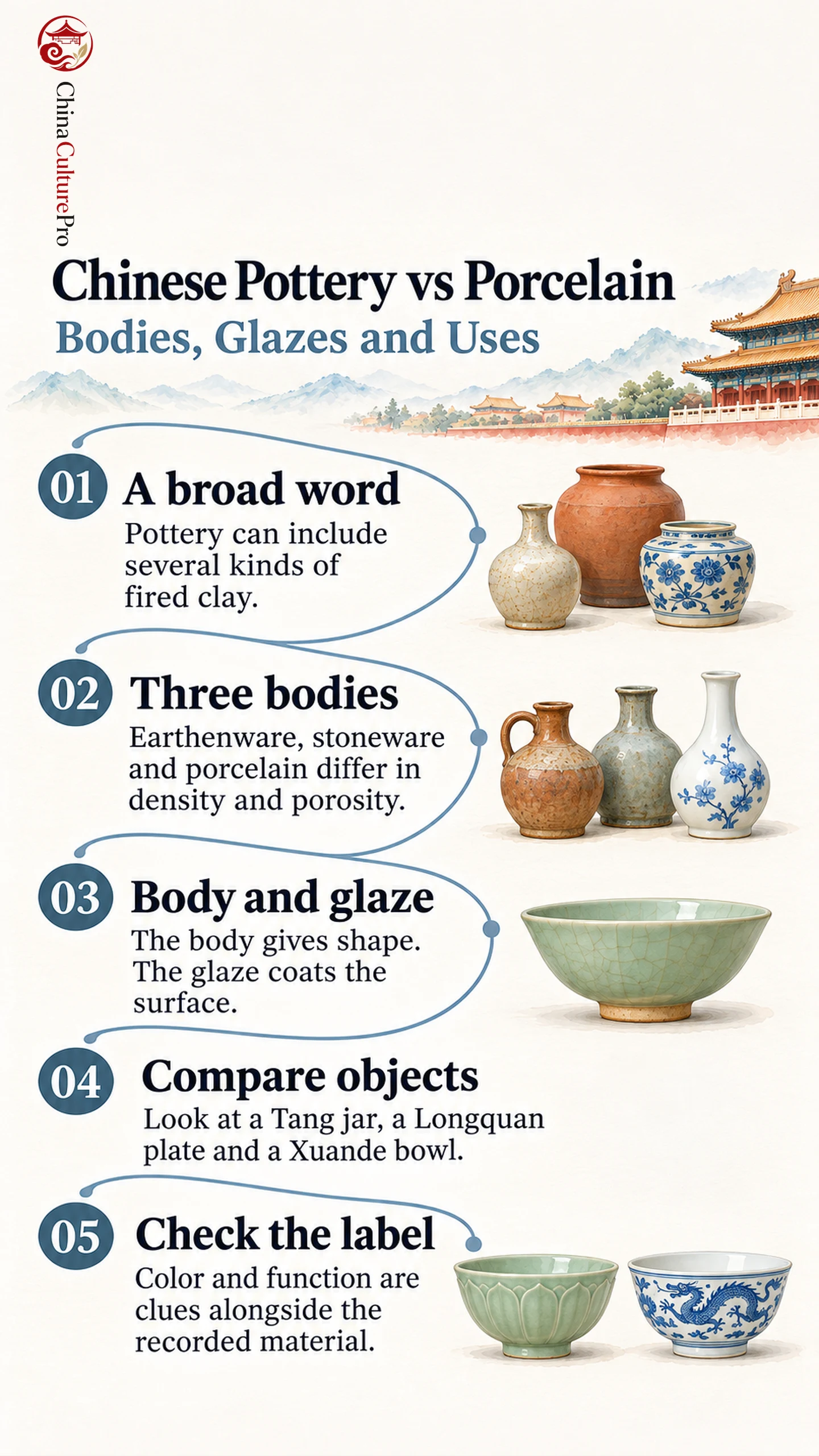
Pottery can mean objects made by firing clay, including earthenware (陶器, táoqì), stoneware and porcelain (瓷器, cíqì). In everyday comparisons with porcelain, people often use pottery more narrowly for earthenware or other clay wares. Porcelain generally has a dense body that can transmit some light in thin sections. [1][2][3]
- Glaze and body are separate layers. A glossy surface can cover porous earthenware or a dense porcelain body. [1][2][4][5]
- Stoneware gives a useful third category. A Longquan celadon can have a dense stoneware body under its green glaze. [1][6]
- The use of a vessel is another clue. Objects made for a court or a household can belong to different ceramic categories. [7][6][8][5]
Read the material and the surface description together.
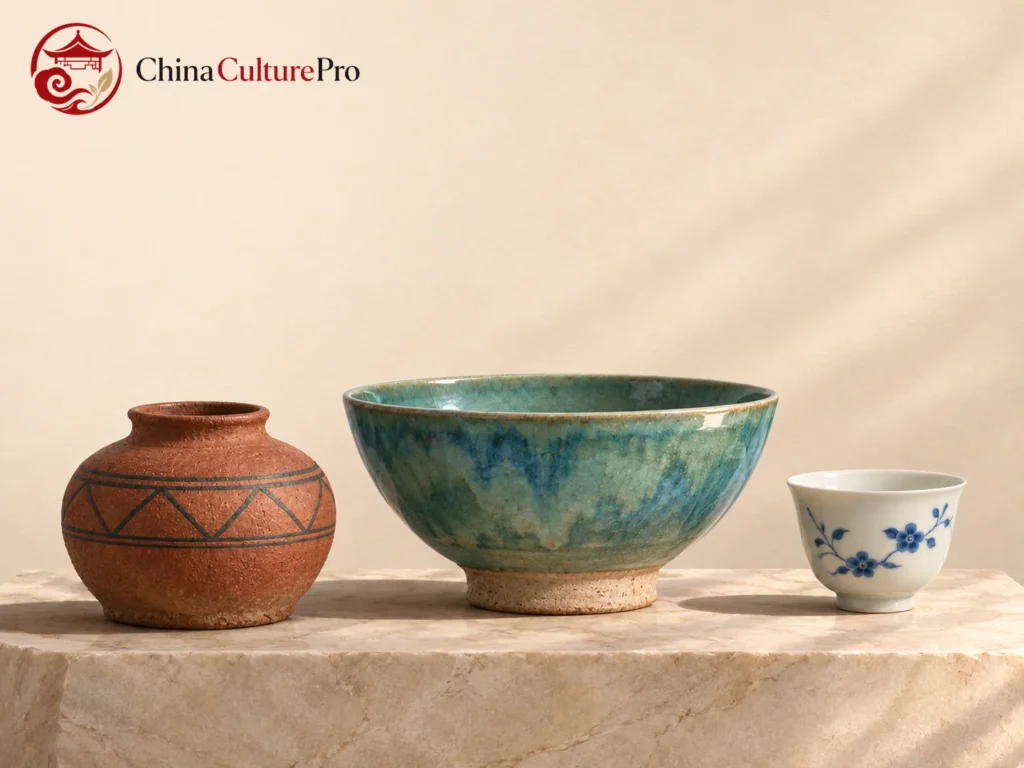
A Tang jar and a Ming bowl can both shine under museum lights. That shine says something about the surface. The material under the glaze explains why the two objects may be given different names.
What Pottery Means
A museum may use pottery as a broad category for objects formed from clay and hardened by firing. In that usage, Chinese porcelain is a kind of pottery. In ordinary speech, pottery may suggest an opaque clay vessel, while porcelain brings to mind a fine, pale body. Those uses can coexist. [1][2][3]
English museum labels often distinguish three bodies. Earthenware typically remains porous after firing. Stoneware generally has a denser body with much lower absorption. Porcelain is a dense high-fired body, often pale and sometimes translucent where thin. Historical naming conventions vary across languages and collections. [1][2][3]
Earthenware, Stoneware and Porcelain
| Body type | Common qualities | One documented example |
|---|---|---|
| Earthenware | Usually porous, commonly fired at lower temperatures | Majiayao painted jar |
| Stoneware | Dense and generally opaque, with low water absorption | Longquan lotus plate |
| Porcelain | Dense, often white or pale, sometimes translucent in thin areas | Xuande pomegranate bowl |
These are typical properties of the fired bodies. A thick porcelain vessel may transmit little visible light. A thin edge can be easier to see light through than a thick foot. A stoneware body can be light, and a glossy glaze can hide the body’s original color. Museum classifications draw on several traits and the evidence available for the individual object. [1][2][3][9][6][8]
Clay, Firing and Glaze
The body starts with the prepared material a potter shapes. As the kiln heats it, particles bond and the material hardens. In many high-fired bodies, a glassy phase fills some of the gaps between particles. That process is called vitrification. Different recipes and kiln conditions can yield different densities and degrees of porosity. [1][2][3]
At Jingdezhen, workshops used local porcelain stone and later incorporated kaolin. These were important materials in the history of Jingdezhen porcelain, though formulas changed over time. Pale raw materials and a suitable firing can produce a light, dense body, while the thickness affects how much light passes through it. [2][3][7]
A glaze forms a glassy coating on the surface. It can add shine or color and cover the pores at the surface of an earthenware vessel. An unglazed foot can show a clay color or texture that differs from the glazed surface. In many cases, the catalogue supplies the evidence needed to identify the material. [1][4][6][5]
Another possible layer is slip, a thin mixture containing clay. The Met’s Northern Song Cizhou vase with a peony scroll is stoneware covered with white and black slips. Cutting into the upper slip brought out the design, and a transparent glaze covered it. Some of the pale color on the finished object therefore comes from a clay coating over the body. That distinction helps explain why the surface is an unreliable guide to the body by itself. [5][10]
Three Chinese Examples to Compare
| Example | Body and surface | What it illustrates |
|---|---|---|
| Tang covered jar | Earthenware with three-color glaze | A porous body can carry a shiny, colored surface |
| Longquan lotus plate | Stoneware with celadon glaze | A dense body can be green-glazed and incised |
| Xuande pomegranate bowl | Porcelain with underglaze cobalt | A pale body can carry a painted design under glaze |
The Tang jar illustrates Tang sancai, a glaze tradition on earthenware. The Longquan plate illustrates Chinese celadon, with an incised pattern beneath a green glaze. The Xuande bowl illustrates blue-and-white porcelain. Its color comes from cobalt painting beneath the glaze. The body term in each label identifies the fired material. The remaining words describe how the surface was made. [4][6][8]
Why Use and Appearance Can Overlap
A bowl form can be made in more than one body. Different clay and glaze combinations can also serve a similar activity, such as drinking tea. The Met catalogues a plum-blossom-shaped Yixing teapot by Shi Dabin as stoneware. An eighteenth-century Jingdezhen teapot in the same collection is porcelain, with underglaze blue and enamels added later. In both cases the spout and vessel identify the object’s function. The catalogue describes the fired body and surface separately. [1][7][5][11][12]
The Longquan plate and Xuande bowl both belong to the history of Ming ceramics, although the Met identifies their bodies differently. In that comparison, “Ming” answers a question about date. “Stoneware” and “porcelain” answer a question about material. “Celadon” and “underglaze cobalt” describe the surface. [6][8]
FAQs About Chinese Pottery and Porcelain
Is porcelain a kind of pottery?
In broad usage, pottery includes shaped, fired clay objects such as earthenware, stoneware and porcelain. In an everyday contrast, pottery can have a narrower meaning. [1][2][3]
Does a glazed piece have to be porcelain?
Earthenware and stoneware can both be glazed. A Tang sancai jar is an example of glazed earthenware, while a Longquan celadon plate can be glazed stoneware. [4][6]
Is a white ceramic always porcelain?
A pale surface can come from the body, a pale glaze or another surface coating. Porcelain is identified from a combination of material and firing-related properties. [1][2][3][5]
Sources
[1] The Museum of Oriental Ceramics, Osaka. Guide to Enjoy the Exhibit
[2] Victoria and Albert Museum. An A–Z of Ceramics
[3] National Museum of Asian Art. Porcelain
[4] The Metropolitan Museum of Art. Covered Jar
[5] National Museum of Asian Art. Technology and Tea Culture
[6] The Metropolitan Museum of Art. Foliated Plate with Lotus
[7] National Museum of Asian Art. Jingdezhen
[8] The Metropolitan Museum of Art. Bowl with Pomegranates, Lotus Scrolls, and Chrysanthemum Petals
[9] The Metropolitan Museum of Art. Jar (Guan)
[10] The Metropolitan Museum of Art. Vase with Peony Scroll
[11] The Metropolitan Museum of Art. Teapot in the Shape of a Plum Blossom
[12] The Metropolitan Museum of Art. Jingdezhen Teapot