

Quick Answer: What Is Chinese Celadon?
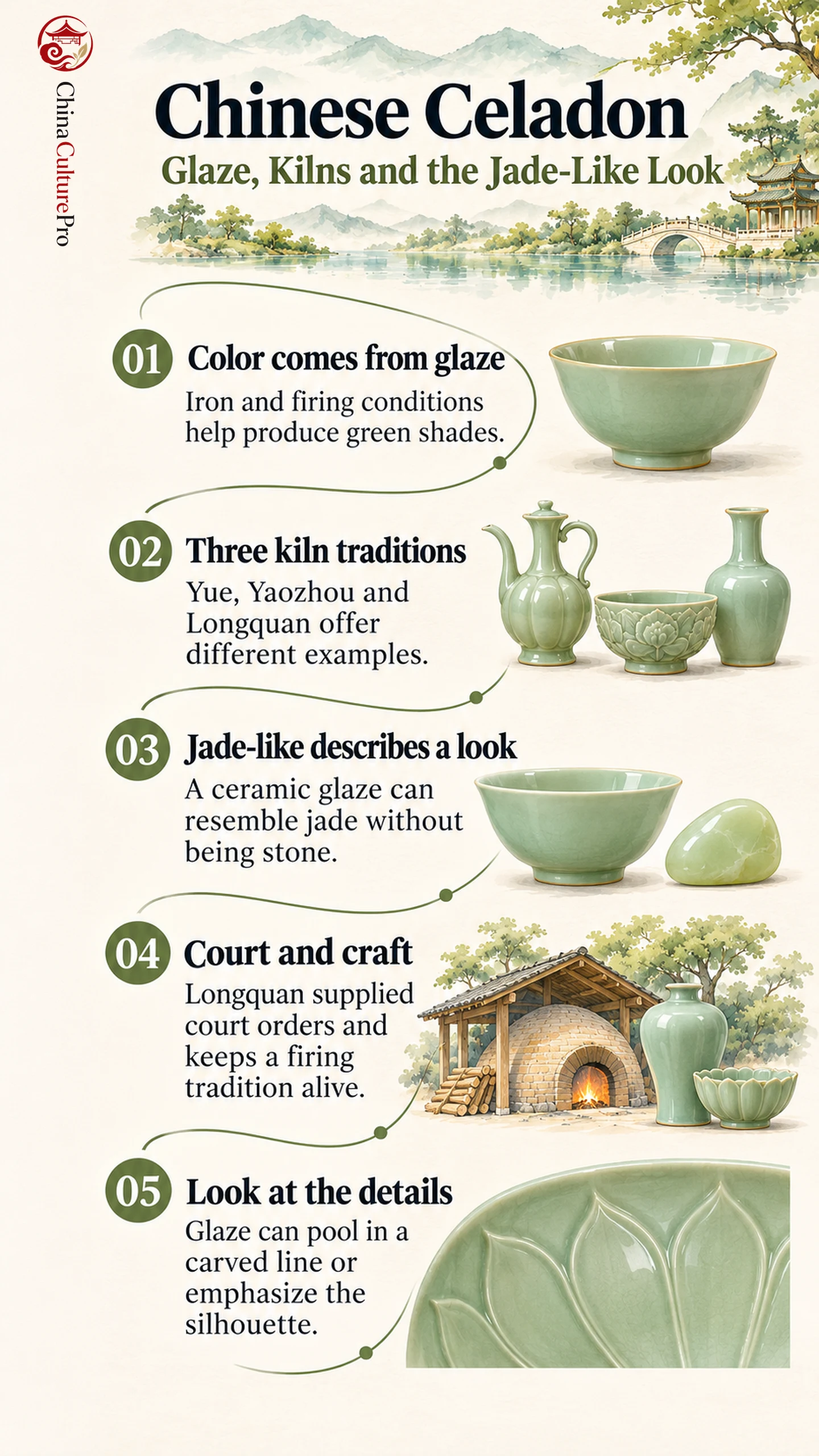
Chinese celadon (青瓷, qīngcí) is a family of high-fired ceramics known for glazes ranging from olive green to pale blue-green. A small amount of iron in the glaze and the conditions inside the kiln help produce the color. Yue, Yaozhou and Longquan are three important production traditions. [1][2][3][4][5]
- The glaze gives celadon its characteristic color. Color can deepen where the glaze collects in a carved line or recess. [1][4][6]
- Jade-like describes a visual effect. The smooth color and shine can recall polished stone, while the vessel remains a fired ceramic. [1][5][7]
- Celadon includes different shapes and uses. Workshops made ewers, bowls, bottles and dishes, including wares commissioned for the court. [3][4][5][6]
Look for the glaze color, the form beneath it and any decoration cut or molded into the body.
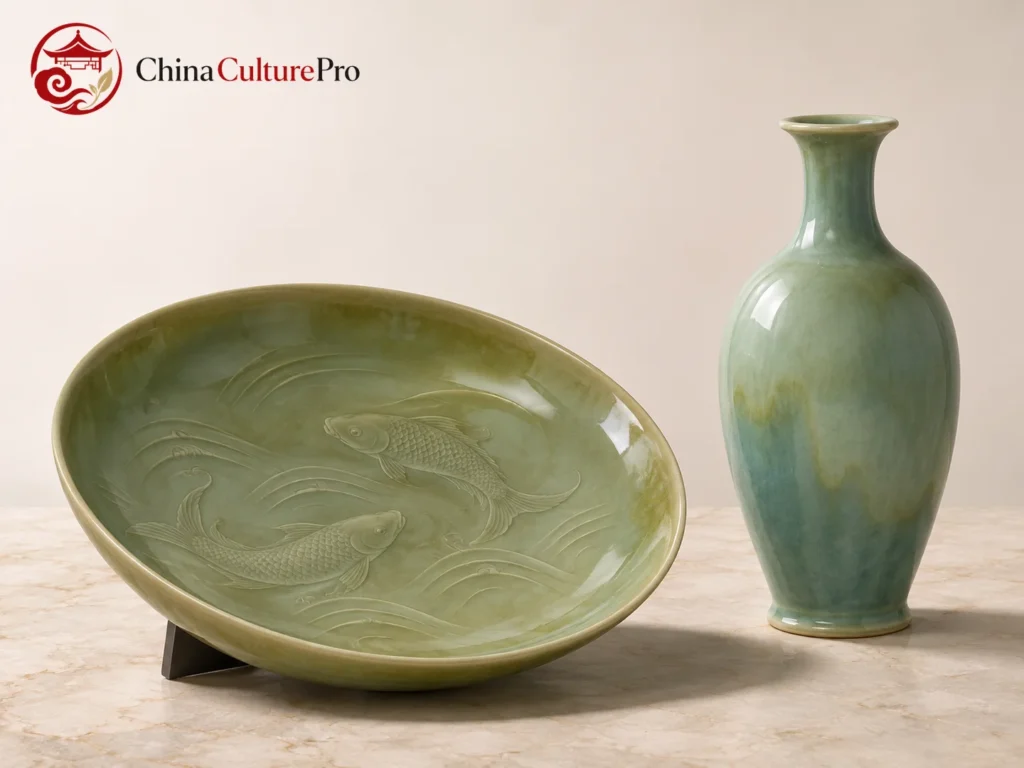
In a shallow bowl, green glaze can collect in an incised line. The line appears darker and the raised parts remain brighter. This is one way color and shape work together in celadon.
How an Iron Glaze Turns Green
Celadon glaze contains a small proportion of iron. In a kiln with a reduced supply of oxygen, often called a reducing atmosphere, iron-bearing glazes can develop green or blue-green tones. Color can also vary with the recipe, firing conditions and glaze thickness. One vessel can show more than one shade of green. [1][2][8]
That variation can make a design more visible. When glaze collects in a groove, the deeper layer can appear darker than the coating on the raised edge. A smooth bottle can use a related effect without a complex design. Its glaze changes subtly where the surface curves from neck to shoulder. [1][4][5][6]
The color belongs to the surface layer. In much blue-and-white porcelain, cobalt is painted as a pattern under a clear glaze. Comparing the two approaches helps you see the difference between a tinted glaze and a painted motif within the wider history of Chinese porcelain. [1][2][9]
Yue, Yaozhou and Longquan
| Tradition | Region | Example to look for |
|---|---|---|
| Yue | Zhejiang | A Five Dynasties ewer with parrots incised under celadon glaze |
| Yaozhou | Shaanxi | A bowl with fish formed in a mold and wave lines cut into the surface |
| Longquan | Zhejiang | A Southern Song bottle vase with a luminous blue-green glaze |
Yue kilns were making green-glazed wares before the Song period. The Met’s ewer shows how a curved vessel can carry incised ornament under the glaze. The Yaozhou example at the National Museum of Asian Art brings two forms of ornament together. The fish are molded and the waves incised. The molded shapes and cut lines give the glaze different surfaces to cover, so the fish and their setting remain distinct under a single color. [2][3][4]
The Met’s Southern Song Longquan bottle has a different emphasis. The glaze and the balance of the body, neck and foot draw attention even without a dense painted motif. The object also has gold lacquer repairs, evidence that it continued to be used or valued after it left the kiln. [1][5]
A Jade-Like Look and Different Clay Bodies
A museum description may call the glaze jade-like because of its color and visual depth. Polished nephrite and jadeite can have a comparable sheen or depth of color. They are minerals found in jade, while the color on a celadon vessel comes from a fired glaze. [1][5][7]
The body may be identified separately from the glaze. The Met classifies its Yue ewer, Southern Song Longquan bottle and early Ming Longquan plate as stoneware with celadon glaze. Labels in different traditions may place high-fired bodies under different categories. The distinction between pottery and porcelain helps explain why a pale or green surface is only part of the description. [2][3][5][6]
Court Use, Trade and Continuing Craft
Longquan kilns supplied more than one kind of buyer. The Met’s early Ming plate with an incised lotus is an example of a court commission. Its green glaze and incised design sit alongside painted Ming ceramics in the history of the period. Jingdezhen was another major center, associated with different bodies, glazes and decoration. [2][6]
The National Museum of Korea holds a Longquan bottle excavated from a fourteenth-century shipwreck near Sinan. The vessel was part of cargo on a merchant ship heading from China to Japan. In this case the findspot identifies the bottle’s trading context, while its manufacture is associated with Zhejiang. [10]
Traditional Longquan firing continues as a craft. UNESCO records knowledge of glaze preparation and management of the firing as part of the tradition. A collection can preserve a finished glaze. The craft tradition also passes on decisions about the glaze mixture and the progress of a firing. [8]
What to Notice on a Celadon Vessel
Follow the glaze from a raised edge into a depression and see whether the color deepens. An exposed foot can show the color and texture of the body. The outline of the vessel and a carved or molded pattern give two other ways to describe what the glaze brings out. [1][3][4][5][6]
Check whether the object has a repair. Gold lacquer on the Met’s bottle is recorded as a later addition. It changes the appearance of the surface and tells you something about the vessel’s life beyond production. A label can separate such changes from the work that came out of the kiln. [5]
FAQs About Chinese Celadon
Why can celadon look green or blue-green?
Iron in the glaze and a reducing atmosphere can produce several green shades. The recipe, glaze thickness and firing help explain variations across or between pieces. [1][8]
Is celadon made from jade?
Celadon is fired ceramic with a glaze. Some examples resemble polished jade in color or depth of surface. [1][5][7]
Is every Chinese celadon piece porcelain?
Celadon describes a family of glazes and glazed wares. Many examples, including some Yue and Longquan pieces, have bodies identified as stoneware in English-language museum catalogues. [2][3][5][6]
Sources
[1] National Museum of Asian Art. Acquisition: Four Chinese Celadon Ceramics
[2] The Museum of Oriental Ceramics, Osaka. A Brief History of Chinese Ceramics
[3] The Metropolitan Museum of Art. Ewer with Parrots
[4] National Museum of Asian Art. Yaozhou Ware Bowl with Molded Fish and Incised Waves
[5] The Metropolitan Museum of Art. Bottle Vase
[6] The Metropolitan Museum of Art. Foliated Plate with Lotus
[7] Gemological Institute of America. Jade Description
[8] UNESCO Intangible Cultural Heritage. Traditional Firing Technology of Longquan Celadon
[9] Victoria and Albert Museum. Chinese Blue-and-White Ceramics
[10] National Museum of Korea. Longquan Celadon Bottle from the Sinan Shipwreck