


Quick Answer: What Is Chinese Export Porcelain?
Chinese export porcelain describes Chinese-made porcelain produced for overseas customers or documented in export trade. The term connects ceramics to markets and circulation across periods. It encompasses several shapes, glazes and decorative techniques.[1][3]
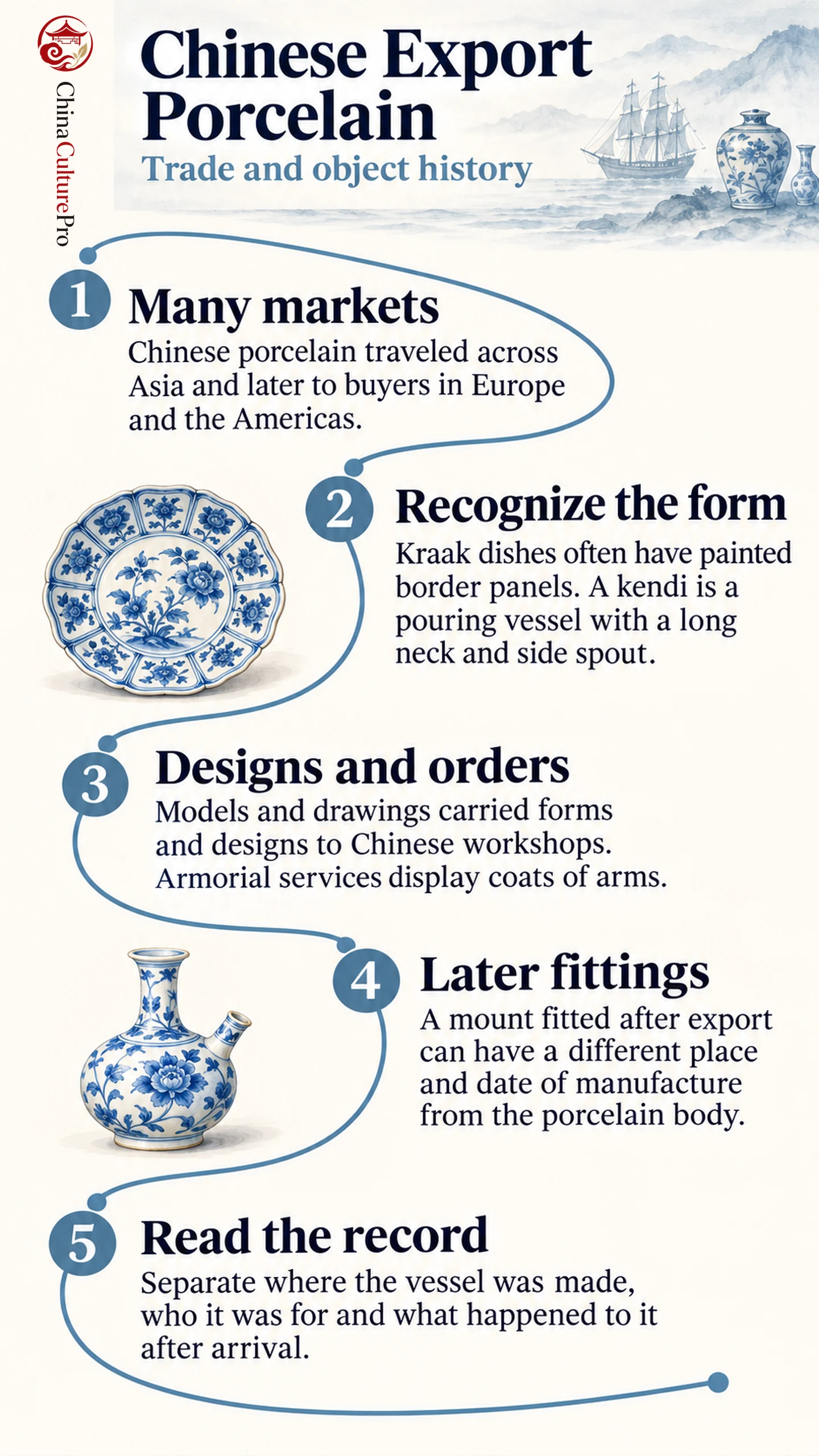
- Markets: Chinese wares traveled to destinations across Asia, Europe and later the Americas.
- Design: A piece may use a familiar Chinese form, adapt a form from another market or carry an ordered design.
- Object history: A later metal mount can record another stage in the life of an exported vessel.
Read where a piece was made, which market it was intended for and what happened to it afterward as separate parts of its record.[2][5]
A blue-and-white plate can travel without a bespoke order. A dinner service may be painted for a specific family. A cup may gain new metal fittings after it arrives. Each object can reveal a different kind of exchange.
How Export Markets Changed Over Time
Chinese ceramics moved through Asian maritime networks long before European companies began ordering dinner services. The Song, Yuan and Ming wares now grouped as Longquan celadon circulated overseas in green-glazed forms. Early trade included useful vessels alongside pieces later prized by collectors.[3]
By the early sixteenth century, Portuguese merchants were bringing Chinese porcelain to Europe in growing quantities. Later, merchants placed orders for familiar table and drinking shapes. Paneled blue-and-white dishes became a recognizable part of the trade, and detailed enamels gave eighteenth-century painters more ways to reproduce heraldic designs.[1]
One late-eighteenth-century service in the Met collection was made in China for the American market. Dated 1785–90, it bears the Townley family arms. The catalogue names Samuel Chase as the probable commissioner. The named market and the identity of the person who ordered it carry different degrees of certainty.[7]
Kraak Dishes, Kendi and Table Services
Begin by identifying a form or decorative technique within the wider range of Chinese porcelain. A label may then add a separate term for its intended market or place of manufacture.
| Form or group | What to look for |
|---|---|
| Kraak dish | A wide rim often has painted panels around a central scene. Potters commonly painted the design in underglaze cobalt blue before firing.[1] |
| Kendi | This pouring vessel has a long neck and a side spout. A late-sixteenth-century example attributed to Jingdezhen (景德镇, Jǐngdézhèn) has patterns also seen on kraak wares.[2] |
| Armorial service | Matching tablewares can bear a family coat of arms. Colored overglaze enamels make small heraldic details easier to distinguish.[1] |
Kendi is a Malay term. Chinese kilns made the form for Southeast Asian markets, and examples also circulated farther west. The familiar paneled design on this example leaves its destination open.[2]
How Designs Crossed Borders
A commissioned piece could combine a form familiar in one market with an emblem intended for another. A jug dated about 1520–40 has Portuguese royal arms under the glaze and a shape derived from Islamic metalwork. The arms appear upside down. The form, intended customer and actual place of manufacture tell different parts of the story.[4]
Drawings and samples also carried designs. A plate made for the British market in 1739–43 can be compared with a surviving pattern for Leake Okeover’s service. The surviving pattern gives the commission a documentary reference that can be compared with the finished object.[6]
Another kind of exchange took place after firing. A Ming porcelain cup and cover have London-made gilded silver mounts dated about 1570. The porcelain and its fittings have separate manufacture dates and places. Both belong in the label for the assembled cup.[5]
How to Read an Export Porcelain Label
Look for the country or kiln under production place. The intended market is a separate field when the catalogue identifies one. A piece recorded as “Chinese, for American market” combines a manufacture attribution and a statement about its intended customers. Later acquisitions belong to provenance, the documented history of ownership and custody.
An object can contain design elements with several possible sources. A documented kraak dish combines figures identified as Persian with tulip and landscape motifs. The proposed origins of individual motifs carry varying certainty. The same catalogue identifies the dish itself as Jingdezhen porcelain.[8]
Use Chinese porcelain marks to read a base or inscription in context. A fuller entry in a museum collection catalogue can supply the object number, dates, material and the grounds for an attribution.
FAQs About Chinese Export Porcelain
Is Chinese export porcelain always blue and white?
The category includes blue-and-white pieces, white wares, celadon and wares decorated in colored enamels. The market and object history determine how the export label is used.
Does a coat of arms tell you where the porcelain was made?
A coat of arms can point to the intended owner or customer. The ceramic body may have been made in China even when the family represented by the arms lived elsewhere.
Can a kraak pattern identify the destination market?
The pattern identifies a decorative tradition. The same motifs can appear on vessels associated with different customers, so the production and market fields still need to be read.
Why can an export porcelain piece have two dates?
A body and its later fittings can have separate dates. A record for a mounted object may give one range for the porcelain and another for the metalwork.
Sources
[1] Alice Cooney Frelinghuysen and Jeffrey H. Munger. East and West: Chinese Export Porcelain
[2] The Metropolitan Museum of Art. Pouring Vessel (Kendi) with Flowers and Fruits
[3] The Palace Museum. Longquan of the World: Longquan Celadon and Globalization
[4] The Metropolitan Museum of Art. Jug with Portuguese Arms, 61.196
[5] The Metropolitan Museum of Art. Cup and Cover, 68.141.125a, b
[6] Clare Le Corbeiller and Alice Cooney Frelinghuysen. Chinese Export Porcelain
[7] The Metropolitan Museum of Art. Table Service, 10.149.1–.248
[8] British Museum. Room 95 Chinese Ceramics Large Print Guide