
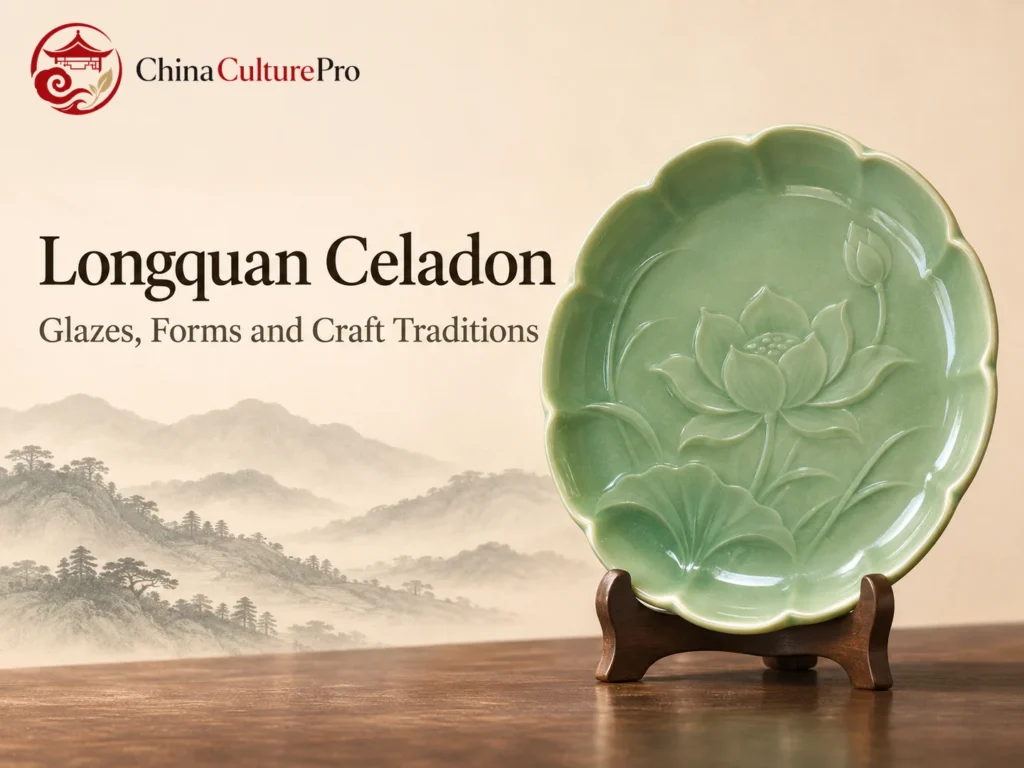

Quick Answer: What Is Longquan Celadon?
Longquan celadon (龙泉青瓷, Lóngquán qīngcí) is the green-glazed ceramic tradition associated with Longquan and nearby kiln sites in southwestern Zhejiang. Historic wares from the Song, Yuan and Ming periods include serving vessels, vases and pieces made for the imperial court.[1][4]
- Glaze: The surface can range from pale greenish blue to richer plum green (梅子青, méizǐqīng).
- Decoration: Carved lines, molded relief and the vessel’s own profile can show through the glaze.
- Circulation: Longquan ware served domestic markets and traveled abroad in maritime cargoes.
A green glaze can suggest celadon (青瓷, qīngcí). The kiln attribution depends on further evidence about the object.[1]
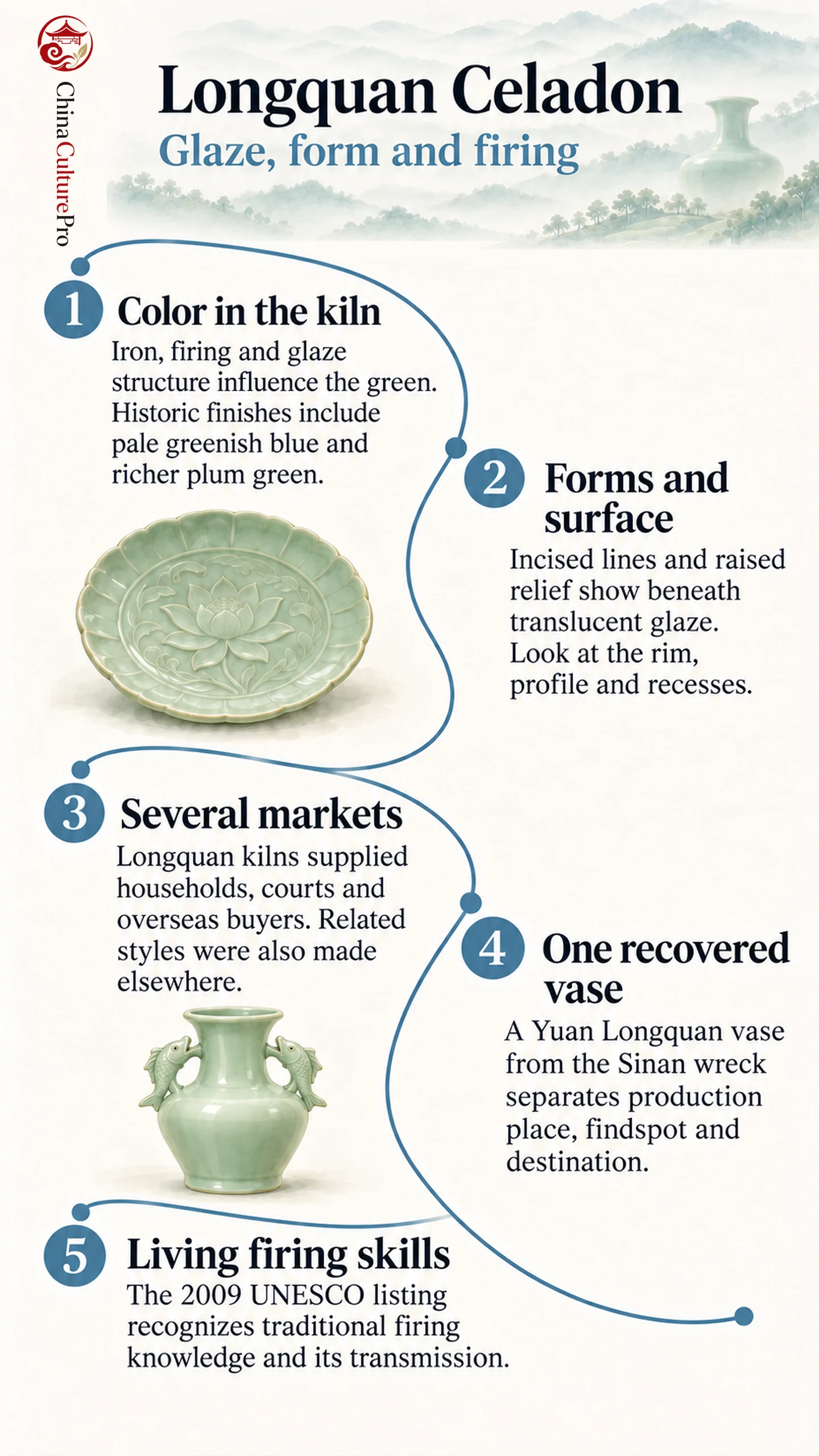
A pale green vase recovered from a shipwreck and a large lotus plate made for the court tell different parts of the same story. Their glaze draws the eye, while their shapes and records reveal what Longquan potters made and where their work went.
How the Glaze Gets Its Color and Depth
Celadon color develops in the kiln. Iron in the glaze, the firing atmosphere and the fired structure of the glaze help determine the hue and the way it reflects light. A study of Southern Song samples found differences in the chemical state and surroundings of iron in light greenish-blue and plum-green glazes. Those results describe tested pieces from a particular period.[3]
Plum green names a richer green finish within the tradition. A glaze can look darker where it pools and lighter where it thins over a sharp edge. The body beneath it and the way the light falls also affect what you see. Look at the edge and the recesses on the same piece before comparing color in photographs.
Tests on excavated sherds from Longquan kiln sites found relatively high-calcium glazes in the sampled Song material and calcium-alkali glazes in the sampled Yuan material. The comparison reveals changing workshop choices within one production region.[2]
The guide to Chinese porcelain explains how body material and glaze are described separately on labels. A museum may describe a Longquan piece as stoneware with celadon glaze.[4]
Reading Longquan Forms and Decoration
Start with the profile and then follow the decoration. On an incised piece, cut lines alter the surface beneath the glaze. Relief rises from the body. With either technique, the light and the varying depth of the glaze make the design visible.
| Documented form | Details to look for |
|---|---|
| Large foliated plate | A fifteenth-century lotus plate has a scalloped outline and incised decoration under the glaze. Its 41.6 cm diameter and early Ming court context are part of the object record.[4] |
| Vase with paired handles | The Sinan vase has fish-like dragon handles and a form inspired by earlier metal vessels. The shape shows one way that Chinese bronze vessels influenced later ceramics.[5] |
| Incised and carved dish | A fifteenth-century dish in the Gulbenkian collection combines a geometric center, peony scrolls and a patterned rim under a grey-green glaze.[6] |
On a shallow plate, a motif can spread across the well. On a vase, the neck, shoulder and handles are more prominent as you turn it. These differences help explain why the same general glaze family works with very different shapes.
From Zhejiang Kilns to Overseas Markets
Longquan was a group of production sites. The kilns supplied Chinese households and the court, and their wares traveled widely from the Song through the Ming. Overseas demand also encouraged potters elsewhere to make ceramics in related styles. Read the attributed manufacture field when a label uses the phrase “Longquan style.”[1]
The Sinan vase was recovered from an early-fourteenth-century shipwreck off southwestern Korea. The vessel was part of the merchant ship’s cargo on a voyage from China toward Japan. Its production attribution, findspot and intended destination describe three different places.[5]
Westward circulation is visible in surviving collections as well. A Ming dish attributed to Longquan has comparably decorated dishes in the Topkapı collection in Istanbul. That comparison helps locate the ware in a wider market, while the ownership history of a particular dish needs its own evidence. See Chinese export porcelain and Chinese museum collections for how trade and object records answer different questions.[6]
The Firing Craft Practiced Today
In 2009 UNESCO inscribed the traditional firing technology of Longquan celadon on the Representative List of the Intangible Cultural Heritage of Humanity. The entry describes knowledge carried through families and teachers, including preparing glazes and controlling heating and cooling. Potters use observation of the firing as well as instruments. The decision describes darker, crackled “elder brother” finishes and thick lavender-gray or plum-green “younger brother” finishes within this living tradition.[7]
The inscription concerns the living transmission of a craft. When you see a new vessel in the Longquan tradition, read its maker and production information alongside the glaze. The guide to Chinese intangible cultural heritage explains how practices and skills become the focus of safeguarding.
FAQs About Longquan Celadon
Is every celadon vessel from Longquan?
Celadon is the wider glaze and ware category. Longquan identifies a production region or tradition. Some labels qualify an object as Longquan-style when the attribution is about resemblance.
Is Longquan celadon always plum green?
Historic Longquan finishes vary from light greenish blue to stronger green. Lighting, glaze thickness and the ceramic body also influence how a particular object looks.
Is Longquan one of the Five Famous Song Kilns?
The conventional Five Famous Song Kilns grouping names Ru, Guan, Ge, Ding and Jun. Longquan was an important ceramic production center in its own right.[1]
What did UNESCO recognize in Longquan?
The listing recognizes the traditional firing knowledge and its transmission. An individual vessel still has its own maker, date and production record.
Sources
[1] The Palace Museum. Longquan of the World: Longquan Celadon and Globalization
[2] The Palace Museum and Zhejiang archaeological research partners. The Body Glazes of The Song-Yuan-Ming Longquan Celadon Products and Their Sintered Temperature
[3] Journal of the European Ceramic Society. Comparative Study on Coloration Mechanisms of Light Greenish-Blue and Plum-Green Glazes of Longquan Celadon from the Southern Song Dynasty
[4] The Metropolitan Museum of Art. Foliated Plate with Lotus, 1980.449
[5] National Museum of Korea. Celadon Vase with Fish-like Dragon Handles, Sinan6558
[6] Calouste Gulbenkian Museum. Dish, Inventory 920
[7] UNESCO Intangible Cultural Heritage. Decision 4.COM 13.24 on the Traditional Firing Technology of Longquan Celadon