
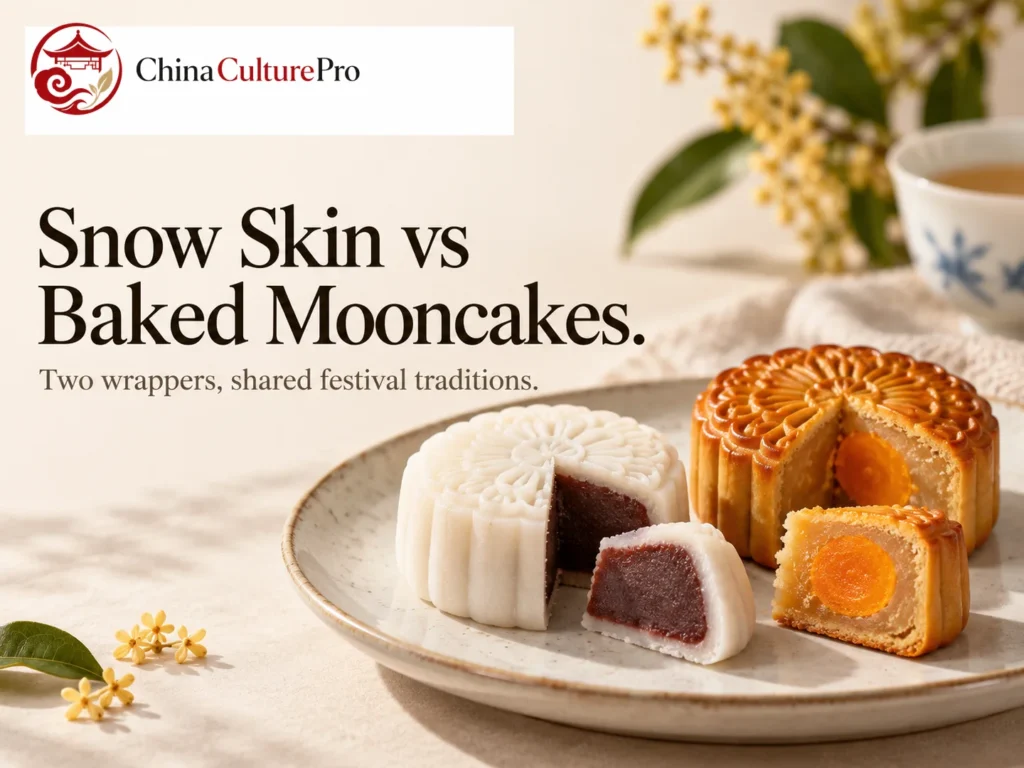

Quick Answer: How Do Snow Skin and Baked Mooncakes Differ?
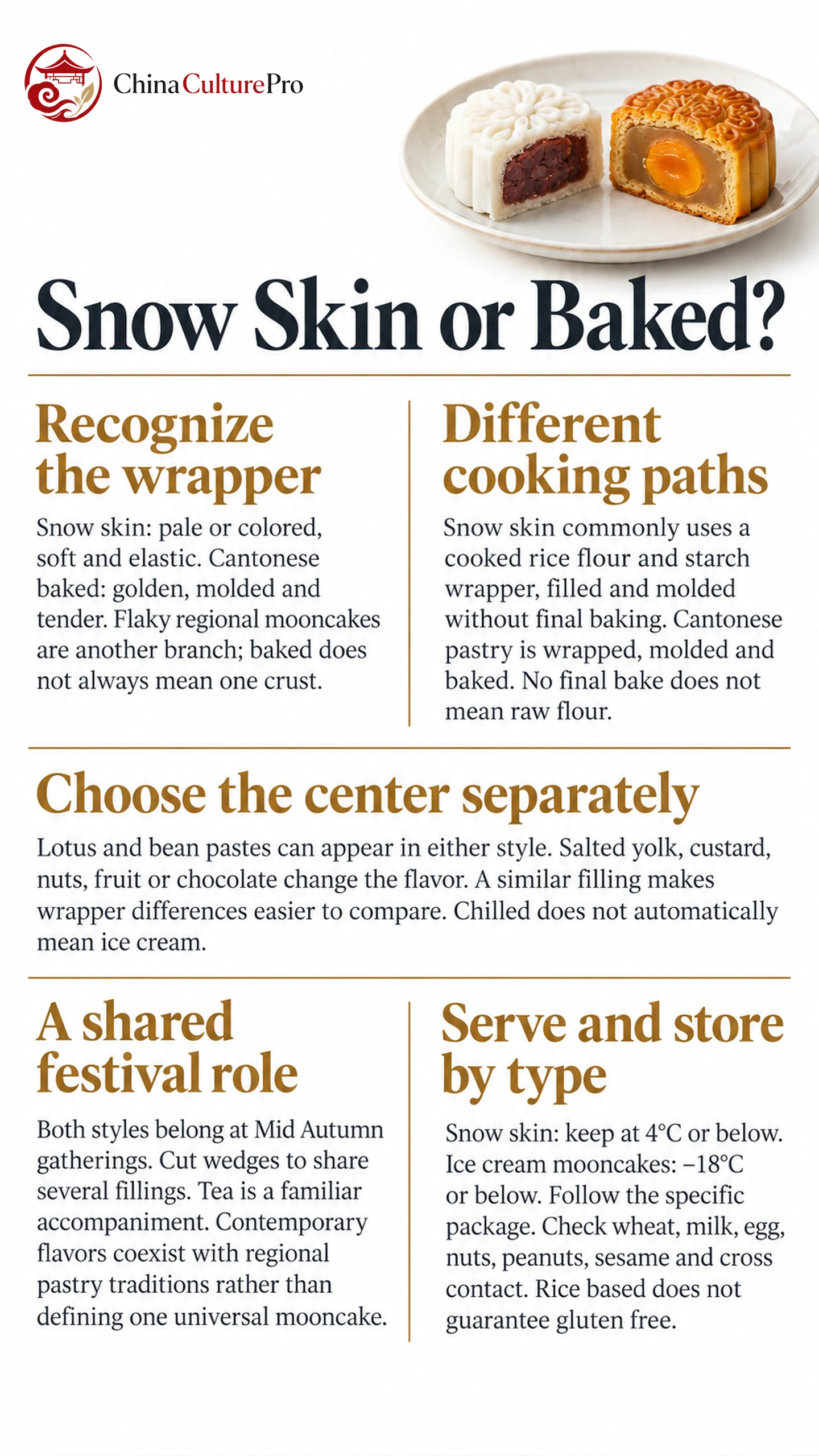
Snow skin mooncakes, bingpi yuebing(冰皮月饼,bīngpí yuèbǐng), have a soft, chewy wrapper and are usually served chilled. The familiar Cantonese baked version has a browned, molded pastry skin.
- Wrapper: Rice-flour-based snow skin versus a wheat-based baked pastry.
- Preparation: A cooked wrapper assembled without final baking versus a filled pastry baked in the oven.
- Experience: Cool and springy versus tender pastry surrounding a dense filling.
Both belong to Mid-Autumn mooncake culture. Their fillings overlap, and neither style has one universal recipe. Here, “baked” primarily means the molded Cantonese style; flaky regional mooncakes form another branch.
Cut a pale snow skin mooncake beside a golden baked one and the contrast is immediate. One wrapper stretches slightly around its filling; the other yields like tender pastry. Choosing between these mooncakes becomes easier when you separate the skin, filling and serving conditions instead of treating each box as a complete flavor category.
The Two Skins Side by Side
Snow skin often begins white or slightly translucent, but coloring and flavor additions can make it pink, green or purple. Its appearance does not guarantee a particular filling. The important clue is its pliable rice-based wrapper, which stays soft rather than developing a browned crust.[1]
| Feature | Snow skin mooncake | Cantonese baked mooncake |
|---|---|---|
| Wrapper base | Commonly glutinous rice flour, rice flour and added starch | Commonly wheat flour, syrup and oil |
| Surface | Pale or colored, without oven browning | Golden brown, often with an egg-washed finish |
| Bite | Soft, elastic and slightly sticky | Tender pastry around a compact filling |
| Final assembly | Cooked components wrapped and molded | Filled dough molded and then baked |
| Typical service | Chilled | Commonly served at room temperature, subject to label |
A baked Cantonese mooncake is not necessarily crisp like a biscuit. Its thin skin can be soft and glossy. Nor does “baked mooncake” describe every regional crust: Suzhou mooncakes use layered pastry and require a different comparison.[2]
How Cooking Changes the Wrapper
Snow skin is a no-final-bake preparation, not an instruction to eat raw flour. One common method mixes rice flours and starch with liquid, cooks that mixture by steaming, then works it into a smooth wrapper. The prepared filling is enclosed and the mooncake is pressed into a mold. The skin has already been cooked before the decorative shape is made.[3]
Other formulations use prepared cooked flour or commercial mixes, so a single home method should not be elevated into a rule for every bakery. The defining result is a pliable wrapper without the final browned pastry bake. “Mochi-like” is a useful description of its chew, rather than proof that every snow skin formula is identical to Japanese mochi.[1]
For Cantonese baked mooncakes, syrup, oil and wheat flour form a dough that can enclose a substantial filling. Molding produces the patterned surface, and baking develops its color. An egg wash may enhance the finish. Here, the wrapper’s tender pastry character comes from a different mixture and treatment, not simply from serving the same rice dough warm.[2]
Fillings Do Not Belong to Just One Skin
Lotus seed paste with salted duck egg yolk is a familiar baked combination. A slice shows a dense paste surrounding a contrasting savory yolk. Yet neither lotus paste nor salted yolk defines all baked mooncakes; red bean paste, nuts and other fillings also appear across the broader mooncake family.[2][4]
Snow skin can enclose lotus or bean paste too. Custard versions introduce egg and dairy, while fruit, chocolate and other contemporary fillings offer different flavors. The wrapper needs a filling that can be enclosed and hold its shape; a runny dessert cannot simply be substituted without changing the preparation.[1][3]
This gives a practical way to compare a mixed box: first ask whether you prefer pastry or chew, then choose the center. A baked lotus mooncake and a snow skin lotus mooncake let you compare wrappers with a similar filling. Comparing baked salted-yolk lotus with chilled chocolate custard changes both variables at once.
Ice-cream mooncakes are a separate storage case. A cold mooncake is not automatically filled with ice cream, and a snow skin label alone does not tell you to keep the product frozen.[5]
Mid-Autumn Sharing and Modern Variety
Mooncakes are closely associated with family reunion and the full-moon imagery of Mid-Autumn. Cutting a dense cake into small wedges makes it easy to share several fillings around the same table. Tea provides a familiar accompaniment without imposing a single required pairing.[4]
Both snow skin and baked versions can take part in that occasion. One does not lose its festival role because it has a newer wrapper or a contemporary flavor. At the same time, the existence of new fillings should not erase regional pastry traditions: the familiar Cantonese molded cake is one important style within a much larger family.
Snow skin belongs to the modern expansion of mooncake styles, rather than a replacement for all earlier pastries. The wrapper and method distinguish them, while their festival setting belongs to Mid-Autumn traditions.
Choosing, Serving and Keeping Mooncakes
Choose a snow skin mooncake when you want a cool, elastic wrapper; choose the Cantonese baked style for tender browned pastry. Then read the filling description. Neither a white skin nor a fruit name establishes how sweet the complete product will taste.
Keep the cold chain in mind when taking a box to a gathering. Hong Kong consumer guidance specifies snow skin mooncakes at 4°C or below and ice-cream mooncakes at −18°C or below. Follow the package’s instructions for the particular product, carry chilled items in an insulated container and avoid leaving them out as table decorations.[5][6]
Baked products also require their own storage directions; do not infer an unlimited room-temperature life from the browned crust. Once a package is opened, its handling requirements still matter.
For dietary needs, check wrapper, filling and finish separately. Milk, egg, wheat, nuts, peanuts or sesame may occur in different components. Rice-based snow skin can include wheat starch, so “rice” is insufficient evidence of gluten-free suitability. Ask about ingredients and cross-contact rather than relying on the color of the cake.[7]
FAQs About Snow Skin and Baked Mooncakes
Are snow skin mooncakes raw?
No. Common methods cook the wrapper before filling and molding. “No bake” refers to the absence of a final oven bake, not permission to eat raw flour.
Are snow skin mooncakes the same as mochi?
They can have a similar rice-based chew, but snow skin mooncakes are a distinct filled festival pastry with varied formulas.
Are snow skin mooncakes gluten-free?
Not automatically. Some wrappers contain wheat starch, and fillings or shared equipment also require checking. Use the complete product information.
Which mooncake is less sweet?
That depends on the formula, filling and portion. The wrapper category alone does not establish a sweetness ranking.
Sources
[1] Judy Leung. Snow Skin Mooncakes
[2] Judy Leung. Lotus Mooncakes with Salted Egg Yolks
[3] KP Kwan. Snow Skin Mooncake with Custard Filling
[4] Hong Kong Tourism Board. How to Celebrate Mid-Autumn Festival
[5] Centre for Food Safety, Hong Kong. Mooncakes and Food Safety
[6] Hong Kong Government. Seasonal Mooncake Surveillance and Consumer Advice, 2026
[7] U.S. Food and Drug Administration. Food Allergies: What You Need to Know