


Quick Answer: Who Was the Shunzhi Emperor?
The Shunzhi Emperor (顺治帝, Shùnzhì Dì; 1638–1661) was an early Qing ruler. He became emperor as a child in 1643, moved to Beijing in 1644 and began personal rule in 1651.[1][2][3]
- Regency: Senior princes, especially his uncle, exercised power during his childhood.
- Government: Conquest and administrative reconstruction continued across the reign.
- Legacy: His religious interests and early death generated stories that need to be compared with the political and burial record.[1][2][4]
The dates of accession, an era’s first year and the start of personal rule identify different events; they should not be used interchangeably.
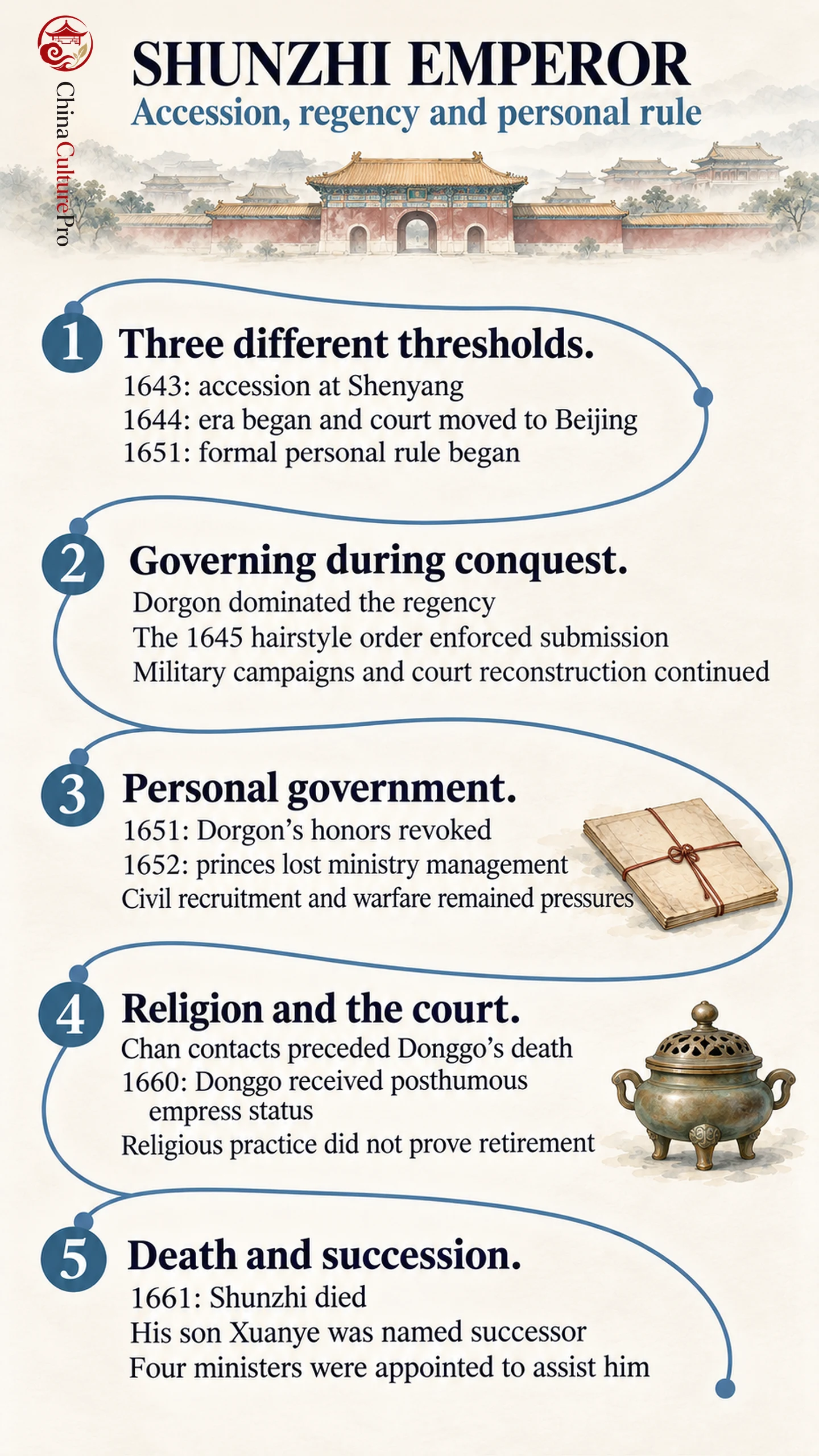
A child enthroned before the Qing entered Beijing, Shunzhi later tried to govern amid powerful princes and continuing war. His short life also inspired a monastery-retirement legend. Separating political chronology, religious activity and the evidence for his death gives a clearer account of his reign.
Accession, the Era Name and the Move to Beijing
His personal name was Fulin (福临, Fúlín). Born in 1638, he was a son of Hong Taiji (皇太极, Huáng Tàijí); his mother is remembered as Empress Dowager Xiaozhuang (孝庄皇太后, Xiàozhuāng Huángtàihòu). After his father’s death, the princes resolved the succession in favor of the child.[1][3]
Dorgon (多尔衮, Duō’ěrgǔn) and Jirgalang (济尔哈朗, Jì’ěrhālǎng) were appointed to assist the government. Dorgon became the dominant regent. The arrangement kept the throne within Hong Taiji’s line while placing executive authority in adult hands.[1]
| Date | What changed |
|---|---|
| 1643 | Fulin succeeded as emperor at Shenyang. |
| 1644 | The Shunzhi era (顺治, Shùnzhì) began; later that year the court moved to Beijing. |
| 1651 | He formally began personal rule after Dorgon’s death. |
The first era year began after accession, and relocation brought another enthronement ceremony. This difference between Chinese era dating and Gregorian years explains why summaries may foreground either 1643 or 1644.[1][2]
Regency, Conquest and Coercion
During the regency, armies defeated rival forces and brought large territories under Qing control. Occupation of Beijing did not finish the conquest. The annals continue to record campaigns, resistance and changing control of southern regions well into the reign.[1][2]
The new government also imposed coercive measures. In 1645 it ordered male subjects to adopt the prescribed shaved-front hairstyle and queue, with military punishment for refusal. Land enclosure and rules pursuing escaped dependents further marked the unequal conditions of early conquest. Such measures belong to the history of Qing state formation, not simply to a story of smooth dynastic succession.[1]
An institutional example is the Shixian calendar (时宪历, Shíxiànlì), associated with the Jesuit astronomer Adam Schall von Bell (汤若望, Tāng Ruòwàng). The Palace Museum preserves an early Shunzhi-era edition and dates the new calendar’s adoption to 1644, with nationwide promulgation the following year. Technical expertise, calendrical authority and the recruitment of specialists were part of building the new court.[5]
Personal Rule and Imperial Government
Dorgon died late in 1650. In 1651 the emperor formally assumed government, and the dead regent’s honors were soon revoked amid accusations against him and his supporters. The transition involved allies and factional conflict, rather than a solitary young ruler suddenly becoming free of every constraint.[1][2]
The annals record attacks on official corruption and demands that governors identify capable, honest administrators. In 1652 princes were removed from managing ministry business. These measures show an effort to place government more firmly under the throne, although an order announcing reform does not by itself demonstrate uniform enforcement.[2]
Recruiting civil officials also mattered. The imperial examinations were already operating under the regency: the annals record degree awards in 1646. Their continuation should not be misdated as an institution invented after his personal rule began.[1]
The record combines tax remissions, military expenses, appointments and repeated campaigns. In 1659 Zheng Chenggong (郑成功, Zhèng Chénggōng) attacked the Nanjing region, requiring a major military response. Court-building and warfare remained connected pressures, making it misleading to summarize the reign only as cultural learning or only as military conquest.[2]
Buddhism and Consort Donggo
Shunzhi’s interest in Chan (禅, Chán) Buddhism developed through meetings with monks, including Yulin Tongxiu (玉林通琇, Yùlín Tōngxiù). The museum account records the religious name Xingchi (行痴, Xíngchī) and practice within the court.[4]
Consort Donggo (董鄂妃, Dǒng’è Fēi) died in 1660 and received posthumous empress status. The annals record official mourning and the change in her title. They establish the public treatment of her death without giving unrestricted access to the emperor’s private emotional life.[2]
His Buddhist contacts preceded her death. Her loss therefore cannot explain the origin of all his religious interests.[4]
Death in 1661 and the Story of Retirement
He died in 1661 after illness. The Palace Museum identifies smallpox as the cause.[3] The annals record his death at the palace and the succession arrangements.[2]
The succession document named his son Xuanye (玄烨, Xuányè), later the Kangxi Emperor (康熙帝, Kāngxī Dì), and appointed four senior ministers to assist him: Soni (索尼, Suǒní), Suksaha (苏克萨哈, Sūkèsàhā), Ebilun (遏必隆, Èbìlóng) and Oboi (鳌拜, Áobài). A long statement of imperial faults accompanies it. That official text belongs to the politics of succession; it is not an unmediated private diary explaining every decision of the reign.[2]
The Shenyang Palace Museum describes cremation and the burial of his ashes at Xiaoling (孝陵, Xiàolíng) in 1663, distinguishing this record from the later story of secret retirement at Mount Wutai.[4]
The Draft History of Qing (清史稿, Qīngshǐgǎo) is itself a retrospective compilation. Its annals are valuable for chronology and transmitted documents, while its final praise interprets the reign. Together with objects and museum research, such evidence supports a history of governing, conflict and succession beyond the romantic ending.[1][2]
FAQs About the Shunzhi Emperor
Was Shunzhi his personal name?
No. Fulin was his personal name; Shunzhi was the era name. The guide to Chinese emperors and their titles explains these different naming systems.[1][3]
Was Shunzhi the first Qing emperor?
He was the first Qing ruler to govern from Beijing after 1644, but he succeeded an existing dynasty. He did not create Qing rule from nothing.[1]
Did Shunzhi secretly retire to a monastery?
His Buddhist involvement does not prove secret retirement. The accounts of his death, succession and burial give no basis for treating the monastery story as established history.[2][4]
Sources
[1] Jin Zhaofan, Deng Bangshu and other compilers. Draft History of Qing, Chapter 4: Emperor Shizu, Part One
[2] Jin Zhaofan, Deng Bangshu and other compilers. Draft History of Qing, Chapter 5: Emperor Shizu, Part Two
[3] Palace Museum. The Shunzhi Emperor
[4] Shenyang Palace Museum. Did the Shunzhi Emperor Become a Monk?
[5] Li Shijuan, Palace Museum. The Shunzhi-Era Shixian Calendar, Imperial Astronomical Bureau Edition