

Quick Answer
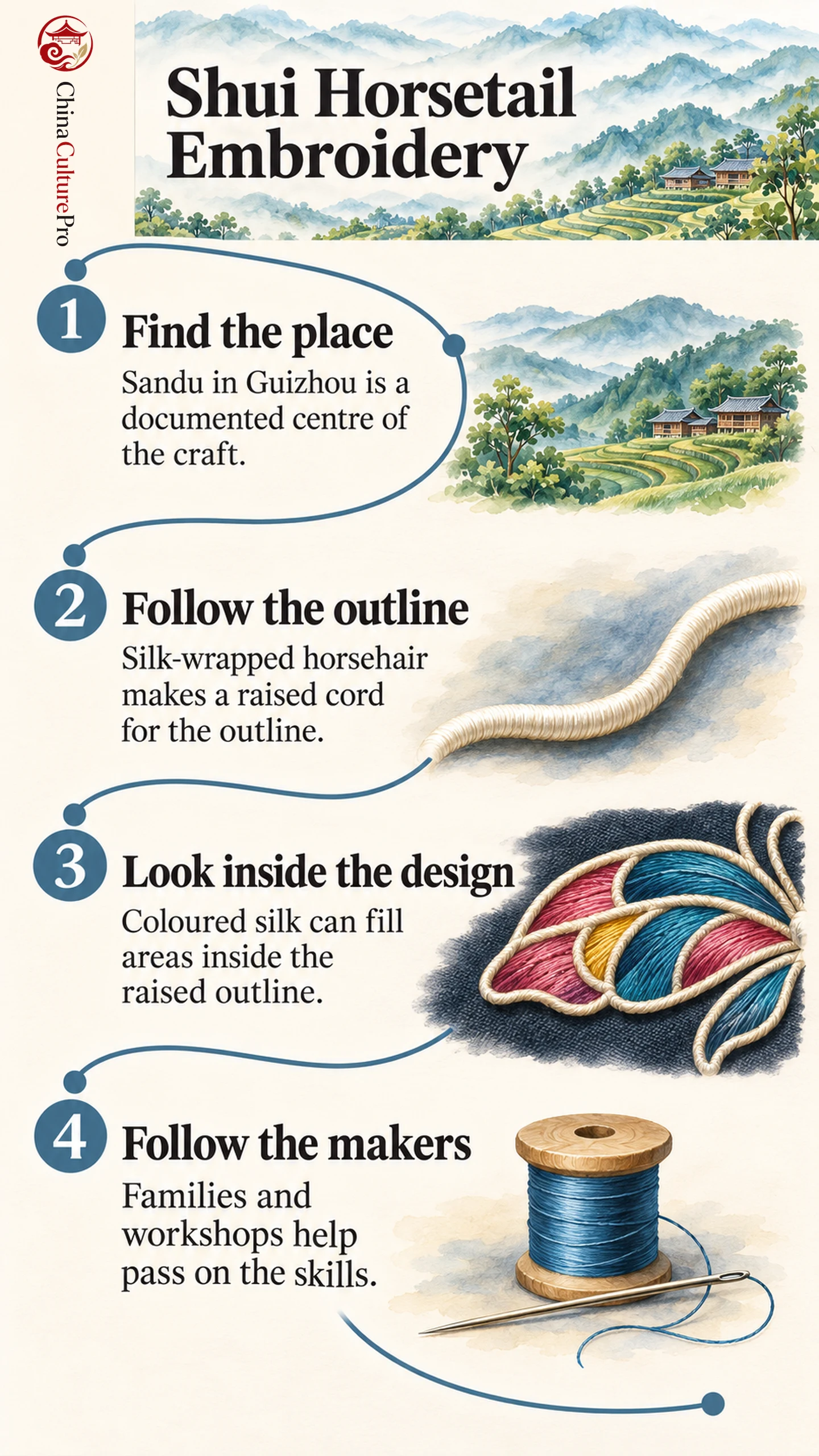
Shui (水族, Shuǐzú) horsetail embroidery (马尾绣, mǎwěixiù) uses horsehair wrapped in silk to create a raised outline on cloth. In the technique documented in Sandu, Guizhou, coloured thread can fill areas inside that outline. Baby carriers and embroidered shoes are among the forms recorded in China’s national inventory.[1][2]
- Outline: The horsehair gives a wrapped cord its core.[1][2]
- Colour: Coloured silk can fill the parts enclosed by the cord.[2]
- Objects: The craft appears on baby carriers, footwear and other items used or made in Shui communities.[1]
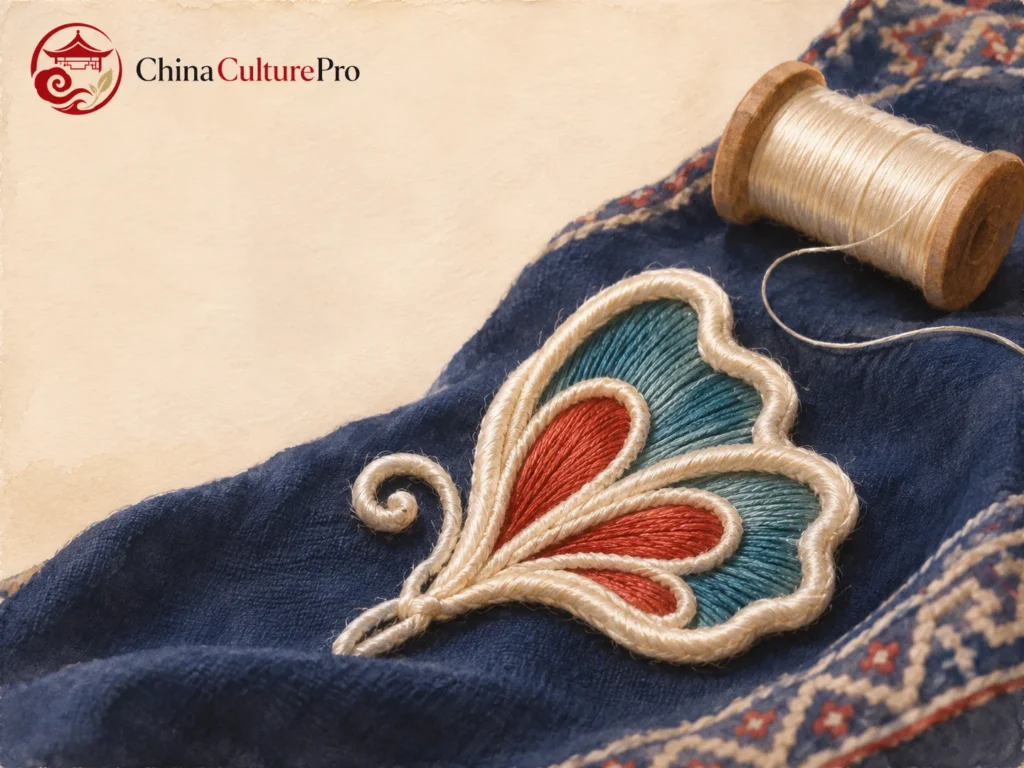
A close view can help you distinguish the raised cord at a boundary from the flatter stitching in the field inside it.[1][2]
In a Sandu baby carrier catalogued by the Shanghai Museum, a butterfly sits within a wider arrangement of flowers, fruits and other designs. A raised line and the colour it encloses work together to separate the shapes. The object gives a concrete example of what horsehair does in the embroidery.[2]
Where Shui Horsetail Embroidery Is Practiced
Sandu Shui Autonomous County in Guizhou submitted the entry for Shui horsetail embroidery that was listed nationally in 2006. The record names Shui villages in places such as Sandong, Zhonghe and Tangzhou. It describes a skill handed down among Shui women over generations.[1]
The inventory describes the origin as uncertain. The dated museum carrier provides a firm reference point for one surviving piece. The raised outlines can be compared with techniques in the broader guide to Chinese embroidery for context.[1][2]
How Horsehair Makes a Raised Outline
In the Shanghai Museum’s account, fine white silk is wrapped around hair from a horse’s tail. The resulting cord follows the boundary of a design. The hair gives the cord body. Once secured to the ground cloth, it stands above the surface and helps give the embroidery a low-relief appearance.[1][2]
The museum describes coloured silk used to fill parts of the motif. This is a separate job within the same design. If a photo shows only bright colour, it can be hard to see where the cord runs. A view across the surface may show the change in height between the boundary and the fill.[2]
Reading a Sandu Baby Carrier
The Shanghai Museum dates its carrier to the second half of the twentieth century and identifies Sandu as its place of origin. It measures 98 by 166 centimetres including the strap. The museum records butterfly, flower and fruit motifs as well as longevity characters, silver dots and yellow edging.[2]
The national inventory describes a type of carrier with a large embroidered area at the top, straps at the sides and a decorated lower section. It also records shoes with raised tips, aprons, caps and other objects. The placement of a pattern can be read alongside its intended use, just as the shoe form gives context to decoration in Chinese embroidered shoes.[1]
How Makers Pass On the Craft
The national profile of Song Shuixian records that she learned from her grandmother and mother-in-law. She later opened a shop and family museum, then worked in production, technical guidance and training. Her career documents how a skill learned within a family could be taught in a public or workshop setting.[3]
Another Sandu practitioner, Wei Taohua, learned from her mother. Her heritage profile describes her use of the techniques on contemporary clothing, shoes, straps and bags, alongside teaching.[4]
For another aspect of life in Shui communities, see the Shui Duan Festival for its calendar and gatherings.
FAQs About Shui Horsetail Embroidery
Is the Whole Design Made from Horsehair?
Horsehair forms the core of the raised cord, and fine silk wraps it. Other embroidery threads can provide fill and detail, as the Shanghai Museum describes for its Sandu carrier.[1][2]
Is Every Piece a Baby Carrier?
Carriers are prominent in the national entry. The same record also describes embroidered shoes, aprons, children’s caps and other items.[1]
Sources
[1] China Intangible Cultural Heritage Network. National inventory entry for Shui horsetail embroidery
[2] Shanghai Museum. Baby Carrier with Horsehair Embroidery, Shui
[3] China Intangible Cultural Heritage Network. Representative bearer Song Shuixian
[4] China Intangible Cultural Heritage Network. Representative bearer Wei Taohua