

Quick Answer: What Is a Hani Long-Table Banquet?
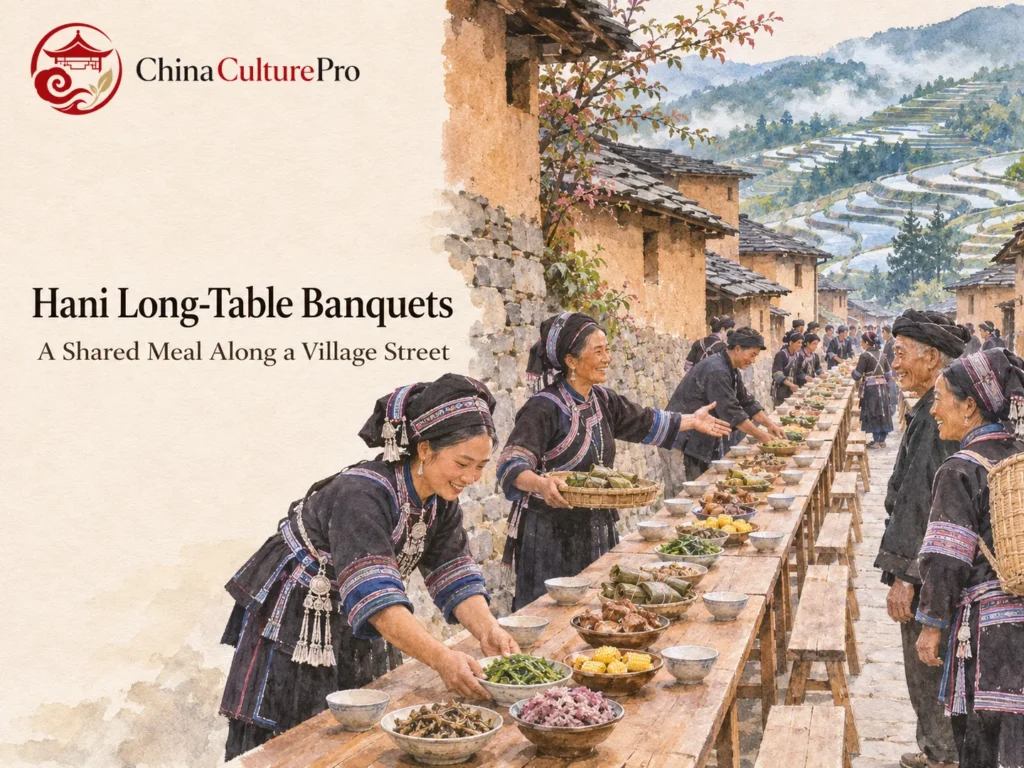
At a Hani (哈尼族, Hānízú) long-table banquet (长街宴, chángjiēyàn), households can place their tables in a line along a village street and share food with neighbors and guests. The format is documented in Honghe, southern Yunnan, at more than one kind of festival.[2][4]
- In one village, families bring dishes to the joined tables.[2]
- Angmatu (昂玛突, Ángmǎtū) can include a meal connected with honoring the village guardian.[3]
- A long-table meal can also mark the harvest and New Year.[1]
The arrangement is shared across occasions. The festival explains why people are gathering.

A single long table in a photograph can be many household tables put end to end. Looking at who prepares the food and who welcomes guests helps explain the work that makes a shared meal possible.
How Households Make One Banquet
In Habo (哈播, Hābō), Yuanyang County, an account describes families setting out their best dishes on tables of their own. A respected villager announces the start. Joined in the street, those individual contributions become one occasion for the village to receive guests.[2]
Three Occasions for the Long Tables
Honghe’s cultural record distinguishes three settings.[1]
- Angmatu can connect the banquet with honoring the village guardian and hopes for the farming year.
- At the Sixth-Month festival, a line of tables can accompany prayers for crops to mature.
- At the Hani October New Year, the banquet can celebrate the harvest and bring people together for the turn of the year.
The Four-Season Production Songs offer another way to read the links between farming and customary occasions.
What the Habo Example Shows
Yuanyang’s heritage description places the meal after an observance for the village guardian. An account from Habo describes guests, singing and dancing alongside the shared food.[2][3] The example shows how a banquet can be part of Hani village life through both observance and hospitality.
FAQs About Hani Long-Table Banquets
Is the banquet always held at New Year?
Honghe records it at several festivals, including Angmatu and the Sixth-Month festival.[1]
What makes the table so long?
Households set their tables beside one another in the street.[2]
Where is one documented example?
Habo Village in Yuanyang County is a documented Angmatu example.[2]
Sources
[1] Honghe Prefecture Bureau of Culture and Tourism. Three types of Hani long-street banquets
[2] Yuanyang County People’s Government. Long banquet in Habo
[3] Yuanyang County People’s Government. Provincial heritage project: long-street banquet
[4] Yunnan Ethnic and Religious Affairs Commission. Publication of the study of Hani long-street banquets