


Quick Answer: What Is the Shoton Festival?
The Shoton Festival (雪顿节,Xuědùn Jié in Mandarin) is a major Tibetan celebration especially associated with Lhasa. Its name is commonly translated as “yogurt banquet,” but food is only one part of the occasion. Religious image displays, Tibetan opera (藏戏,zàngxì) and public outings bring different communities together. A monastery observance and an afternoon watching performers in a garden have distinct purposes, even when both belong to Shoton. Understanding the festival means following those connections while keeping each activity’s religious, artistic or social setting clear.[1]
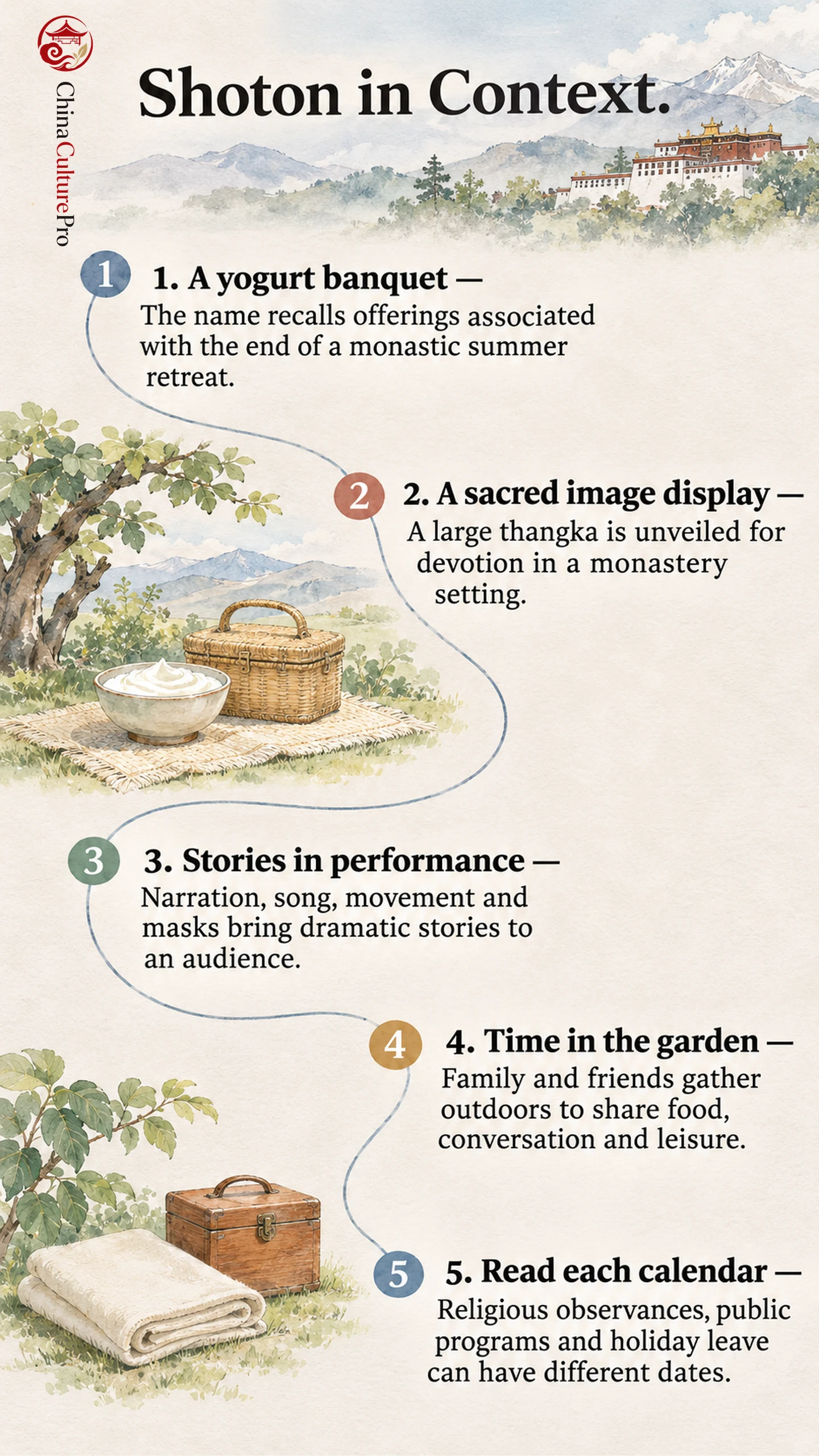
A sacred textile image on a monastery hillside and an opera audience in a park offer two very different views of the same festival. Add a family sharing food beneath the trees, and Shoton becomes easier to understand as a collection of connected occasions. These settings connect the festival with everyday Tibetan culture.
The Yogurt Banquet Name and Monastic Background
The name connects Shoton with yogurt offered to monks after their summer retreat. This association links lay supporters and monastic communities: food serves as an offering and a welcome at the close of a period of religious observance. The familiar English name “Yogurt Festival” preserves that relationship, though it gives only a partial impression of today’s celebration.[2]
The retreat association explains a relationship between monastic discipline and lay support. It does not establish one documented founding year for every element of the modern festival.
Over time, opera performances became associated with several Lhasa settings, including Drepung Monastery, the Potala and Norbulingka. The development of these performance settings connected monastic observance with a broader public occasion. The festival’s national heritage record recognizes Shoton under project X-31 in China’s first list, announced in 2006.[1]
Buddha Unveiling at the Monasteries
At Shoton, a thangka (唐卡,tángkǎ), or sacred textile image, is displayed in the Buddha unveiling (展佛,zhǎnfó) ceremony. The phrase “Buddha-sunning” refers to bringing that image into public view.[3]
Drepung is particularly associated with the opening observance. Reports also document unveiling ceremonies at Sera Monastery. The textile is carried and unfolded as part of a religious occasion, with worshippers attending to view and venerate the image. The purpose is devotional, even though the scale and setting also attract visitors.[3]
The textile format connects this public observance with the wider artistic and devotional uses of Tibetan thangka. Looking at how an image is used helps distinguish the ceremony from an exhibition concerned primarily with art.
Tibetan Opera as a Festival Centerpiece
Opera is a dramatic tradition within Shoton, not simply music in the background. Its traditional forms combine storytelling, song, dance, chant and other performance skills. A narrator advances the story while performers enact it, with singers and dancers supporting the drama. Masks help create the visual world of the performance, and many stories draw on Buddhist ethical themes.[4]
These features give an audience several ways to follow a performance: the narrated plot, vocal delivery, movement and visual characterization all contribute. Watching one excerpt does not necessarily show the structure or duration of an entire opera. Tibetan opera has its own repertoire and performance traditions beyond its place on a festival program.
During Lhasa’s 2026 celebrations, at Zongjiao Lukang Park, a local folk opera troupe opened a public showcase with singing, masked performers, drums and cymbals. Local residents and visitors shared the audience. The scene demonstrates the festival’s role as a meeting point between established performance practice and a wider public.[5]
Tibetan opera was inscribed on UNESCO’s Representative List in 2009. That recognition concerns the performing art; it is distinct from Shoton’s Chinese national heritage listing.[4]
Lingka Outings and Shared Leisure
Lingka (林卡,línkǎ in Mandarin) is a Tibetan word for a garden, also associated with spending leisure time outdoors. During Shoton, families and friends may gather in parks or suburban green spaces, bringing food and enjoying time together. This part of the festival works through hospitality, conversation and shared space, alongside the more formal settings of religious ceremonies and performances.
Photographs taken at Norbulingka on August 15, 2026 show people relaxing and taking photographs during the holiday. They document a particular day of garden leisure, rather than an obligation for every household to hold the same picnic or serve an identical menu.[6]
Contemporary programs also develop this social aspect in new ways. Lhasa’s 2026 activities included a family outing at Lalu Wetland combining nature learning, games and yogurt tasting. This was one organized activity within a wider program. The connection with Shoton lay in outdoor gathering and shared experience, rather than in turning the outing into a monastery ritual.[7]
Dates, Venues and Different Festival Calendars
Lhasa’s traditional observance falls around the end of the sixth Tibetan month and the beginning of the seventh. Those months should not be read as June and July in the Gregorian calendar.[1] For a visit, identify the year and the particular activity rather than relying on “August festival” as a complete schedule.
The 2026 festival opened on August 12.[5] The public program and municipal holiday notice described different date ranges, as the table shows.
| Arrangement | Published 2026 dates | Place or scope |
|---|---|---|
| Opera performances and heritage displays | August 12–17 | Zongjiao Lukang Park, in the published cultural program.[7] |
| Shoton horse-racing meeting | August 14–15 | Lhasa’s northern suburban racecourse.[7] |
| Municipal holiday leave | August 14, joined to the weekend | A day-off arrangement, not the date of the monastery opening.[8] |
These are past, dated examples. They show why a holiday calendar, an opera listing and a religious event announcement cannot substitute for one another. Check the current local program for the site and activity you hope to attend. At a monastery, treat the image and worshippers respectfully and follow the site’s viewing arrangements; a public performance or picnic has a different setting.
FAQs About the Shoton Festival
Is Shoton only a yogurt festival?
No. The name preserves an offering tradition, while today’s festival also includes sacred image displays, opera and public leisure.
When is the Shoton Festival?
Lhasa’s observances fall around the sixth-to-seventh Tibetan month transition. Gregorian dates and individual event schedules must be checked for the year concerned.
Is the unveiled Buddha image a thangka?
Yes. The large religious textile image is a thangka displayed for devotion, rather than a new painting created in front of the audience.
Is Shoton itself on UNESCO’s heritage list?
Shoton has a Chinese national heritage listing from 2006. Tibetan opera, an important part of the festival, has a separate UNESCO inscription from 2009.
Sources
[1] China Intangible Cultural Heritage Network. Shoton Festival: National Heritage Entry
[2] Library of Congress, Tibetan Oral History Archive Project. Glossary: Shodön and Shotön
[3] Xinhua. Shoton Festival Opens: Drepung and Sera Observances, 2010
[4] UNESCO. Tibetan Opera
[5] Lhasa Culture and Tourism. Shoton Opens with Opera at Zongjiao Lukang Park, 2026
[6] Xinhua, photographs by Tenzin Nyida and Jigme Dorje. Lingka Time During Shoton, 2026
[7] Lhasa Culture and Tourism. August 2026 Shoton Cultural Program
[8] Lhasa Municipal People’s Government. 2026 Shoton Holiday Leave Notice