

Quick Answer: What Is Losar?
Losar means “new year” in Tibetan and is known in Chinese as 藏历新年(Zànglì Xīnnián). It brings together family renewal, special foods, greetings and religious observances. Tibetan communities celebrate it across different regional and diaspora settings, alongside related but distinct Himalayan New Year traditions.[1]
A useful account separates the calendar date from the wider festive season, preparations from New Year’s Day, and household customs from monastic ceremonies. There is no single schedule that describes every community. The familiar Lhasa-centered observance is one important reference point, with other regional New Years occurring in earlier Tibetan months.

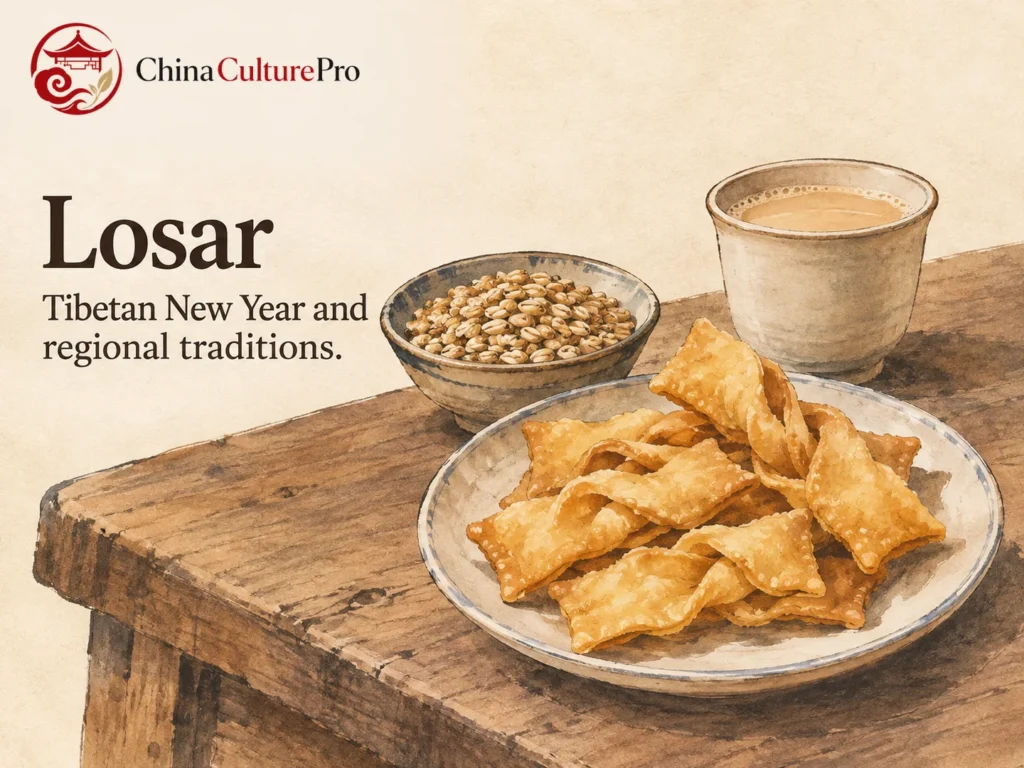
A plate of twisted pastries, a barley offering and a New Year greeting can belong to the same celebration while serving different purposes. Losar connects these household details with a new calendar year and a wider circle of relatives and community members. Understanding the occasion starts with identifying whose calendar and customs are being described.
When Losar Falls and Why Regional Dates Differ
As checked on November 5, 2026, the next Lhasa-centered Tibetan New Year begins on Sunday, February 7, 2027, the first day of the first Tibetan month. The date is a calendar reference, rather than a promise that every public event or regional New Year will take place that day.[2]
Tibetan calendars combine lunar months with solar-year reckoning. Their calculations are not identical to those of the Chinese calendar, so Losar and Chinese New Year should not be assumed to coincide.[1]
Regional differences extend beyond a change in the Gregorian date. The following examples use Tibetan month numbers, not Gregorian months:[3]
| New Year observance | Regional association | Tibetan-calendar beginning |
|---|---|---|
| Lhasa-centered Losar | Lhasa and the widely observed Tibetan New Year | First day of month 1 |
| Kongpo New Year(工布新年,Gōngbù Xīnnián) | Kongpo area around Nyingchi | First day of month 10 |
| Purang New Year(普兰新年,Pǔlán Xīnnián) | Purang in Ngari | First day of month 11 |
| Farmers’ New Year(农事新年,Nóngshì Xīnnián) | Shigatse agricultural communities | First day of month 12 |
Across Nepal and the wider Himalayas, Gurung, Tamang, Sherpa and Tibetan communities also maintain distinct Losar traditions and calendrical arrangements. Sharing the word does not make all these communities Tibetan, or their festivals interchangeable. A comparison should name the community before comparing dates.[1]
Preparations Before the New Year
Cleaning and food preparation belong to the approach to Losar. A cultural-institute account describes families cleaning thoroughly on the twenty-ninth day of the outgoing year and preparing special foods before the first morning. The work is connected with leaving behind the unwanted aspects of the old year and making the home ready.[4]
Guthuk is a soup associated with that twenty-ninth-day observance. Descriptions include dough tokens whose contents are humorously interpreted as character traits. These interpretations belong to the social custom; they are not a way to establish someone’s personality. Guthuk’s place before Losar is also important: it should not automatically be described as the standard breakfast on New Year’s Day.[4]
Preparing ahead allows the first morning to focus on greetings, offerings and time together. The household’s work and the meaning attached to it should be distinguished from a fixed ceremony that every family must perform in the same order.
Festive Foods and Auspicious Displays
Khapse are fried pastries made in several shapes, including small twisted pieces and larger forms used in displays. Small pieces can be offered to guests, while larger forms contribute to offering displays. The name covers different shapes and uses.[4]
Tsampa(糌粑,zānbā), roasted barley flour, also appears in festive settings. A divided chemar box can hold grain on one side and flour on the other, with decorated barley ears and butter ornaments above it. A Lhasa account describes this as an object for expressing auspicious wishes at the New Year.[5]
The barley, flour and decorations have different physical roles in the display. The divided container is not simply a bowl of everyday porridge, and an auspicious arrangement does not mean every part is treated as ordinary snack food. Its meaning depends on how the household or religious community presents it.
At Dolma Ling Nunnery in India, a documented Losar display included a chemar box and butter decorations made by the nuns. This is a specific community example of the connection between food, craft and offering.[6]
Family Visits, Greetings and Community Life
“Tashi Delek” is a familiar greeting heard during Losar; “Losar Tashi Delek” adds the New Year context. Visits can bring people together over food and tea. A Dolma Ling account describes nuns and staff visiting one another’s rooms to exchange greetings and drink salty butter tea.[6]
A different setting appears in a 2021 first-person account from Berkeley. A young Tibetan resident described her family’s usual temple visits, a community potluck and wearing a chupa, a Tibetan garment. Her recollection connects Losar with being part of a Tibetan community while living outside the Himalayan region.[7]
These accounts illustrate different scales of celebration: a room visit, a household gathering and a larger community event. They do not establish one visiting timetable for every place. When joining a celebration, a greeting and attention to the host’s way of receiving guests are more useful than assuming a universal sequence.
The broader setting is Tibetan family and cultural life, with practices sustained through relationships as well as public performances.
Religious Observances and Public Celebrations
In Tibetan Buddhism(藏传佛教,Zàngchuán Fójiào), Losar can include prayers, offerings and community religious ceremonies. The Dolma Ling account describes prayer-hall gatherings as well as the renewal of prayer flags. The purpose of an offering belongs to religious belief and intention, rather than a guarantee of prosperity or health.[6]
Renewing prayer flags is one documented New Year observance. Its place within a nunnery’s activities is different from preparing a household meal or hosting a community gathering.
The celebration can extend beyond its first day. An introductory account describes an initial three-day festive period within a wider season of about fifteen days, including later offerings and public activities. This is a useful distinction between New Year’s Day and the celebratory season, not a rule that every family stops work or follows the same program for fifteen days.[8]
A family meal, a monastery ceremony and a public song-and-dance event can all belong to Losar while doing different things. Keeping their purposes visible explains the festival’s range without turning one example into a universal ritual manual.
FAQs About Losar
When is the next Losar?
The commonly observed Tibetan New Year begins on February 7, 2027. Check the relevant regional calendar and event announcement when a particular community’s celebration is meant.
Is Losar the same as Chinese New Year?
No. They use different calendrical calculations and have distinct cultural traditions. Their dates can coincide in some years and differ in others.
What do you say to someone at Losar?
“Losar Tashi Delek” is a familiar New Year greeting. Follow the host’s language and manner of greeting rather than assuming one formula is compulsory.
Does every Tibetan community celebrate Losar in the same way?
No. Regional dates, family practices and religious settings differ, and diaspora communities maintain their own ways of gathering and celebrating.
Sources
[1] Westin Harris, Rubin Museum of Himalayan Art. Losar Celebrations Across Himalayan Cultures
[2] Rabten Foundation. Tibetan Calendar: February 7, 2027
[3] Xizang Culture and Tourism Department. Regional New Year Dates in a Winter Culture Overview
[4] Norbulingka Institute of Tibetan Culture. Losar: Tibetan New Year
[5] Liao Dongfan, China Tibetology Publishing House. Celebrating Tibetan New Year in Lhasa: Origins and Preparations
[6] Tibetan Nuns Project. Tibetan New Year Losar: A Dolma Ling Account
[7] Tenzing Chosang, KQED Perspectives. Losar
[8] Christina Watson, Rubin Museum of Himalayan Art. Losar: Tibetan New Year Traditions