

Quick Answer: What Is a Tibetan Thangka?
A thangka(唐卡,tángkǎ)is a Tibetan hanging-scroll image, commonly painted on cloth and set within a textile mount. Some thangkas are woven, embroidered or assembled from pieces of fabric instead of being painted. The term describes the object’s form, not one particular deity or composition.[1]
Thangkas are closely associated with Tibetan Buddhism(藏传佛教,Zàngchuán Fójiào)and may support devotion, teaching and religious practice. To understand one, distinguish its medium, pictured subject, artistic tradition and use. A mandala can be the subject of a thangka, but the two terms are not interchangeable.
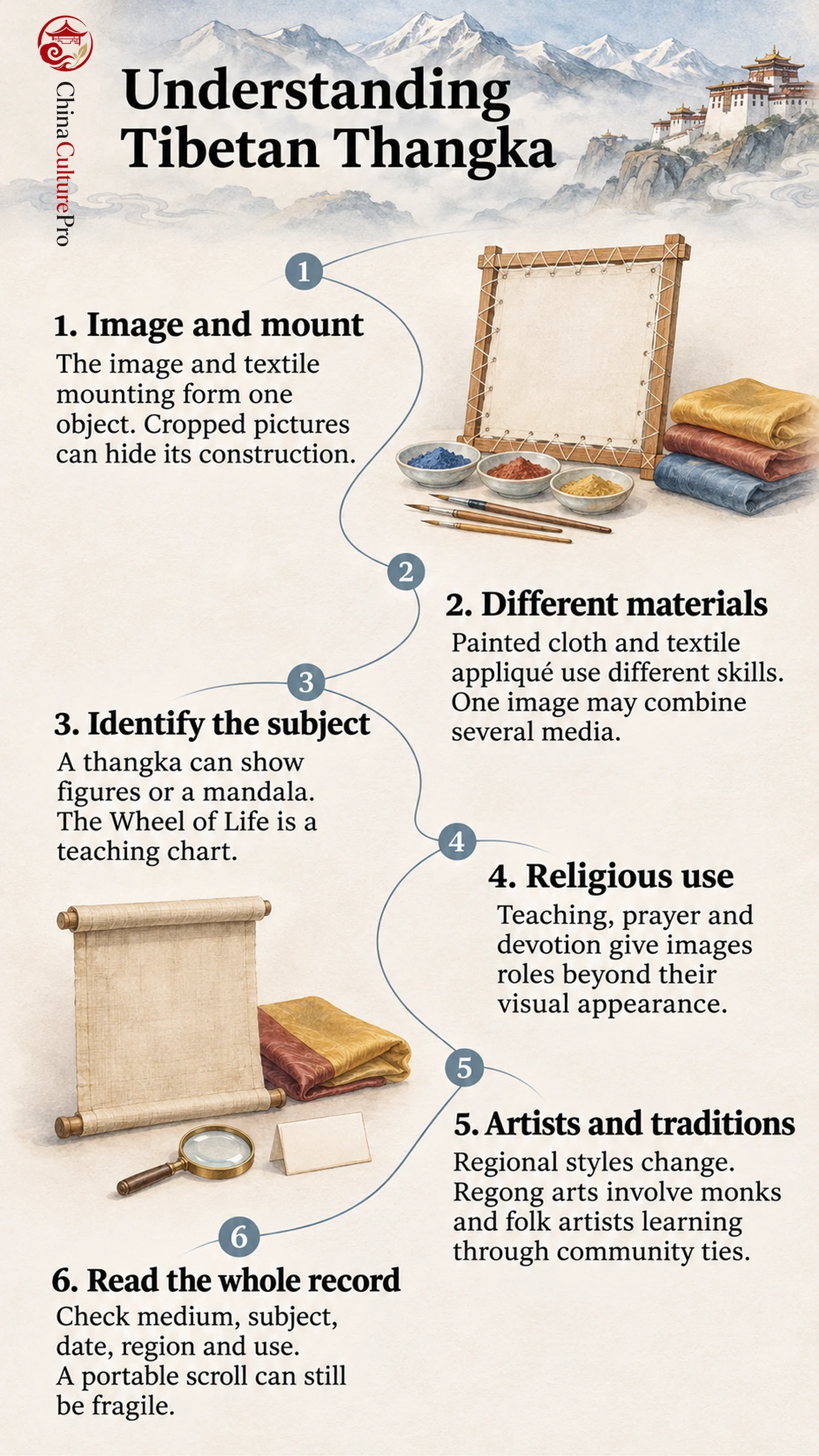
A thangka seen behind glass can look like a framed painting, yet its cloth borders and rolled-scroll construction tell a different story. It may have belonged in a household shrine, a monastery or another religious setting. Looking at the whole object connects image making and textile work with Tibetan religious and cultural life.
The Image and Its Textile Mount
A typical painted thangka combines an image on prepared cotton with a surrounding silk brocade mount. A wooden rod at the bottom helps the scroll hang flat and allows it to be rolled. Woven and appliquéd examples use the same broad hanging-scroll form while constructing the image through textile work.[1]
The mount is part of the religious object, rather than disposable packaging for the central picture. Traditional examples can include several textile sections, upper and lower stiff bars, a fine protective cover, cords and ribbons. Seeing only a cropped reproduction of the image can hide that structure.[2]
A useful description therefore separates the central image from its mounting while recording both. “Pigments on cotton” describes a painting surface; “silk brocade mount” identifies another component. Neither phrase by itself describes the complete object.
How Painted and Textile Thangkas Are Made
Painted thangkas require both image knowledge and material skill. Sacred figures follow systems of relative proportion, known as iconometry. Their attributes and colors also follow iconographic conventions, while backgrounds can allow more room for an artist’s interpretation.[3]
A documented painting sequence begins with cloth stretched on a frame and prepared with a smooth ground. Drawing establishes the composition before the application of colors, shading, fine outlines and selected gold details. The painted panel is subsequently stitched into its textile mounting. The making of the image and the making of the mount are related tasks, rather than a single painting operation.[3]
Textile thangkas build the image differently. An appliquéd figure can be assembled from shaped fabrics, with embroidery, attached cords and painted details adding further definition. A nineteenth-century Kurukulla example combines satin, brocade, damask, silk embroidery and small painted elements. “Textile thangka” therefore does not mean that every visible mark was woven or stitched.[4]
These processes explain why identifying a medium matters. A printed reproduction, an image painted on cloth and an appliquéd hanging can share a composition while being materially different objects.
Subjects and How to Read Them
Start with the identified subject, then look at the arrangement of figures and supporting scenes. Peaceful deities, wrathful deities and mandalas all appear in thangkas. Religious teachers can also connect an image with a particular tradition: portraits of Tsongkhapa, for example, are associated with the Gelug school. The complete composition provides more evidence than a single color or facial expression.[5]
| Subject type | What the image presents | Useful reading question |
|---|---|---|
| Peaceful religious figures | A deity or group of figures shown in a composed form | Which figure is named, and which attributes support that identification? |
| Wrathful religious figures | An intense, forceful form within religious iconography | How does the catalogue explain this form’s religious role? |
| Teachers and associated figures | A named teacher or figures connected with a teaching tradition | Which names or relationships does the label identify? |
| Mandala compositions | A specifically identified sacred arrangement | What is the named mandala, rather than simply its geometric shape? |
These are subject categories, not a set of painting styles. They also do not make every circular composition a mandala. The Wheel of Life is classified as a teaching chart of Buddhist cosmology; although it can look mandala-like, it is not itself a mandala.[6]
For a forceful-looking figure, the useful next step is its named identity and religious role. Facial expression alone does not provide that explanation.
Religious Settings and Uses
In religious teaching, an image can help explain the figures and ideas being discussed. A thangka can also provide a focus during a ceremony and a medium for prayer. These functions place it within an activity involving practitioners, rather than only on a wall for visual enjoyment.[7]
Other commissions have served as aids to meditation, acts of thanksgiving or expressions of hopes for long life and religious merit. Those purposes describe the beliefs and intentions surrounding the commission.[5]
Consecration adds another aspect to use. Some thangkas have ritual syllables on the reverse, and the religious importance of the object cannot be read only from its front. A painting’s creation, consecration and later display are different parts of its history.[2][3]
In a museum, the explanatory label may emphasize date, materials and artistic relationships. In a shrine, the same kind of image can have an active devotional role. The difference concerns setting and use; it does not require treating artistic skill and religious meaning as competing explanations.
Styles and Living Art Communities
Painting traditions changed through regional workshops, patrons and artistic exchange. In eighteenth-century New Gardri work from Kham, landscapes gained depth, figures became smaller relative to their settings, and compositions could leave more space open. Khamri combined rich Menri color with elements of Gardri composition and landscape. These are historical relationships among styles, not a rule that one hue identifies a school.[8]
Regong arts(热贡艺术,Règòng Yìshù)provide a further community context. In the Longwu River basin of Qinghai, Tibetan and Tu monks and folk artists practice thangka and mural painting alongside patchwork textile work and sculpture. Skills pass through family teaching and master-apprentice relationships. Regong arts were inscribed on UNESCO’s Representative List of the Intangible Cultural Heritage of Humanity in 2009.[9]
That inscription concerns a group of living art traditions. It is not a certificate for every object called a thangka, nor does it mean that only monks make them. The relationship between Regong arts and thangka painting is one of a regional artistic community within a wider tradition.
Looking Carefully at a Museum Thangka
Two documented works show why a label’s material description matters. A Chakrasamvara mandala dated approximately 1700–1800 is recorded as colors on cotton. A nineteenth-century Kurukulla hanging, by contrast, is primarily appliquéd textile with embroidery and painted details. Both are thangkas, but their surfaces were built differently.[4][5]
After identifying the subject and medium, note the date, regional attribution and any information about the mount or original use. Separate a catalogue’s firm identification from a qualified date or attribution. “Approximately” and “attributed to” are meaningful parts of an object record.
Portable also does not mean robust. Repeated rolling can strain a structure made from paint and several textile layers; brittle surfaces and worn fabrics can suffer damage. Conservation displays may present only part of that material history.[2]
Understanding living cultural heritage alongside museum objects keeps the maker’s skills and the object’s later care in view. The picture, its textile construction and its use each contribute evidence.
FAQs About Tibetan Thangka
Is every thangka a painting?
No. Painted examples are common, but woven, embroidered and appliquéd textile forms also exist. Read the medium rather than assuming from the hanging-scroll shape.
Is a thangka the same as a mandala?
No. Thangka names an object form; mandala identifies a kind of sacred composition. A thangka can depict a mandala or a different subject.
Are thangkas made only by monks?
No. Monks and lay artists participate in relevant art traditions, including the Regong arts. Training and community practice matter more than that assumption.
Is a museum thangka simply decorative art?
No. Museum display can foreground artistry, but the object may also have a history of religious commissioning, consecration and devotional use.
Sources
[1] Rubin Museum of Himalayan Art. Thangka
[2] Field Museum. Thangka Preservation
[3] Rubin Museum of Himalayan Art. Painting on Cloth
[4] Kristine Kamiya, Metropolitan Museum of Art. Rescuing the Goddess: Conservation of an Appliquéd Silk Tibetan Thangka
[5] Asian Art Museum. Tibetan Thangka Painting: Sacred Pictures
[6] Jeff Watt, Himalayan Art Resources. Wheel of Life Main Page
[7] National Museum of Ireland. Tibetan Buddhist Thangkas
[8] Rubin Museum of Himalayan Art. Eastern Tibetan Art
[9] UNESCO. Regong Arts