
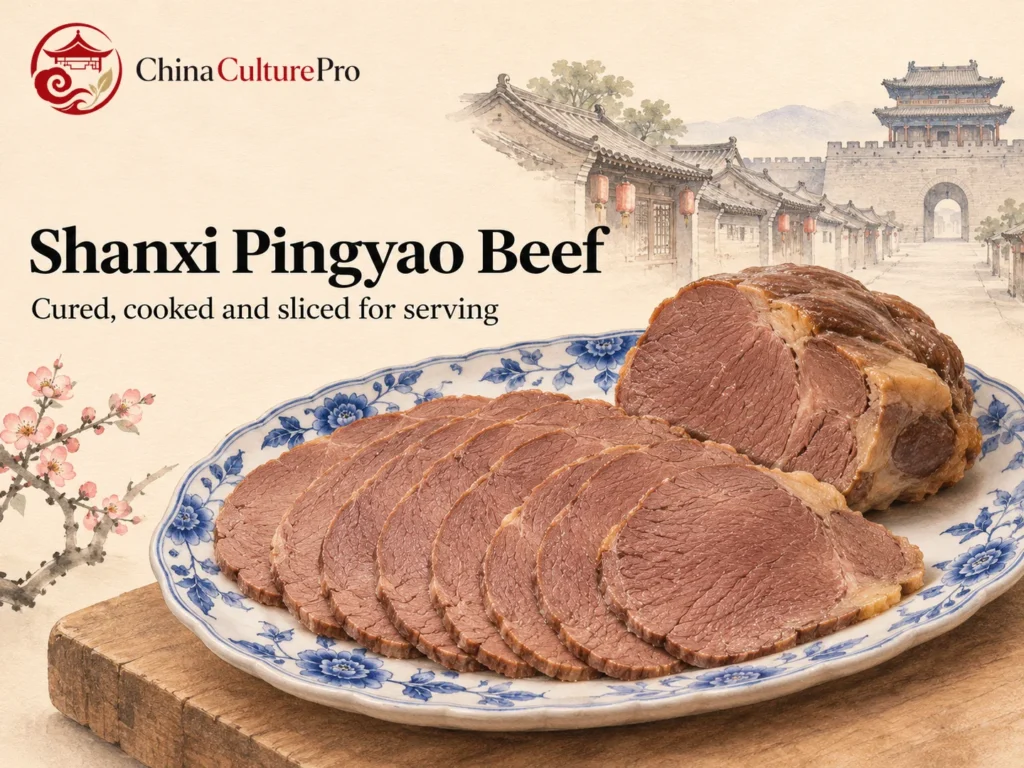

Quick Answer: What Is Pingyao Beef?
Pingyao beef (平遥牛肉, píng yáo niú ròu) is a regional cured-and-cooked beef specialty from Pingyao in Shanxi, known for a rose-colored cut surface, compact texture and tender bite.[1][3]
- Curing precedes the prolonged moist-cooking stage.[2]
- Beef and salt are central, while finished products have their own ingredient labels.
- Some packaged versions are sold ready to eat.[4]
This guide explains the production tradition and serving the finished beef; it is not a long-curing home recipe.

The appeal lies in a slice that holds together yet yields easily when eaten. Within Shanxi cuisine, it provides a meat-based counterpart to the province’s many flour foods.
Ingredients and the Texture to Expect
Characteristic features include beef flavor, slight saltiness, a deep rose-colored interior and closely knit meat. The defining flavor does not require a heavy spice mixture.[3]
Beef shank is one commercial cut choice, although a single product should not define every producer’s range.[4]
Read the actual label rather than interpreting a short traditional description as an additive-free promise. One documented modern method uses controlled salt and sodium nitrite in place of historical curing salt. That is a processing detail, not a dosage instruction or a claim that every packet has the same formula.[2]
How the Traditional Production Method Works
The process belongs to the wider history of Chinese salting and preservation, with cooking and finishing added to the curing stage.
- Select and divide: the beef is chosen and separated into suitable cuts.
- Cure: seasoning penetrates the prepared meat under controlled processing conditions.
- Cook: cured meat undergoes prolonged moist cooking, with heat managed through different stages.
- Trim and finish: cooked meat is drained, cooled, sorted and shaped for sale.[2]
Modern production may use brine injection, mechanical tumbling, controlled heating and specialized packaging.[2]
Pingyao within Shanxi Food Culture
The traditional processing skill appears in a national heritage listing published in 2008. Its development is linked to Pingyao’s workshops and commercial life, a useful connection to Chinese merchant culture and the broader culture of Shanxi.[1]
When comparing versions, look at the cut, seasoning, texture and intended storage. A freshly sliced cooked product and a sealed packet can share the regional name while requiring different handling. Packaging style alone does not tell you whether refrigeration is required.[6]
Slice, Serve and Store the Finished Beef
Start with beef clearly labelled cooked and ready to eat. For a simple tasting plate, choose a modest portion and keep the rest stored as directed.
- Check the package’s opening, serving and storage instructions. Follow any required heating step before serving.
- Use a clean board and knife. Slice across the visible grain; begin around 2–3 mm thick and adjust to the firmness of that cut.
- Arrange the slices without burying them in another sauce. Serve as a small plate alongside Shanxi wantuo or a meal featuring cat-ear noodles.
- Refrigerate opened leftovers promptly in shallow containers at 40°F/4°C or below, within two hours or one hour above 90°F/32°C. Use within three to four days, or sooner if the label requires; reheat leftovers to 165°F/74°C when serving hot.[5][6]
The slicing thickness is a serving suggestion, not a production standard. An unopened commercial packet’s labelled shelf life should never be transferred to opened slices or homemade cooked beef.
FAQs About Shanxi Pingyao Beef
Can it be eaten straight from the packet?
Only if that particular product is labelled ready to eat and has been stored as directed. A vacuum seal by itself does not establish readiness or shelf stability.[4][6]
Does the rose color mean the beef is rare?
No. Rose color is a described feature of the finished regional product. Check its cooked or ready-to-eat status rather than using color as a doneness test.[3]
Can I copy the long curing process at home?
A production account does not supply a validated household curing recipe. Safe replication needs a complete process specifying ingredients, exact curing measurements and temperature controls. Use a suitable established recipe if cooking raw beef; this guide’s serving procedure begins with finished cooked meat.
Sources
[1] China Intangible Cultural Heritage Digital Museum. 牛羊肉烹制技艺(冠云平遥牛肉传统加工技艺)
[2] Ministry of Commerce Digital Museum of Time-Honored Brands. 冠云
[3] China National Intellectual Property Administration. Pingyao Beef
[4] Shanxi Pingyao Beef Group, SIAL Paris exhibitor listing. Pingyao beef product description
[5] FoodSafety.gov. Leftovers: The Gift that Keeps on Giving
[6] USDA FSIS. Can I keep meat in vacuum packages at room temperature?