

Quick Answer: What Is Shangdang Bangzi?
Shangdang Bangzi (上党梆子, Shàngdǎng Bāngzi) is a form of Chinese opera from southeastern Shanxi. Bangzi singing makes up most of its repertory. The genre also preserves material from four other vocal traditions.[1][2]
- Place: Changzhi and Jincheng are two centers of the form.[1][2]
- Sound: Rhythmic patterns shape how a line moves and holds.[1]
- First viewing: A banquet in a Yang family story puts formal posture and singing to work together.[1][2][3]
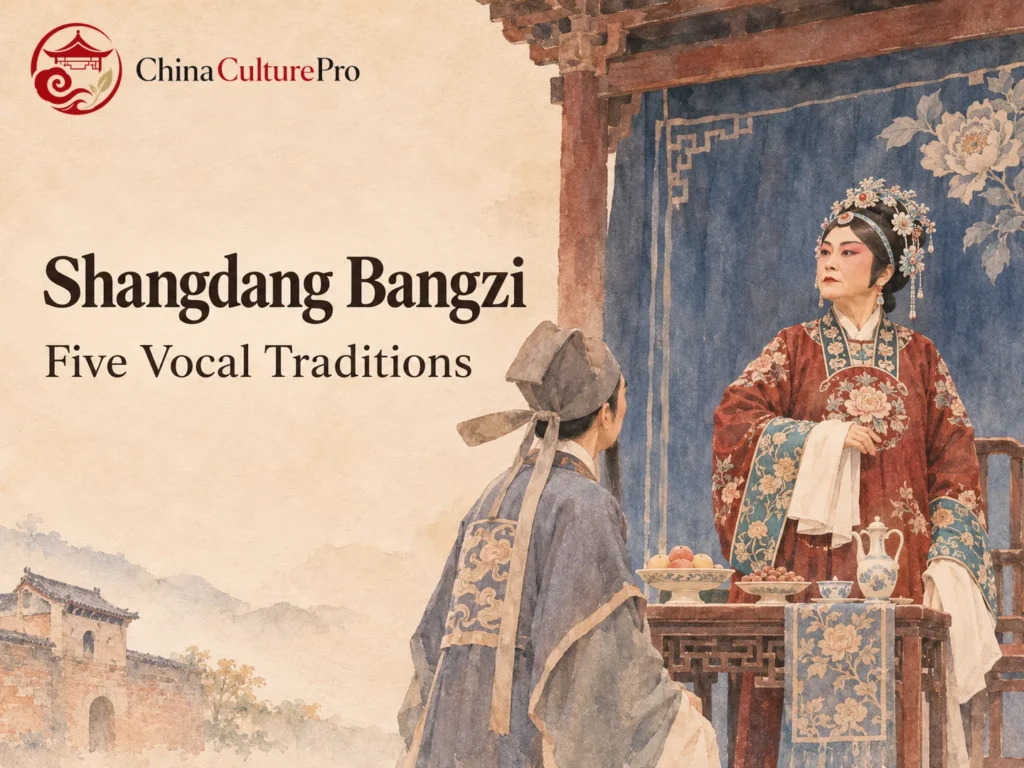
Start with the banquet scene and watch how the performers face one another when a family connection comes into the open.

When a matriarch recognizes a man at the opposing court, the banquet can no longer proceed as before. The actors still carry the formal posture of people attending a meeting between rulers.
A Theater of Southeastern Shanxi
The form developed in the historical Shangdang region of southeastern Shanxi. Heritage accounts describe established troupes in the Qing. When the genre was presented in Taiyuan in 1934, it went by the name Shangdang Gongdiao (上党宫调, Shàngdǎng Gōngdiào). The name Shangdang Bangzi was adopted at a provincial showcase in 1954.[1][2]
The national registry includes separate entries from Jincheng and Changzhi. The Changzhi account describes a company formed in 1994 that took performances to rural audiences, keeping a local base for the form.[1][2]
Why the Repertoire Has Five Vocal Traditions
The historical repertory combines five traditions, including bangzi, Kun opera, pihuang (皮黄, píhuáng), luoluo (罗罗, luóluó) and juanxi (卷戏, juǎnxì). Bangzi accounts for most of the traditional plays. Luoluo and juanxi are now seldom performed according to the Changzhi heritage account.[1][2]
Two characteristic rhythmic frameworks are daban (大板, dàbǎn) and siliu (四六, sìliù). Listen for the moment when a singer places particular weight on a syllable. A singer can hold one word across the beat or fit several syllables into the same space.[1]
How a Banquet Scene Carries the Drama
In Banquet at the Three Passes (三关排宴, Sān Guān Pái Yàn), the Yang family matriarch attends a meeting with the Liao court on behalf of the Song. She reveals that a man at the Liao court is a member of her family. A film adaptation followed in 1962, with writer Zhao Shuli involved in adapting the script.[3]
The heritage entry describes an erect bearing and rounded arm positions. At the banquet, watch how a performer turns from one addressee to another while keeping that formal shape. A guide to Chinese opera roles explains how the actors’ character types frame those choices. The heritage profile of Zhang Baoping (张保平, Zhāng Bǎopíng) lists the play among his representative works.[2][3][5]
FAQs About Shangdang Bangzi
Are all five vocal traditions equally common?
Bangzi is the principal tradition and accounts for most of the documented plays. The heritage records describe some of the other vocal traditions as rarely performed.[1][2]
Did later performers change the singing style?
Zhang Aizhen (张爱珍, Zhāng Àizhēn) studied with Wu Wanzhi (吴婉芝, Wú Wǎnzhī) and developed a more lyrical approach associated with her own name. Her work shows the range a singer can develop within this regional form.[4]
Sources
[1] China Intangible Cultural Heritage Network. Shangdang Bangzi in Jincheng
[2] China Intangible Cultural Heritage Network. Shangdang Bangzi in Changzhi
[3] Jincheng Municipal Government. A Classic Shangdang Play
[4] China Intangible Cultural Heritage Network. Zhang Aizhen
[5] China Intangible Cultural Heritage Network. Zhang Baoping