
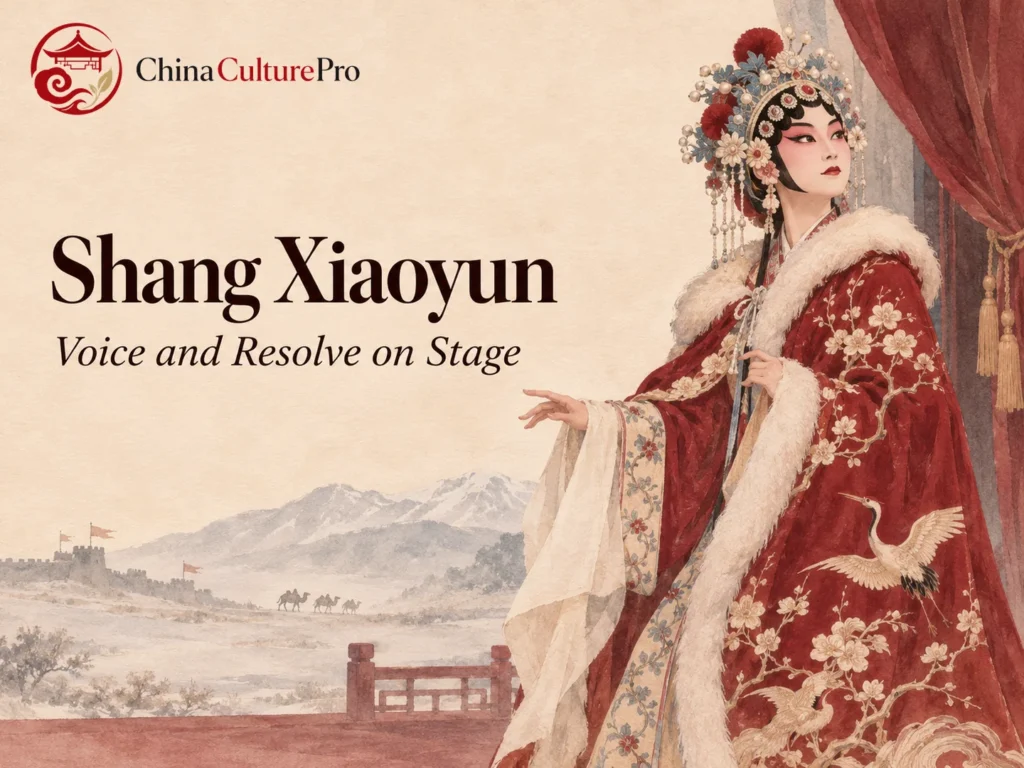

Quick Answer: Who Was Shang Xiaoyun?
Shang Xiaoyun (尚小云, Shàng Xiǎoyún, 1900–1976) was a Peking opera (京剧, Jīngjù) actor known for dan (旦, dàn), the female roles. The Shang school (尚派, Shàngpài) grew around his forceful singing and movement, with a repertoire passed down to other performers.[1][2][3]
- Voice: Listen for a bright high register and strong attacks on syllables.[2][3]
- Roles: His repertory includes travelers, heroines and figures from court stories.[2][3][5]
- First viewing: A CCTV archive excerpt credits Shang in the role of Wang Zhaojun.[4][5]
Start with that excerpt and listen for the places where the pitch rises in successive steps.

As Wang Zhaojun leaves for the frontier, the singing gives the departure its pace. Shang can make a syllable stand out and then carry that momentum into the next rise in pitch.
A Female-Role School Takes Shape
The female category in Chinese opera roles includes a variety of characters. The characters he played could call for very different movement, from a measured turn to a fast traveling step. His singing is described as bright and strong, with firmly articulated syllables and successive rises in pitch across a phrase.[1][2][3]
A 1927 newspaper selection named Shang alongside Mei Lanfang, Cheng Yanqiu and Xun Huisheng. Each became associated with a different performance school and repertoire.[1]
Listen to Wang Zhaojun’s Departure
CCTV preserves an excerpt of Wang Zhaojun Crosses the Frontier (昭君出塞, Zhāojūn Chū Sài) with Shang as Wang. Listen for how the line is carried up through successive pitches and how its words remain distinct. Then watch where a turn of the head or upper body picks up the musical phrase.[2][4][5]
The headpiece and garment also give a turn a visible outline. An introduction to Chinese opera costumes can help you read these details as part of the stage action.[3][4]
How the Style Passed to Other Performers
Shang helped fund training at the Rongchun Society (荣春社, Róngchūn Shè) by selling works from his art collection. Dance scholarship also records him teaching Korean dancer Choe Seung-hui a sliding step used in a rain scene. In the rain scene, a sliding step helps show someone moving to shelter.[6][7]
In CCTV’s Shang-school program, Sun Mingzhu (孙明珠, Sūn Míngzhū) performs Liang Hongyu (梁红玉, Liáng Hóngyù). Look at who is credited for each excerpt before comparing the two actors’ choices.[3][5]
FAQs About Shang Xiaoyun
Was Shang Xiaoyun one of the Four Great Dan performers?
Yes. The title recognizes four celebrated performers of the female roles in Peking opera. The Shang school is the lineage associated with his performances and repertoire.[1][2]
How can I tell whether a recording features Shang himself?
Read the cast and any separate sound and picture credits. In the excerpt from Thirteenth Sister in the special, CCTV credits Shang for the sound and Sun Mingzhu for the picture.[4][5]
Sources
[1] ChinaCulture.org. Four Famous Dan Actors
[2] People’s Daily Online. Shang Xiaoyun
[3] Huzhou Grand Theatre. Peking Opera Schools
[4] CCTV. Wang Zhaojun Crosses the Frontier
[5] CCTV. Shang School Special
[6] People’s Daily Online. Painting, Collecting and the Four Great Dan Performers
[7] Dance Research Journal. Crossing Over: Choe Seung-hui’s Pan-Asianism in Revolutionary Time