

Quick Answer: What Is Sanxingdui?
Sanxingdui (三星堆, Sānxīngduī) is a Bronze Age archaeological site in Sichuan. Its walls, buildings and eight pits document a major center associated with ancient Shu (古蜀, Gǔ Shǔ).[1][2]
- Place: A walled settlement on the plain northeast of present-day Chengdu.
- Finds: Bronze masks, a towering standing figure, branching bronze trees and deposits of gold, jade and ivory.
- Significance: Distinctive local art coexisted with regional exchange.[1][5]
The finds reveal more about objects and deposits than about named rulers or gods.
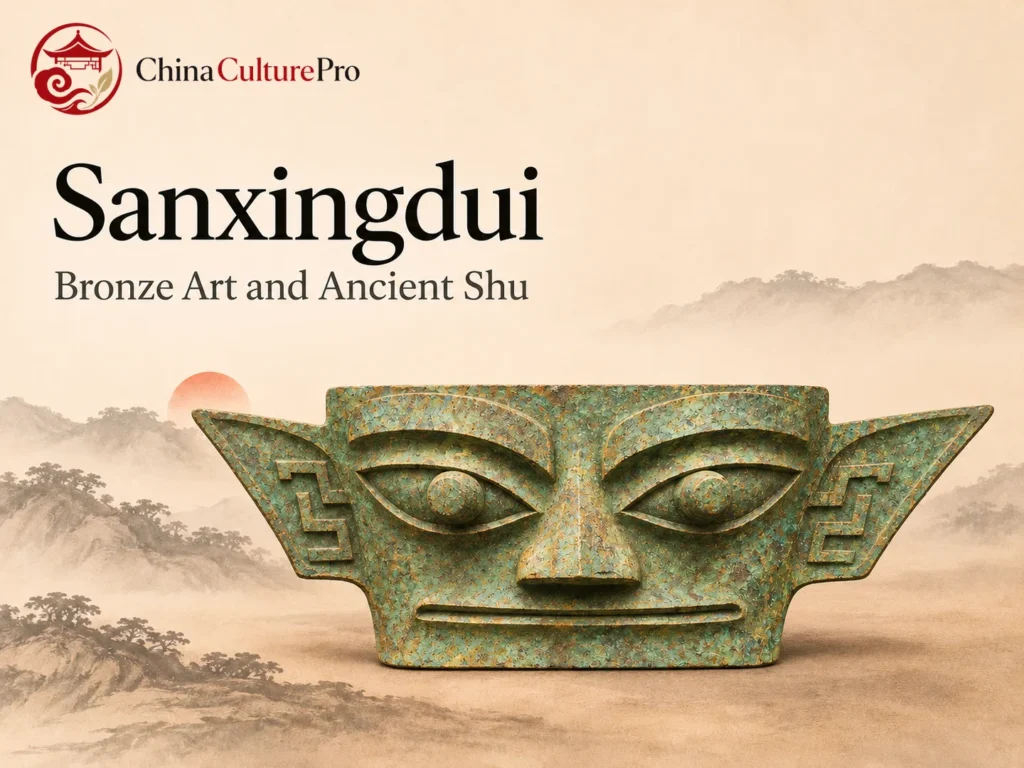
A giant mask attracts attention, but its size is only the first clue. How it was assembled, which objects lay around it and which layer contained it can tell different stories. At Sanxingdui, those distinctions help separate the history of a city from the interpretation of a remarkable deposit.
A Bronze Age City on the Chengdu Plain
Sanxingdui lies at Guanghan (广汉, Guǎnghàn), northeast of Chengdu in Sichuan. The archaeological area covers about 12 square kilometers on the Chengdu Plain (成都平原, Chéngdū Píngyuán). Its sequence spans roughly 2700–1000 BCE, from occupations that predate the mature bronze assemblages to the end of the site’s main archaeological sequence. That span is for the site as a whole. It does not assign one age to every object or establish that the city walls stood throughout the entire period.[1]
Excavations have examined wall segments, building foundations and a cemetery as well as the deposit area. Those contexts show an organized settlement in which people built, lived and buried their dead. The famous pits represent a specific part of that settlement. For the earlier communities behind such developments, see the guide to Chinese prehistory.[1][2]
The Eight Pits and How They Were Dated
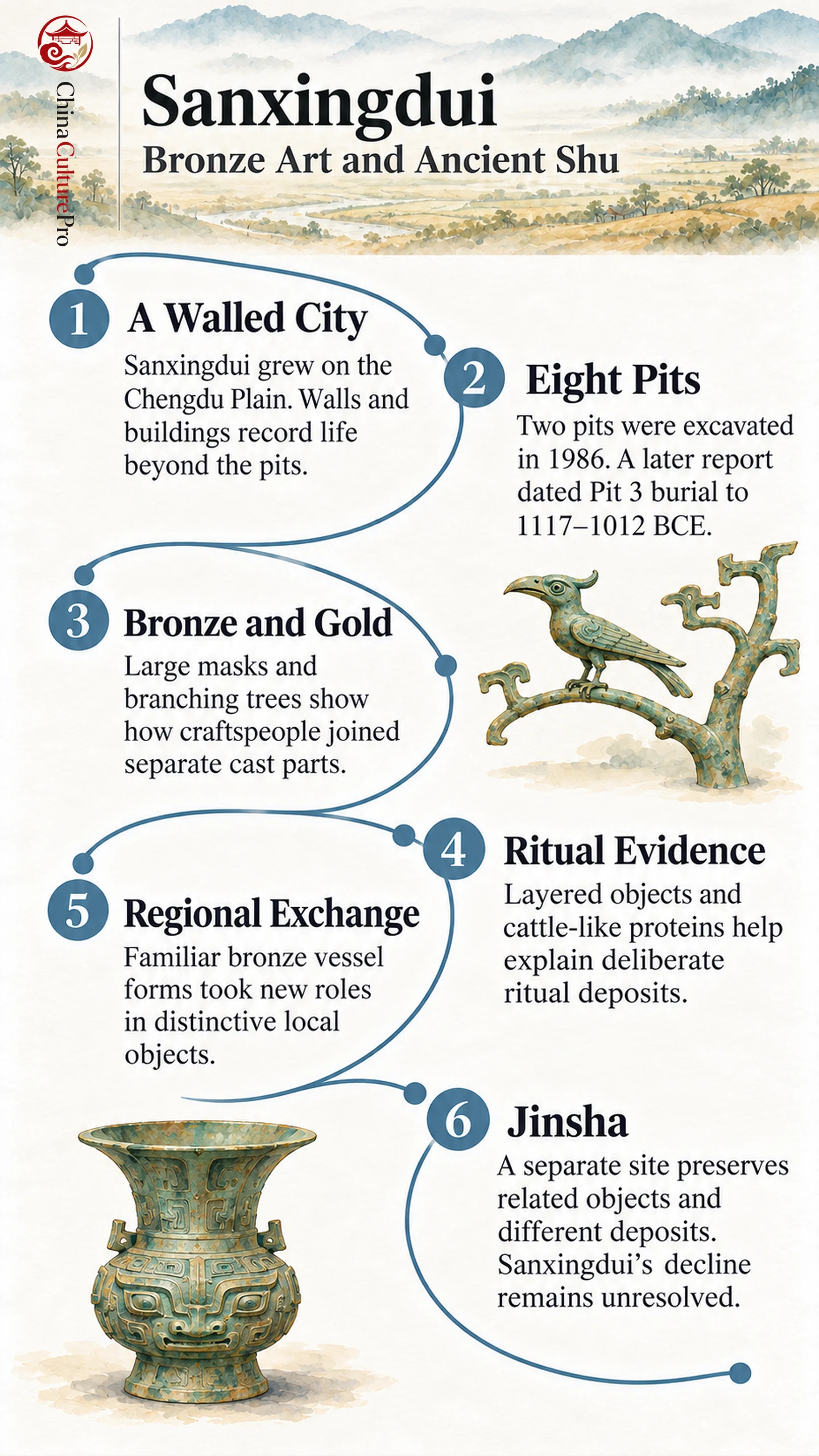
Jade and stone finds in the late 1920s drew attention to the site, and the first excavation took place in 1934. In 1986, workmen digging for clay exposed the deposits that led to excavation of Pits 1 and 2. Six further pits were discovered during investigations that began in 2019 and excavated in 2020–2022. The two campaigns transformed understanding of the site in different ways: the first revealed the scale of the bronzes, and the second allowed archaeologists to compare a wider range of deposits.[1][2][8]
Dating a pit takes more than identifying the style of its objects. The published excavation report for Pit 3 gives a 95.4% probability range of 1117–1012 BCE for its burial, broadly the late Shang (商, Shāng) period. It also documents fragments of the same objects in several pits, giving excavators another way to relate the deposits. The date range is for the burial of Pit 3. An object could already have been in use before it entered the ground.[10]
What the Bronzes and Gold Reveal
The bronze mask with protruding eyes (青铜纵目面具, qīngtóng zòngmù miànjù) from Pit 2 is about 138 centimeters wide. Projecting pupils and wide ears transform the face at a scale that goes far beyond ordinary headwear. It is a distinct object from the broad mask excavated in Pit 3. The latter preserves joins where separately cast components were riveted, and textile residue near an eye supplies a further clue to its history of use.[3][5]
The bronze standing figure (青铜大立人, qīngtóng dàlìrén) reaches about 2.62 meters including its base. The surviving hands leave room for an object, though the figure alone cannot establish what it held. The No. 1 Bronze Sacred Tree (青铜神树, qīngtóng shénshù) rises to about 3.96 meters in its reconstructed form. Its tiered branches carry birds, and its separately cast sections reveal how such a large form was assembled. The top is incomplete. The museum presents more than one interpretation of its imagery.[4][9]
Goldwork broadens that picture. A thin gold mask from Pit 3 has edges shaped to fit over another object. Researchers matched a mouth fragment from Pit 2 with a kneeling figure from Pit 3 and an animal-shaped base from Pit 8. The physical joins and matching forms link objects across excavation contexts, without settling the exact interval between deposits.[5]
What the Deposits Say About Ritual
Many objects show traces of breakage or burning before burial. In Pit 4, excavators found whole tusks over objects at the bottom, with a layer of ash above them. This physical sequence helps explain why excavators describe the features as sacrificial pits. The term identifies an archaeological interpretation of deliberate deposits. It does not give us a record of the ceremony, the people who conducted it or the identity of a recipient.[2][8][11]
Protein analysis adds evidence that does not survive as a recognizable object. A research team detected proteins from cattle-like animals in the bovid family in sampled pit deposits. The results support animal sacrifice alongside the deposition of bronzes, jade and ivory in the contexts studied. The samples cannot identify every animal used or show that the same ceremony took place at each pit.[6]
Ancient Shu, Regional Exchange and Jinsha
Sanxingdui is often described as a center of ancient Shu, whose early rulers appear in much later traditions. Its large masks and branching sculptures give it a distinctive visual identity. Other pieces connect it to a wider Bronze Age world. Some vessel forms resemble those known from the Shang period. A zun (尊, zūn), a type of bronze vessel, appears atop a kneeling figure in a reconstructed Sanxingdui ensemble. A familiar form could thus take a different role in a locally distinctive object. The guides to Shang bronze culture and Chinese bronze vessels give context for that comparison.[1][2][5]
Jinsha (金沙, Jīnshā), a separate site in present-day Chengdu, also yielded gold, bronze, jade and extensive ivory deposits. Its excavated ritual area accumulated offerings by a river channel over centuries, roughly 1200–650 BCE. Shared materials make the relationship worth studying. The overlapping dates and different deposition patterns make it difficult to reduce that relationship to an exact date when one city replaced the other.[7]
The pits provide a strong record of particular deposits and a partial record of the people who made them. They do not establish a single cause for the decline of Sanxingdui. That distinction matters to the broader study of early Chinese civilization, where evidence from several regions helps reconstruct developments that no one site can explain alone.[1][2][7]
FAQs About Sanxingdui
How old are the Sanxingdui bronzes?
Many of the best-known pieces belong broadly to the later second millennium BCE. Specific objects have different dates and a pit’s estimated deposition date can be later than the manufacture of its contents. The much longer span of occupation at Sanxingdui also includes earlier communities.[1][3][5]
Were the masks designed to be worn?
Some are very large. Perforations and construction details on certain pieces suggest attachment to supports or other objects. Archaeologists have proposed display settings, but the surviving evidence does not show exactly how every mask was mounted or used.[3][5]
Is Sanxingdui the same site as Jinsha?
They are separate sites in the Chengdu Plain region. Sanxingdui is at Guanghan, and Jinsha lies in present-day Chengdu. Similar materials suggest cultural connections, while their deposits have different settings and histories.[1][7]
Why did Sanxingdui decline?
The excavation evidence has not established one cause. Jinsha helps show that related practices continued in the region, but a change in where archaeologists find large deposits does not by itself identify a disaster, the movement of a court or the fate of the whole population.[1][2][7]
Sources
[1] Antiquity. New Discoveries at the Sanxingdui Bronze Age Site in South-West China
[2] Harvard University. Re-excavating and Reexamining Ritual Artifacts from the Sanxingdui Site
[3] Shanghai University Museum. Bronze Mask with Protruding Eyes
[4] Sanxingdui Museum. No. 1 Bronze Sacred Tree
[5] Hong Kong Palace Museum. Gazing at Sanxingdui: New Archaeological Discoveries in Sichuan
[6] University of Cambridge Repository. Protein Evidence for Animal Sacrifice and Shared Ritual Practices in Bronze Age Sanxingdui
[7] Jinsha Site Museum. The Sacrificial Remains of Jinsha
[8] The Metropolitan Museum of Art. Treasures from a Lost Civilization: Ancient Chinese Art from Sichuan
[9] National Science Review. New Archeological Marvels of Ancient Shu Civilization
[10] Sichuan Provincial Institute of Cultural Relics and Archaeology. Excavation Report on Sanxingdui Pit 3
[11] Sichuan Provincial Institute of Cultural Relics and Archaeology. Excavation Report on Sanxingdui Pit 4