
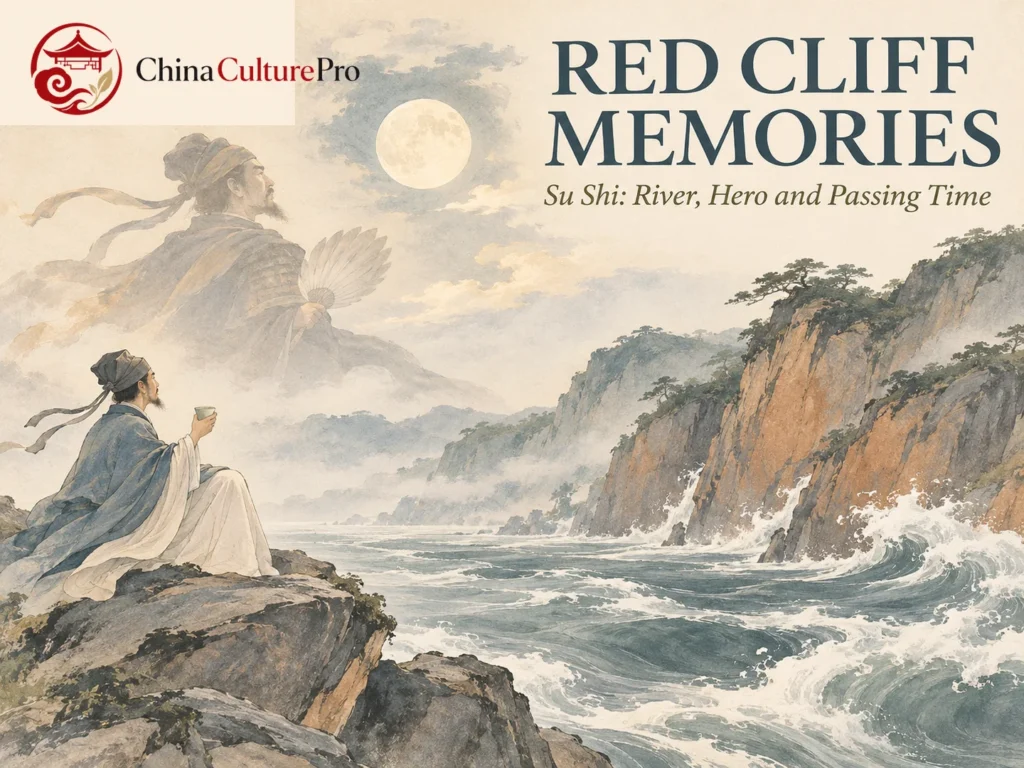

Quick Answer: What Is Red Cliff Memories About?
Red Cliff Memories (念奴嬌·赤壁懷古, Niànnújiāo · Chìbì Huáigǔ) by Su Shi (蘇軾, Sū Shì) is a ci (詞, cí) lyric that turns a river landscape into reflection on historical glory and the speaker’s passing years.[1]
- Opening: Water seems to sweep the great figures of earlier ages away.
- Central figure: Zhou Yu (周瑜, Zhōu Yú) appears in an idealized vision of youthful command.
- Ending: The speaker notices his graying hair and pours wine in an offering toward the moon over the river.
Its historical scene is imagined through poetry; its final gesture leaves room for both sorrow and release.
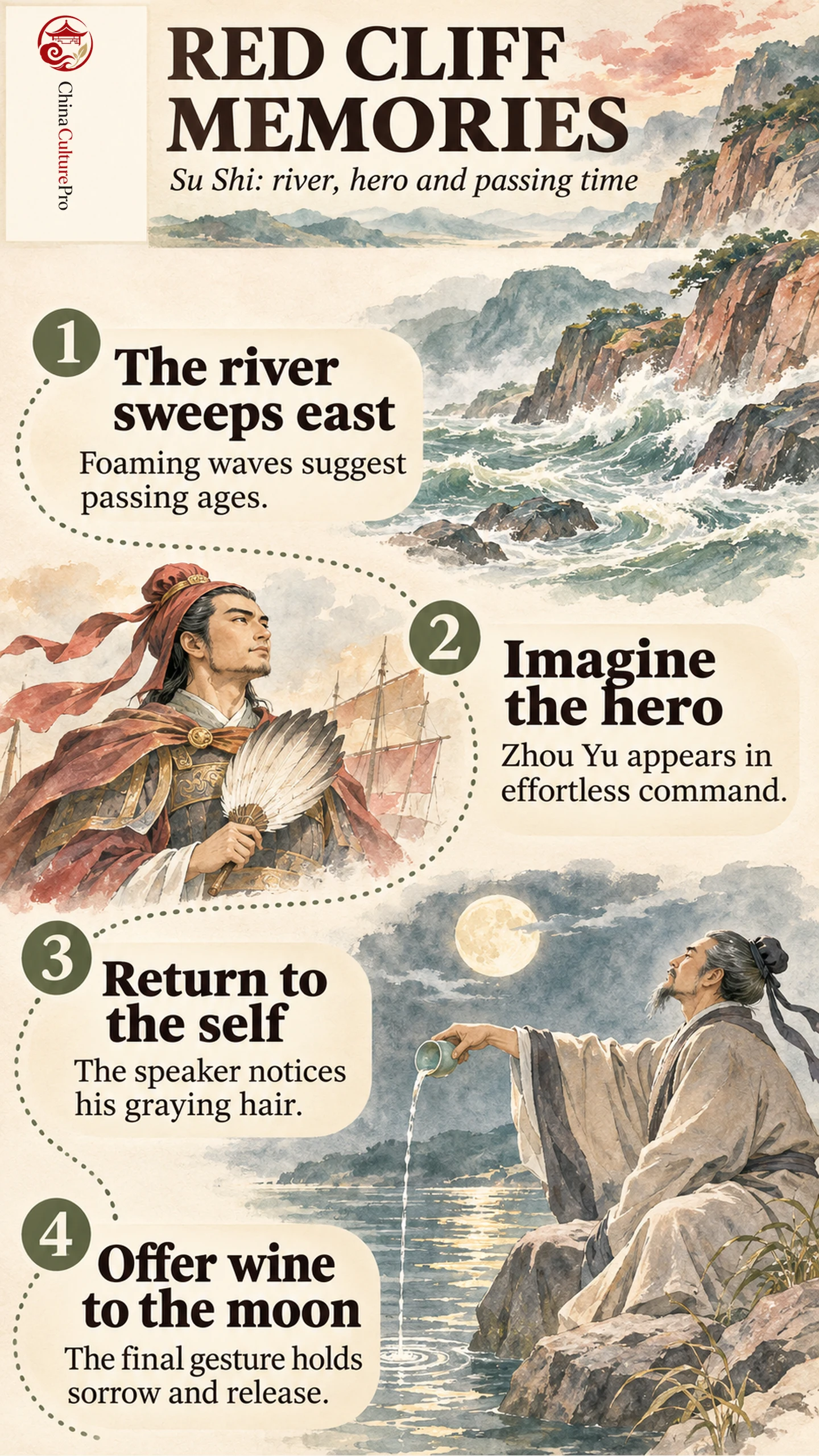
The river makes human achievement seem brief; the remembered commander makes the watching poet feel old. This lyric moves between those two scales before returning to a cup of wine and the moon. Following its changes of viewpoint is more useful than treating it as a battlefield chronicle.
The Complete Ci and an English Sense Translation
Niannujiao (念奴嬌, Niànnújiāo) names the tune pattern; “remembering the past at Red Cliff” names this lyric’s subject. The Song ci tradition uses patterned phrases of unequal lengths. This complete text has 100 Chinese characters, excluding punctuation: 49 in the first stanza and 51 in the second.[1][2]
The text below follows the reading with 檣櫓, “masts and sculls,” and 人生, “human life.” The English is an original sense translation; each row groups several rhythmic phrases.[1]
| Chinese text | English sense translation |
|---|---|
| 大江東去,浪淘盡、千古風流人物。 | The great river flows east; its waves sweep away the outstanding figures of a thousand ages. |
| 故壘西邊,人道是、三國周郎赤壁。 | West of the old ramparts, people say, is the Red Cliff of Young Master Zhou (周郎, Zhōu láng) from the Three Kingdoms (三國, Sānguó). |
| 亂石穿空,驚濤拍岸,捲起千堆雪。 | Jagged rocks pierce the sky; towering waves beat the shore, rolling up a thousand heaps of snow. |
| 江山如畫,一時多少豪傑! | River and mountains are like a painting—how many heroes belonged to that time! |
| 遙想公瑾當年,小喬初嫁了,雄姿英發。 | I picture Gongjin (公瑾, Gōngjǐn) in those days: Xiao Qiao (小喬, Xiǎo Qiáo) newly his bride, his bearing splendid, his spirit bright. |
| 羽扇綸巾,談笑間,檣櫓灰飛煙滅。 | With feather fan and silken headscarf, amid easy talk and laughter, he saw the masts and sculls turn to flying ash and vanishing smoke. |
| 故國神遊,多情應笑我,早生華髮。 | My mind wanders through that old battlefield; I should be laughed at for such deep feeling, my hair already turning gray. |
| 人生如夢,一尊還酹江月。 | Human life is like a dream; with a cup of wine I make an offering to the moon over the river. |
Huangzhou, the Battle and the Imagined Hero
The lyric dates to 1082, during Su Shi’s demotion at Huangzhou (黃州, Huángzhōu). “People say” matters: the speaker invokes a place associated with the old battle without supplying proof that he stands on its exact historical site.[2][4]
The Battle of Red Cliffs occurred in 208. Zhou Yu was a leading commander on the victorious southern side. Gongjin is his courtesy name, while Young Master Zhou is another designation for him; the lyric is not introducing three different heroes.[3]
Xiao Qiao was Zhou Yu’s wife. The historical biography places their marriage years before the battle, before the death of his patron in 200. The lyric compresses the young husband and successful commander into one radiant image. “Newly his bride” should therefore be read as poetic presentation, not a claim that their wedding immediately preceded the fighting.[3][4]
The fan, headscarf, conversation and laughter make victory look effortless. They characterize the lyric’s Zhou Yu; they are not an eyewitness record of his clothing or proof that the actual campaign needed no difficult decisions.
From the Sweeping River to the Graying Speaker
The opening does two things at once. The river’s eastward movement gives the scene immense energy, while “sweep away” makes even exceptional people vulnerable to time. Historical greatness is admired from the first sentence, yet its disappearance is already present.[1]
The white “snow” is the foam thrown up by waves, not a report of winter weather. Rocks reaching upward and water striking the shore create a forceful setting before the imagined commander appears. The scenery is active: it gives the remembered achievement a scale worthy of admiration.
Then the viewpoint contracts. Ages become a single hero; the hero gives way to the speaker’s own prematurely gray hair. Zhou Yu’s ease and brilliance sharpen the speaker’s awareness of his condition. This is why a reading limited to patriotic celebration misses the turn inward.
The movement also differs from Du Mu’s Red Cliff, which pivots on a historical “what if.” Su Shi builds his contrast between the admired past and the present consciousness looking back at it.
The Dream and the Offering to the Moon
“Human life is like a dream” follows the speaker’s self-directed embarrassment. The scale widens again: his disappointments belong to the same passing world as the hero’s victories. That thought can loosen the comparison without erasing the emotion that produced it.[1]
The decisive final verb is 酹, lèi: to pour wine as an offering. The cup gives the reflection a physical action. He makes a gesture toward the moon over the river.[2]
The ending supports a mixed response. The speaker has not announced that achievement is worthless, and the poem does not require a completely cheerful resolution. Admiration, self-awareness and a momentary easing of personal grievance can remain together.
How to Follow the Lyric’s Changes of Scale
- Begin with time: Read the flowing river alongside the disappearance of people across the ages.
- Identify the hero: Connect Zhou Yu, Young Master Zhou and Gongjin before interpreting the newlywed image.
- Locate the inward turn: Notice the change from the commander’s brilliance to the speaker’s graying hair.
- Read the last action: Keep the poured offering in view when deciding what the dream comparison does to the earlier sorrow.
FAQs About Red Cliff Memories by Su Shi
Is the feather fan a reference to Zhuge Liang?
Here it belongs to the portrait of Zhou Yu. Popular associations of the fan with another strategist should not replace the person identified by the surrounding lines.
Why do some editions have different Chinese words?
The lyric has textual variants. This guide uses 檣櫓, “masts and sculls,” and 人生, “human life”; another transmitted reading has 人間, “the human world.” A translation should match its declared Chinese reading rather than silently combine them.[5]
Is this the same work as Red Cliff Rhapsody?
No. Red Cliff Rhapsody (赤壁賦, Chìbì Fù) is a separate prose rhapsody associated with Su Shi’s Huangzhou writing. This work is a ci lyric to the Niannujiao pattern, with its own complete 100-character text.[6]
Sources
[1] Su Shi. Niannujiao: Red Cliff Memories in Yuxuan Lidai Shiyu, volume 70
[2] Hong Kong Education Bureau. Recommended Classical Chinese Passages for Senior Secondary Students, Niannujiao section
[3] Chen Shou, with annotations by Pei Songzhi. Records of the Three Kingdoms, volume 54, biography of Zhou Yu
[4] Yao Caiqing. A Majestic and Unrestrained Masterwork, in Zhejiang Normal University Training Newsletter, issue 3, 2010
[5] Chinese Wikisource. Niannujiao by Su Shi, transmitted versions
[6] Su Shi. First Red Cliff Rhapsody