


Quick Answer: What Is Qiong Opera?
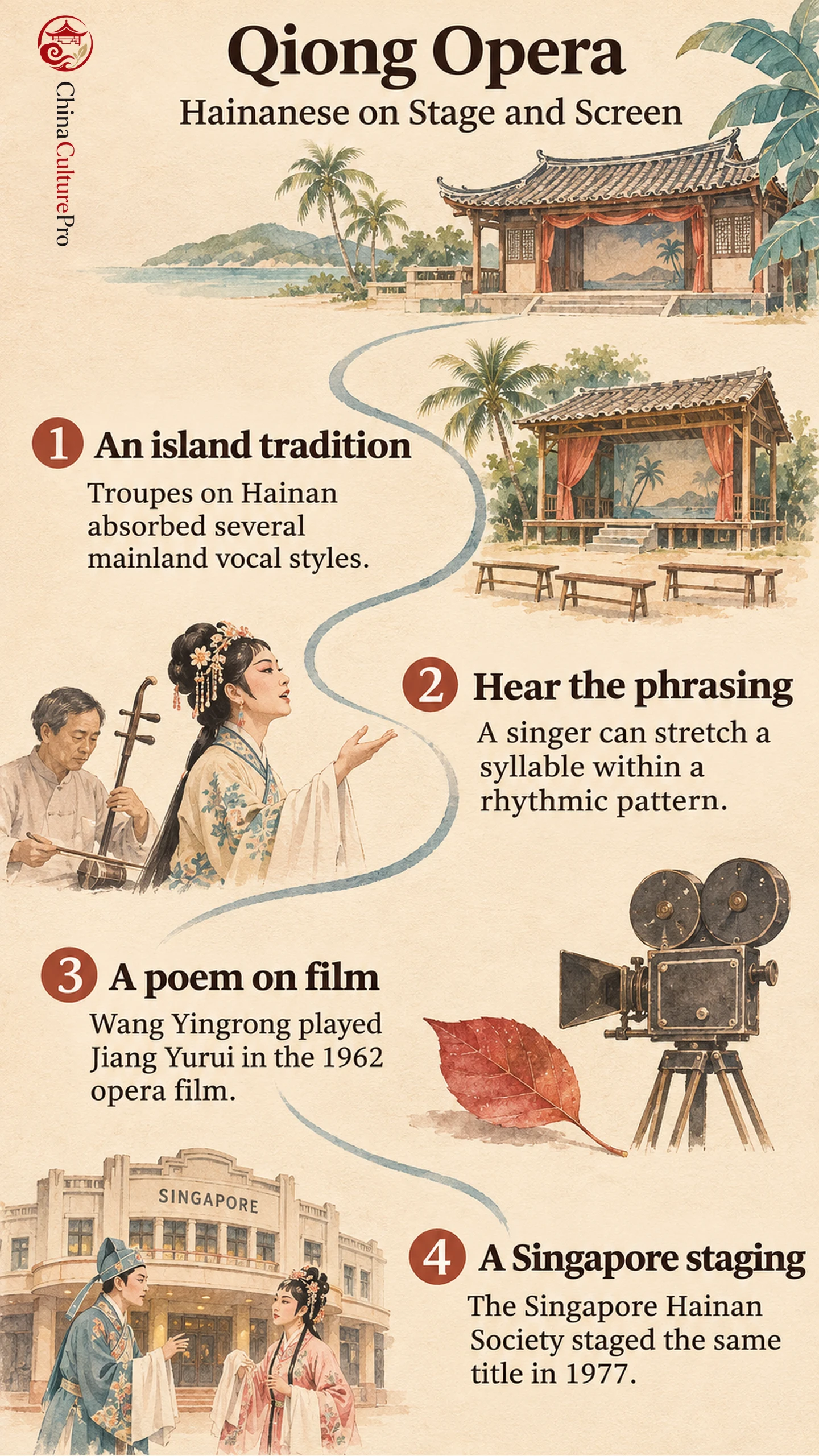
Qiong opera (琼剧, Qióngjù) is a form of Chinese opera from Hainan. Its performers sing in Hainanese (海南话, Hǎinánhuà), shaping local speech within established melodic and rhythmic patterns.[1][2]
- Place: The form developed on the island and spread with Hainanese communities.[1][2][5]
- Sound: Listen for how a voice lengthens words as a scene moves from dialogue into song.[1][2]
- First viewing: An opera film from 1962 gives a documented performance to start with.[3][4]
Follow the story of a poem written on a leaf through its island film and Singapore stage versions.
A poem written on a leaf brings two people into each other’s lives. That simple device held its place as the story moved between stages and a film camera.
How Hainan Developed Its Own Stage Form
In the nineteenth century, troupes on Hainan absorbed vocal styles from the mainland into local theater. The national listing describes further changes as troupes brought acting and singing for civil and martial plays into larger companies.[1][2]
The national heritage entry records a written use of the name Qiongju in 1936. The form was already in use under local names, including names that associated it with Hainan or Qiongzhou.[1][2]
What to Listen For in the Singing
The singing is mainly organized around banqiang (板腔, bǎnqiāng), a way of organizing the melody and rhythm so the same musical material can fit different lines and scenes. A singer can fit a short phrase close to the pulse or give a syllable room to stretch. Listen for that change as a reply becomes a song.[1][2]
A single genre can carry court stories, family drama and scenes of conflict. The guide to Chinese opera roles explains how performers in the larger theater tradition distinguish characters through voices and movement.[1][2]
A Red Leaf on Stage and Screen
In Poem on a Red Leaf (红叶题诗, Hóngyè Tíshī), a poem brings two people into contact. Wang Yingrong (王英蓉, Wáng Yīngróng) played Jiang Yurui in the 1962 opera film. The Hainan provincial troupe restaged the work in 2021.[3][4]
The Singapore Hainan Society staged the same title in 1977. An account of local theater also records Zhang Wenxiu (张文秀, Zhāng Wénxiù) in Singapore’s amusement parks in the 1940s. Wang played a role in that work in Hainan in the 1950s. Local casts and associations sustained their own productions in Singapore. The Singapore Hainan Society also trained performers and invited teachers from Hainan.[3][5]
FAQs About Qiong Opera
Are Qiong opera and Hainanese opera the same?
The names commonly refer to the same stage tradition. Qiongju represents the Chinese name in pinyin. Hainanese opera is common in accounts of performances outside the island.[1][2][5]
Does a familiar opera title tell me which language I will hear?
Check the genre and troupe in the program. A title such as Butterfly Lovers can appear on a program for more than one regional form. A Qiong opera production uses the Hainanese stage tradition to tell the story.[1][5]
Sources
[1] China Intangible Cultural Heritage Network. Qiong Opera
[2] Hainan Provincial Government. Qiongju Opera
[3] China Intangible Cultural Heritage Network. Wang Yingrong
[4] People’s Daily Online. Poem on a Red Leaf Returns to the Stage
[5] Singapore Chinese Cultural Centre. Hainanese Opera in Singapore