


Quick Answer: What Does a Peacock Mean in Chinese Art?
Peafowl (孔雀, kǒngquè) can appear in Chinese art as finely observed garden birds, in decorative pairings with flowers or as official emblems. A peacock with peonies can evoke honor and prosperity. A peacock on a Qing civil badge could identify a grade.[1][2][3]
- Bird. The male’s long train has rows of eyespots.[4]
- Flowers. Peonies can add a wish for honor and prosperity.[2]
- Object. A vase, painting or coat badge gives the image a different job.[1][2][3][5]
A crest or long train can appear in both real and mythical bird imagery.
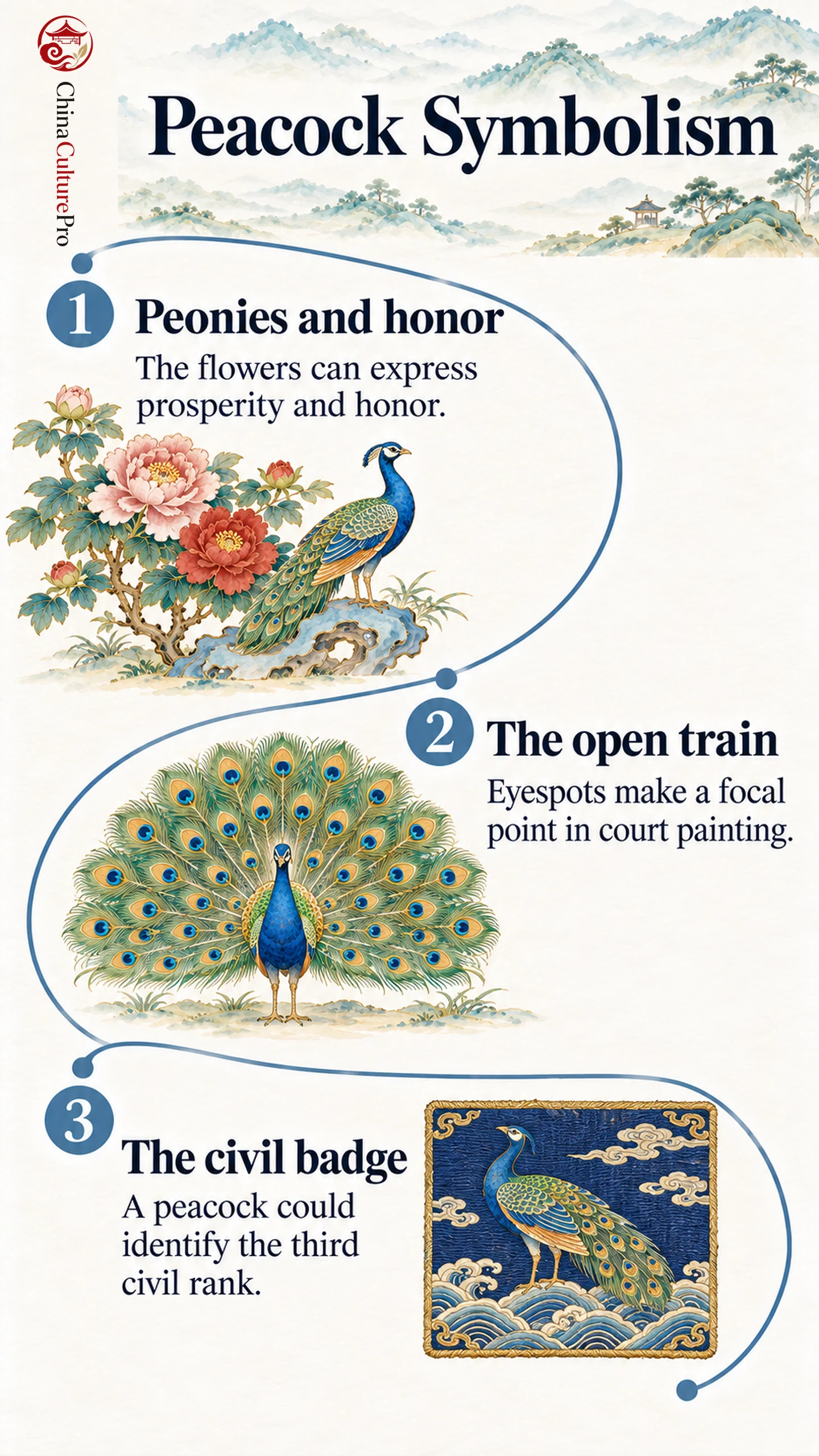
One Yuan painter placed a quiet peahen beside flowers, while Qing court artists made a peacock’s open train the subject of large compositions. The examples show how differently the same kind of bird can occupy a picture.[1][6]
The Peacock, the Peahen and Their Flowers
Bian Lu’s fourteenth-century silk scroll Peahen and Hibiscus shows a standing bird beside flowering branches and a rock. The peahen’s calmer profile and the finely drawn plants encourage close looking. Hibiscus is part of the catalogue’s identification of this particular painting.[1]
On a Jiajing-period porcelain ewer, colored enamels and gold carry the peacock and peony pairing around a vessel. A probably sixteenth-century embroidered badge likewise includes peacocks and peonies. There the blossoms express prosperity and honor, alongside a fungus associated with long life.[2][5]
What a Spread Train Does in a Court Painting
The male peacock fans its long display feathers to court a peahen. The eye-shaped markings make the open train look patterned even when the bird is seen from a distance. A painter can build a whole composition around the moment the feathers spread.[4][6]
A study of Qing workshop records identifies several large peacock-display paintings ordered by the Qianlong emperor. One recorded composition describes two birds, including one with its train open frontally, with magnolia, peonies and rocks nearby. The frontal view lets the train’s eyespots fill a broad area among the garden plants.[6]
How Object Type Changes the Peacock’s Role
An eighteenth-century Qing badge with a peacock corresponded to the third civil rank. On one surviving example, peacock-feather thread forms part of the tail and crest. A real feather could also be worn behind the hat. Peacock feathers and Qing court rank explains why the plume and the embroidered badge were separate features of dress.[3][7]
In Dai peacock dance, the bird’s actions are carried into movement. Gestures can evoke bathing, grooming or spreading the tail. That performance tradition gives the bird a different setting from a court portrait or rank badge.[8]
FAQs About Peacock Symbolism in Chinese Art
Can Chinese art show a peahen without a spread train?
Yes. Bian Lu’s Yuan painting presents a peahen in profile. The open fan of colored eyespots is a male display and does not identify all peafowl imagery.[1][4]
Is a peacock the same bird as a Chinese phoenix?
A peacock is a real bird. A Chinese phoenix is a mythical one that may borrow features such as a crest or an elaborate tail. Object titles, feathers and surrounding imagery can help distinguish them.[2][4][9]
Sources
[1] The Metropolitan Museum of Art. Bian Lu, Peahen and Hibiscus
[2] Smithsonian National Museum of Asian Art. Badge with Peacocks and Peonies
[3] The Metropolitan Museum of Art. Rank Badge with Peacock
[4] Smithsonian National Museum of Asian Art. Peacock
[5] The Metropolitan Museum of Art. Ewer with Peacock and Peonies
[6] Palace Museum. Research on Qing palace paintings of peacocks displaying their trains
[7] Palace Museum. Jadeite plume tube
[8] ChinaCulture. Peacock Dance
[9] National Palace Museum. Study of the Song embroidery of the five relationships