

Quick Answer: Who Was Liu Xiu?
Liu Xiu (刘秀, Liú Xiù; 5 BCE–57 CE), known as Emperor Guangwu (光武帝, Guāngwǔ Dì), founded the Eastern Han (东汉, Dōng Hàn). He claimed the throne in 25 CE and ruled until 57, restoring imperial authority to the Han ruling family after a period of upheaval.[4]
- Rise: A member of a branch of the imperial family became a rebel commander before establishing his own regime.
- Capital: His government was centered east of the earlier Han capital.
- Consolidation: Major rivals remained after his accession; the decisive western victory came in 36.[1][2]
His accession and the military consolidation of his rule were separate developments, rather than a single event.
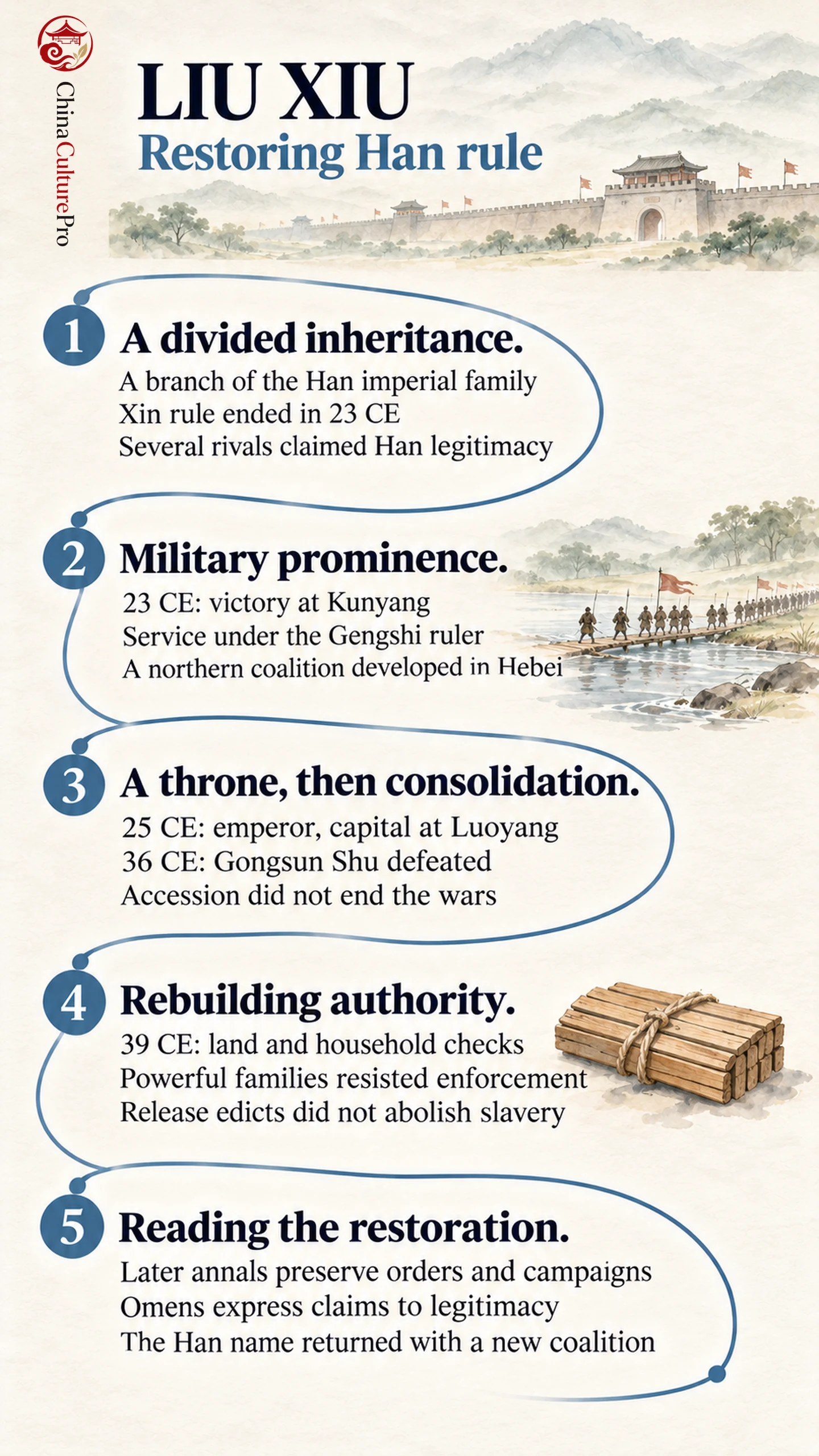
Liu Xiu’s importance lies in how a broken dynasty became a functioning imperial government again. Following his rise requires separating a famous battlefield victory from his accession, and both from the slower work of defeating rivals and rebuilding political authority.
Han Ancestry and the Collapse of Wang Mang’s Rule
Liu Xiu belonged to a collateral branch of the Han imperial clan, with family connections in the Nanyang region. The biographical account describes farming and study before rebellion. Royal ancestry gave him a claim to legitimacy, but did not give him an army or secure the throne.[1]
Wang Mang (王莽, Wáng Mǎng) had displaced Han rule and established the Xin (新, Xīn) regime, conventionally dated 9–23 CE. Its collapse produced competing armies and political centers. Restoring the Han dynasty was therefore a shared slogan among rivals, rather than Liu Xiu’s exclusive project.[1][4]
In 23 the rebels elevated another imperial clansman as the Gengshi Emperor (更始帝, Gēngshǐ Dì). Liu Xiu initially served that regime. His early military successes therefore preceded his own claim to sovereignty.[1]
Kunyang and the Road to the Throne
At Kunyang (昆阳, Kūnyáng) in 23 CE, Liu Xiu helped defeat a major army sent by Wang Mang. The annals describe him organizing resistance, obtaining reinforcements and coordinating his attack with forces inside the besieged city.[1]
Victory enhanced his standing but also left him vulnerable within the rebel leadership. His elder brother was executed on the Gengshi ruler’s orders. The biography portrays Liu Xiu responding cautiously, rather than immediately declaring a rival court.[1]
Later that year, insurgents killed Wang Mang in the capital. Liu Xiu was not the person who struck the fatal blow. Xin’s fall opened a struggle among competing claimants; it did not immediately place Liu Xiu on the throne.[1]
Sent north on the Gengshi government’s behalf, he developed an independent base in Hebei (河北, Héběi). Local officials, allied commanders and powerful families helped turn a temporary commission into a durable political following.[1][3]
From Accession in 25 to Consolidation in 36
Liu Xiu became emperor in 25 and established his capital at Luoyang (洛阳, Luòyáng). His court claimed Han continuity while confronting other rulers who controlled substantial territories. A capital and imperial title did not immediately bring those regions under his authority.[1]
| Date | Development | Why it matters |
|---|---|---|
| 23 CE | Victory at Kunyang | Liu Xiu gained military prominence while serving another rebel ruler. |
| 25 CE | Accession and Luoyang capital | He established an imperial government with its own claim to Han legitimacy. |
| 36 CE | Defeat of the western rival regime | A major remaining obstacle to consolidation was removed. |
The western rival was Gongsun Shu (公孙述, Gōngsūn Shù), whose regime controlled Sichuan. Campaigns against him required sustained operations; the annals record the deaths of important Han commanders before the final advance on Chengdu. Gongsun Shu was wounded in battle and died in 36.[2]
The record also describes violence against Chengdu and the defeated ruler’s family after the victory. Consolidation was coercive as well as administrative. The date 36 marks a major political turning point, rather than proof that every frontier problem or form of resistance had ended.[2]
Rebuilding Government and Managing Powerful Families
Reconstruction meant adapting government to a population damaged by war. An edict recorded for 30 CE ordered reductions in unnecessary offices and the merging of counties unable to sustain separate administrations. The court sought a workable administrative structure, rather than simply restoring every prewar position.[2]
The land and household registration initiative called dutian (度田, dùtián), launched in 39, illustrates a harder problem. The government needed reliable taxable land and population records, but influential families possessed private armed followers. Officials concealed or distorted information, while enforcement could fall heavily on ordinary cultivators.[3]
Punishing officials and combining suppression with accommodation did not eliminate those families’ power. The same regional networks that had helped Liu Xiu win also constrained his government. Rebuilding the tax base required negotiation with allies as well as commands from the throne.[3]
His reign also produced measures concerning enslaved people. Recorded edicts limited privileges for those who killed or branded them, and released specified groups, including some people enslaved during wartime. These were consequential interventions within the existing social order, not a universal abolition of slavery.[2]
Historical Evidence and the Meaning of Restoration
The Book of Later Han (后汉书, Hòu Hànshū), compiled centuries after Liu Xiu’s lifetime, preserves a detailed account of his rise and reign. It includes administrative orders and campaign narratives, but also speeches, auspicious signs and judgments explaining why he deserved imperial power.[1][2]
Those elements require different readings. An accession notice or dated edict supports a political chronology. Stories of unusual light at his birth or signs predicting his sovereignty reveal a language of dynastic legitimacy; they do not independently establish supernatural intervention. The distinction between historical evidence and legend is particularly useful here.[2]
“Restoration” describes the return of rule to the Liu imperial family and the revival of the Han dynastic name. It does not mean that the intervening wars left institutions, ruling coalitions or the capital unchanged. The new government depended on a different alignment of regional power.[3][4]
Liu Xiu died in 57. His lasting achievement was a durable imperial reconstruction after fragmentation. The evidence also preserves its costs and compromises, allowing his political success to be assessed without treating an admiring historical narrative as a complete description of everyone’s experience.[2]
FAQs About Liu Xiu
Was Liu Xiu the same person as Emperor Guangwu?
Yes. Liu Xiu was his personal name; Guangwu is the imperial title by which he is conventionally remembered. Both names refer to the ruler who reigned from 25 to 57 CE.[4]
Why is Eastern Han called a restoration?
The ruling family and dynastic name returned after the Xin interruption. Continuity of that claim coexisted with a different capital and a new political coalition.[1][4]
Did Liu Xiu abolish slavery?
No. His edicts protected or freed particular categories of enslaved people. They did not abolish the institution throughout the empire.[2]
Sources
[1] Fan Ye and later commentators. Book of Later Han, Chapter 1, Part One: Emperor Guangwu
[2] Fan Ye and later commentators. Book of Later Han, Chapter 1, Part Two: Emperor Guangwu
[3] Chen Chengjun, National Museum of China. Private Armies That Became Difficult to Control
[4] David Knechtges, Cambridge University Press. From the Eastern Han through the Western Jin: chapter summary