

Quick Answer: Who Was Li Jing?
Li Jing (李靖, Lǐ Jìng; 571–649) was an early Tang commander whose campaigns helped consolidate the dynasty in southern China and expand its power on the northern and northwestern frontiers. He also held senior civil offices and became an influential name in Chinese military writing.[1][6]
- Southern service: Helped defeat rival regimes using river routes and coordinated forces.
- Frontier campaigns: Led major operations on the northern and northwestern frontiers.
- Legacy: Received imperial honors and became associated with a later military classic.[1][2]
The historical commander’s career and later texts or fictional stories about him belong to different kinds of evidence.
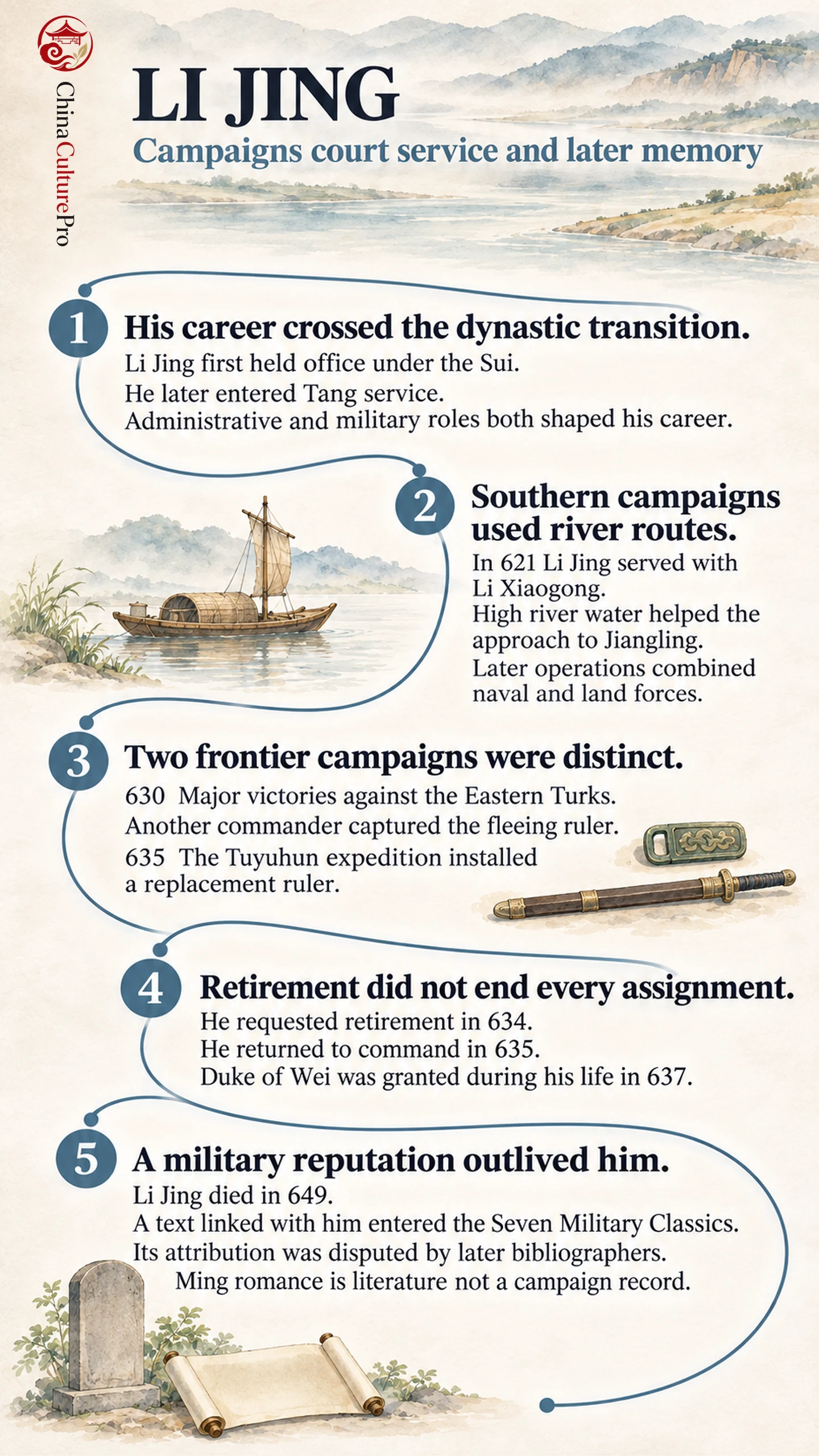
Li Jing’s reputation rests on more than dramatic cavalry victories. His career includes river warfare, court appointments, retirement and renewed command. A useful biography follows these changes while distinguishing the surviving historical narrative from a disputed military dialogue and later romantic storytelling.
From Sui Official to Tang Commander
The biographies place him at Sanyuan in present-day Shaanxi. The earliest of the two standard Tang histories calls his earlier name Yaoshi (药师, Yàoshī). He first served the Sui dynasty, holding administrative posts before the political upheavals that brought the Tang to power.[1]
His transition was not presented as effortless loyalty to the new ruling house. The biography describes suspicion, threatened punishment and eventual employment by the Tang leadership. Its reported conversations dramatize that change, but should not be treated as independently recorded speeches.[1]
This early administrative background helps explain a career that combined campaigning with government. He did not begin as a sovereign or establish a separate dynasty: his later authority came through service to the Tang court.
Southern Campaigns and the Use of River Routes
Li Jing’s southern record is central to understanding the early Tang empire. He worked with the imperial prince Li Xiaogong (李孝恭, Lǐ Xiàogōng), whose command combined royal authority with the general’s operational experience.[1]
In 621 they attacked the regime of Xiao Xian (萧铣, Xiāo Xiǎn), centered at Jiangling. The biography emphasizes advancing during high river water, when opponents expected delay. This was a calculated use of transport and timing, not simply a cavalry charge transplanted to southern terrain.[1]
Their later campaign against Fu Gongshi (辅公祏, Fǔ Gōngshí), who rebelled in 623, involved confronting both naval and land defenses before taking the political center. These accounts show coordination among commanders and the importance of controlling river approaches.[1]
The biography also attributes to Li Jing advice against seizing defeated opponents’ families and property as rewards for the troops after Xiao Xian’s surrender. It presents restraint as a way to encourage further submission. That is a claim about the narrative’s strategy of consolidation, rather than proof that conquest was painless.[1]
The Eastern Turks in 630 and Tuyuhun in 635
Under Tang Taizong (唐太宗, Táng Tàizōng), Li Jing’s most prominent northern operations occurred in a different setting of mobile frontier armies. The following campaigns should be kept distinct.[1]
| Date | Opponent or theater | Biographical significance |
|---|---|---|
| 621 | Xiao Xian’s regime in the Yangtze region | River operations helped consolidate Tang control in the south. |
| 630 | Eastern Turk Khaganate | Major victories disrupted its ruling center and ended Illig Qaghan’s rule. |
| 635 | Tuyuhun (吐谷浑, Tǔyùhún) in the northwest | A long-distance campaign combined pursuit with the installation of a new ruler. |
The 630 campaign included advances against Dingxiang and the ruler’s camp near the Yin Mountains. Li Jing’s attack was decisive, but the biography credits another commander with capturing Illig Qaghan after he fled. Attributing the entire outcome to Li Jing personally erases the wider command structure.[1]
The expedition against Tuyuhun followed in 635. The army faced difficult movement and forage conditions, pressed forward and supported a replacement ruler. Victory did not mean that the region or all its later political problems disappeared. These campaigns belong within Taizong’s imperial policies as well as Li Jing’s individual career.[1]
Court Service, Retirement and Imperial Honors
Li Jing held ministerial office as well as field command. After the northern victories, he faced criticism concerning military discipline before receiving further favor. The biography’s account of accusations and imperial reassurance reveals how battlefield success still required acceptance at court.[1]
He requested retirement because of illness in 634, but returned to lead the Tuyuhun expedition the next year. Retirement from regular office did not make him permanently unavailable for an exceptional assignment. In 637 he became Duke of Wei (卫国公, Wèi Guógōng), an honor granted during his lifetime.[1]
He was among the meritorious figures whose portraits were ordered for Lingyan Pavilion (凌烟阁, Língyān Gé) in 643. He died in 649 and was buried in the Zhaoling (昭陵, Zhāolíng) imperial cemetery. These honors show his place in the court’s commemoration of its founding generation.[1]
Historical Records, Military Texts and Later Stories
The Old Book of Tang (旧唐书, Jiù Tángshū) provides an extended biography, compiled centuries after his life. A commemorative stele now preserved in Zhaoling Museum offers another kind of record, linking his memory with funerary inscription and calligraphy. Neither type of evidence is a private diary.[1][4]
The military work Li Weigong Wendui (李卫公问对, Lǐ Wèigōng Wènduì), commonly translated as Questions and Replies, presents discussions between Taizong and Li Jing. It became one of the Seven Military Classics (武经七书, Wǔjīng Qīshū), established as official military learning in the Northern Song. Its educational importance does not authenticate every conversation.[2]
Medieval bibliographers already questioned its attribution and discussed whether later writers had assembled or supplemented the text. Those disagreements warrant caution: association with Li Jing is not proof of a surviving manuscript he personally wrote or a verbatim dialogue.[3]
Later literature developed another image. The Ming drama Hongfu Ji (红拂记, Hóngfú Jì) joins romance with the story of Tang state-building. Recognizing its literary form preserves a distinction between historical records and later storytelling, while allowing both to matter to Li Jing’s cultural legacy.[5]
FAQs About Li Jing
Was Li Jing a Tang emperor?
No. He was a commander and senior official serving the dynasty. His title Duke of Wei was an aristocratic honor, not an imperial reign title.[1]
Did Li Jing personally capture the Eastern Turk ruler?
The biography credits him with major victories, but says another commander captured Illig Qaghan after the ruler fled. Campaign leadership and personal capture are different claims.[1]
Are the Questions and Replies a verified transcript?
No surviving evidence establishes the text as a verbatim record. Its attribution was debated by later bibliographers, even though it became an influential military classic.[2][3]
Sources
[1] Liu Xu and other compilers. Old Book of Tang, Chapter 67: Li Jing
[2] National Library of China, National Museum of Classic Books. The Seven Military Classics
[3] Ma Duanlin. Comprehensive Examination of Documents, Chapter 221: Military Books
[4] Zhang Qiyue, Shaanxi Daily. Li Jing Stele: Both Form and Spirit, Strength and Gentleness
[5] National Library of China Publishing House. Li Zhuowu’s Commentary on Hongfu Ji, facsimile edition
[6] David K. Jordan, University of California San Diego. The Military Canon