


Quick Answer: Who Was the Jiajing Emperor?
The Jiajing Emperor (嘉靖帝, Jiājìng Dì; 1507–1567) was a Ming ruler who took the throne in 1521. His reign is remembered for a dispute over his parents’ ritual status, extensive Daoist patronage and military pressure on the northern frontier and coast.[2][3][5]
- Succession: Entered the main imperial line from a princely branch of the family.
- Authority: Used ritual decisions and appointments to assert his position.
- Court culture: Supported Daoist ceremonies, religious texts and imperial objects associated with longevity.[2][4][5][6]
His accession in 1521 and the Jiajing era’s beginning in 1522 are different dates. Museum labels often use the era years 1522–1566.[2][5][6]
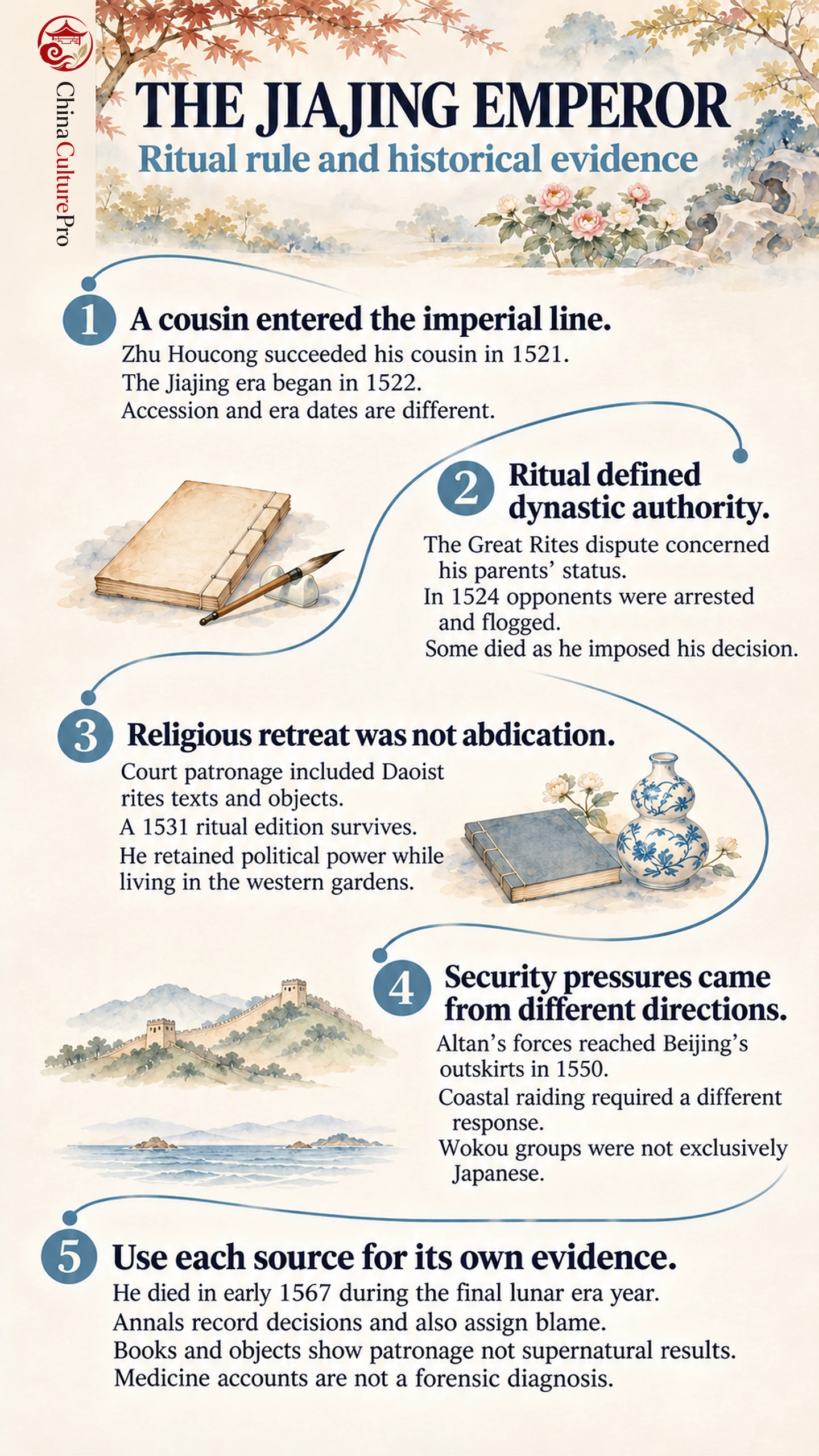
Jiajing is often pictured as a secluded emperor absorbed in the search for long life. His biography also involves contested succession, coercive court politics and repeated security crises. These strands explain more than a judgment based only on his religious interests or palace stories.
A Princely Cousin’s Accession in 1521
His personal name was Zhu Houcong (朱厚熜, Zhū Hòucōng). Born in the princely establishment at Anlu, in the area of modern Zhongxiang in Hubei, he was a cousin of the Zhengde Emperor (正德帝, Zhèngdé Dì), who died without a son in 1521.[1]
He arrived in Beijing as the selected successor from a collateral branch of the Ming imperial family. Even his entry ceremony became contentious: he insisted that he was succeeding to the throne, rather than arriving simply in the position of an imperial heir awaiting accession.[2]
The early government reversed several practices of the previous reign, reduced irregular appointments and issued remissions. These initial decisions complicate a biography focused entirely on the later emperor’s religious retreat.[2]
Why the Great Rites Controversy Mattered
The Great Rites Controversy (大礼议, Dà Lǐ Yì) concerned how the new emperor’s biological parents should be honored within the imperial lineage. Many officials wanted him ritually incorporated into the preceding senior line, calling the previous emperor’s father his imperial father. He insisted on preserving his own father’s paternal status.[2]
This was more than a disagreement over affectionate names. Ancestral ritual defined relationships within the ruling house, and those relationships supported the legitimacy of succession. The dispute therefore involved who could interpret ritual precedent and determine the emperor’s place in the dynasty.
By 1524 the struggle had become coercive. Officials protesting at the palace were arrested and flogged; some died. The emperor secured the recognition he sought, but did so by overriding and punishing substantial opposition. That outcome demonstrates both his success in asserting authority and its human cost.[2]
Daoist Patronage and Rule from the Western Gardens
Jiajing sponsored Daoist specialists, religious ceremonies and publications. A ritual scripture re-engraved in 1531 and preserved in the National Palace Museum provides a concrete example of court-sponsored religious printing. His patronage included prayers connected with imperial heirs and protection as well as longevity.[4][5]
He survived an assassination attempt by palace women in 1542. His later residence was centered in the western gardens, Xiyuan (西苑, Xīyuàn), rather than the main inner palace. The attack and his withdrawal feature prominently in later accounts, but their dramatic details should not substitute for evidence about government.[1]
Reduced public access did not mean he surrendered the throne’s powers. A historical narrative describes him retaining control and reading memorials late at night even during his religious retreat. Senior ministers such as Yan Song (严嵩, Yán Sōng) exercised influence through imperial favor; their position still depended on the emperor.[4]
Material evidence adds another dimension. A Jiajing-period imperial jar at the Metropolitan Museum combines dragons with a stylized longevity character. It connects blue-and-white porcelain with religious and imperial imagery, without proving that this particular vessel held medicine or belonged to his personal daily routine.[6]
Northern Raids and Coastal Warfare
In 1550, forces of the Mongol leader Altan reached the outskirts of Beijing after breaking through the northern defenses. The court mobilized troops and punished officials following the crisis. This exposed weaknesses close to the imperial center, rather than a threat confined to distant border garrisons.[3]
The coast posed a different problem. Records describe attacks in Zhejiang and neighboring maritime regions by groups labeled wokou (倭寇, wōkòu). The label did not describe a force made up exclusively of Japanese participants. The historical account also describes Chinese organizers, illicit trade and alliances across maritime boundaries.[3][7]
Northern defense and coastal security required different deployments and regional officials. Their simultaneous demands help explain the pressure on government resources. Reducing these conflicts to one minister’s corruption or the emperor’s religious interests leaves their geography and military organization unexplained.
Reading His Death and Historical Legacy
Jiajing died in early 1567 by the Gregorian calendar, during the final lunar year of his era, conventionally labeled 1566. The History of Ming (明史, Míngshǐ) records his final illness and return to the main palace. Shizong (世宗, Shìzōng) was the temple name used after his death.[3][5]
| Evidence | What it helps establish | Limit |
|---|---|---|
| Court annals and historical narratives | Appointments, disputes, military emergencies and reported decisions. | Praise, blame and recorded speeches reflect authors’ choices. |
| Surviving ritual books | Court sponsorship and circulation of religious texts. | A text does not verify the supernatural results sought through it. |
| Imperial-period objects | Workshop production, imagery and patronage. | An object is not a diary of its ruler’s personal use. |
Accounts of longevity medicines are evidence about practices and contemporary criticism. They do not by themselves supply a modern forensic determination of his cause of death. Likewise, the official history’s criticism of religious expenditure should be identified as an appraisal, not adopted as the sole explanation of the reign.[3][4]
His legacy is therefore both political and cultural: an emperor who imposed his interpretation of dynastic legitimacy, maintained personal power and left a substantial record of patronage. The distinction between historical evidence and later storytelling keeps those achievements and the costs of his rule open to assessment.
FAQs About the Jiajing Emperor
Was Jiajing his personal name?
No. His personal name was Zhu Houcong. Jiajing was the reign title, while Shizong was his posthumous temple name.[1][3]
Why do museum labels give the dates 1522–1566?
They generally identify the Jiajing era. He acceded in 1521, the era began in 1522, and its final lunar year extended into early 1567.[2][3][5][6]
Did Jiajing stop governing altogether?
No. Although he withdrew from many public court activities, accounts still describe him controlling appointments and reviewing memorials. Seclusion and abdication are different things.[4]
Sources
[1] The Palace Museum. The Jiajing Emperor
[2] Zhang Tingyu and other compilers. History of Ming, Chapter 17: Shizong, Part One
[3] History of Ming compilers. History of Ming, Chapter 18: Shizong, Part Two
[4] Gu Yingtai. Events of Ming History in Their Entirety, Chapter 52: Shizong’s Patronage of Daoism
[5] National Palace Museum, Taipei. Spiritual Reflection: Rare Books from the Ming and Qing Imperial Libraries
[6] The Metropolitan Museum of Art. Jar with Dragon and Stylized Character for Longevity
[7] History of Ming compilers. History of Ming, Chapter 322: Japan