


Quick Answer: How Do You Say I Love You in Chinese?
The direct Mandarin expression is 我爱你 (traditional: 我愛你, wǒ ài nǐ), “I love you.” A reciprocal reply is 我也爱你 (wǒ yě ài nǐ), “I love you too.” [1]
- A declaration: Say that you love someone when that is the feeling you mean to express.
- Different meanings: Liking someone, missing them and addressing them affectionately each do a different job.
- The relationship: Choose wording with the actual person and situation in mind.
- A text code: 520 can stand for the declaration through conventional sound-based wordplay. [6]
These are Mandarin readings. They do not provide the pronunciation of the same written characters in every Chinese language, or a rule for how every Chinese person expresses affection.
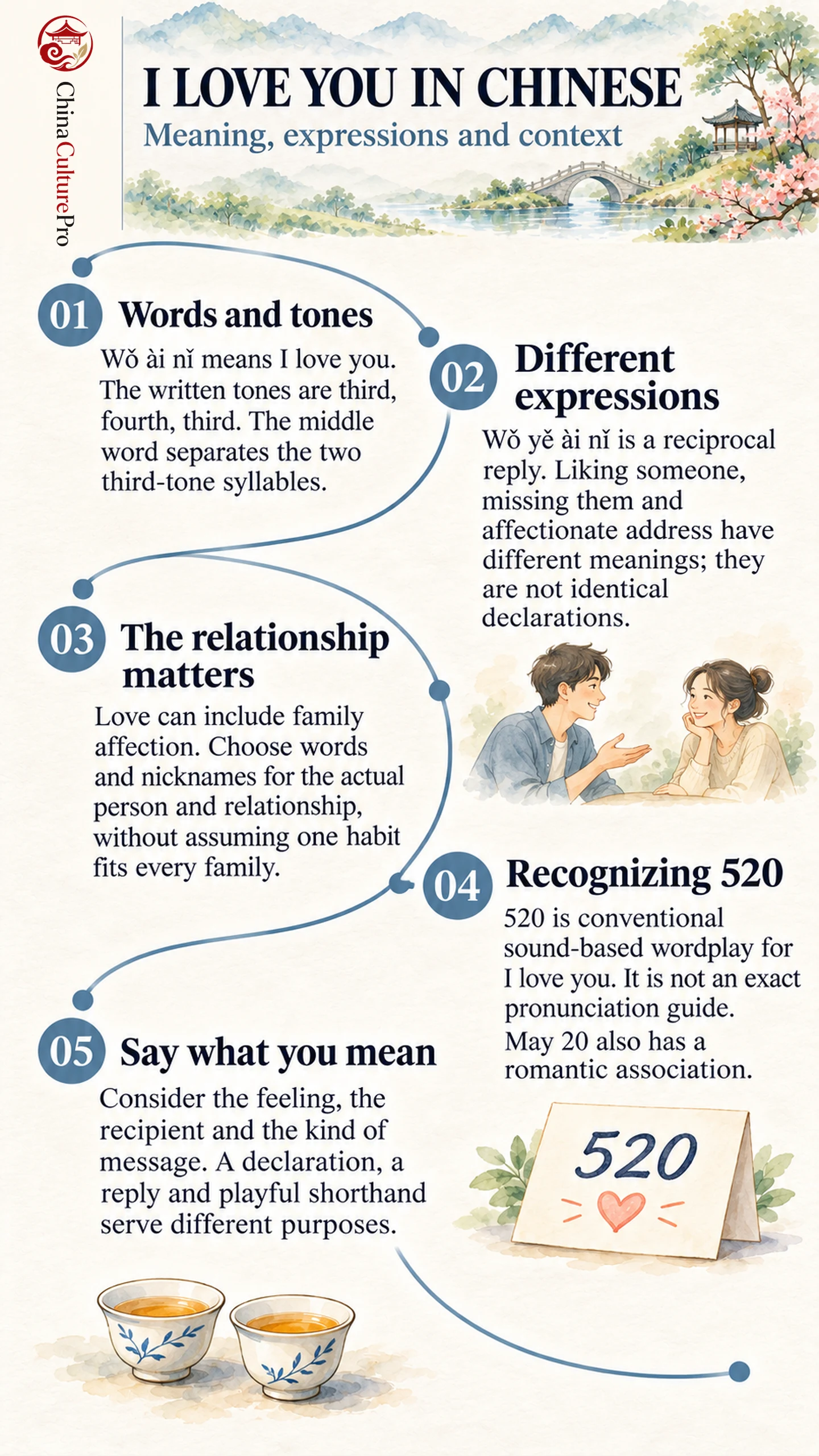
A useful expression of affection says what you actually mean. A message can state a feeling, respond to another person or use an intimate form of address. Treating those functions as interchangeable can make a phrase say more or less than you intend.
This guide focuses on a small set of useful expressions and their meanings. For broader social context, see Chinese greetings and etiquette.
The Three Words and Their Pronunciation
The sentence has three parts: 我 (wǒ), “I”; 爱 (ài), “love”; and 你 (nǐ), “you.” Its word order is the same as the English translation. [4] The Mandarin tone sequence shown in pinyin is third, fourth, third. [1]
Do not change the opening syllable to a second tone merely because the sentence contains two third-tone syllables. The familiar third-tone change concerns adjacent third tones; here, the fourth-tone middle word separates them. [7] Use the pronunciation recording of the whole phrase as well as the written tone marks.
For more detail, see pinyin and Mandarin tones. Pinyin is a sound notation, so reading it as English spelling will not reliably give the intended sounds.
The simplified and traditional versions above differ in the character for love. When writing a message, match the recipient’s usual script. A script preference and a choice of spoken language are separate matters.
Six Expressions with Different Jobs
The catalogue below includes a declaration, a reply, two statements about feelings and two forms of address. The English meanings are intentionally different: these are related expressions, rather than six identical translations.
| Expression and Mandarin pinyin | Meaning | Function |
|---|---|---|
| 我爱你 (wǒ ài nǐ) | I love you. | A direct declaration. [8] |
| 我也爱你 (wǒ yě ài nǐ) | I love you too. | A reciprocal reply. [1] |
| 我喜欢你 (wǒ xǐhuan nǐ) | I like you; in context, I have feelings for you. | Expresses liking, with romantic meaning supplied by context. [3][4] |
| 我想你 (wǒ xiǎng nǐ) | I miss you; I am thinking of you. | Expresses missing or thinking of the person. [3] |
| 亲爱的 (qīn’ài de) | Dear; darling, as a form of address. | Addresses someone affectionately. [5] |
| 宝贝 (bǎobèi) | Darling; baby, as an affectionate form of address. | An intimate nickname or address. [3][5] |
In the reciprocal sentence, 也 (yě) adds “also” or “too.” [1] The response therefore says that you share the feeling. Learning its meaning helps you recognize it without treating it as an automatic reply you owe someone.
Affection, Family and the Relationship
The word ài is broader than romantic love. It can refer to deep affection, including family affection; it also has meanings connected with liking and valuing. [2] A dictionary meaning, however, cannot tell you how often a particular parent, friend or partner likes to hear a declaration.
Likewise, “I like you” can express romantic interest, but it can also describe liking someone without that implication. The surrounding conversation and the way the speaker says it matter. [4] There is no need to turn the phrases into a compulsory sequence that every relationship must follow.
Affectionate address is a separate choice. A nickname may suit one relationship and feel intrusive in another. Use a name the person welcomes; the guide to Chinese nicknames gives wider context. When addressing family members, family terms may be more useful than a romantic pet name.
What 520 Means in Messages
The number code 520 is associated with “I love you” through approximate sound-based wordplay. The association also gives May 20 a romantic significance, reflected in marriage-registration activities on that date. [6]
Treat the digits as a learned convention, rather than a pronunciation lesson: reading the numbers aloud does not reproduce the Mandarin sentence exactly. A short code also relies on the recipient recognizing it. Use the full wording when clarity is more useful than shorthand.
For the date’s wider context, see Chinese Valentine’s Days. You do not need a special calendar date to express affection.
Choosing Words That Match What You Mean
Three questions can help you select a phrase:
- What feeling am I stating? Distinguish love, liking and missing the person. Choose the meaning you want to communicate before considering how elaborate the sentence sounds.
- Who is receiving it? Use the relationship you actually have and the person’s preferred address. Avoid assuming that a phrase feels welcome because it appears in a romantic phrase list.
- What kind of message is this? A direct sentence, a reciprocal reply and playful shorthand serve different purposes. Keep the words clear enough for the other person to understand what you mean.
If you want a literary message, explore Chinese love poems and their context. A poetic quotation may carry a voice or situation quite different from your own, so understand the passage before using it.
FAQs About I Love You in Chinese
Can ài describe love for family?
Yes. Its meanings include deep affection beyond romance, including family affection. How directly a particular family talks about that affection is a matter of its own habits and relationships. [2]
Does I miss you mean the same thing as I love you?
No. Missing or thinking of someone can express affection, but it does not automatically make the same declaration as “I love you.” The Mandarin expressions retain that difference in meaning. [3]
Must I reply with I love you too?
No. It is a reciprocal declaration, not a required acknowledgment. Use it when it expresses your own feeling; otherwise, respond honestly in words that fit what you want to say.
Sources
[1] Chineasy. Talk Chineasy: I Love You
[2] Ministry of Education, Taiwan. Concise Mandarin Chinese Dictionary: 愛
[3] EverydayChinese. Fifteen Ways to Say I Love You in Chinese
[4] Yangyang Cheng, Yoyo Chinese. How to Talk About Love in Mandarin Chinese
[5] Fluent in 3 Months. How to Say I Love You in Chinese, with Pinyin and Examples
[6] Shannan Municipal Civil Affairs Bureau. 相约“520” 共赴人生路
[7] Routledge. Modern Mandarin Chinese: Lesson 2
[8] ChineseClass101. Three Ways to Say I Love You in Chinese