


Quick Answer: What Is Huagu Opera?
Huagu opera (花鼓戏, huāgǔxì), or flower-drum opera, is a family of regional theater traditions. Changsha Huagu opera (长沙花鼓戏, Chángshā Huāgǔxì) is a prominent Hunan example. Folk tunes, stylized speech and a small group of characters can carry scenes about work, courtship or family life.[1][2]
- Region: Hunan has several forms, including Changsha, Changde and Yueyang.[2][3]
- Sound: Singing uses local tune patterns and can be punctuated by percussion.[2][4]
- Story: Plays range from folk legends to comic scenes about everyday work.[1][5][7]
When a program says Huagu opera, look for the place named with it. That can identify the language and music of the production.
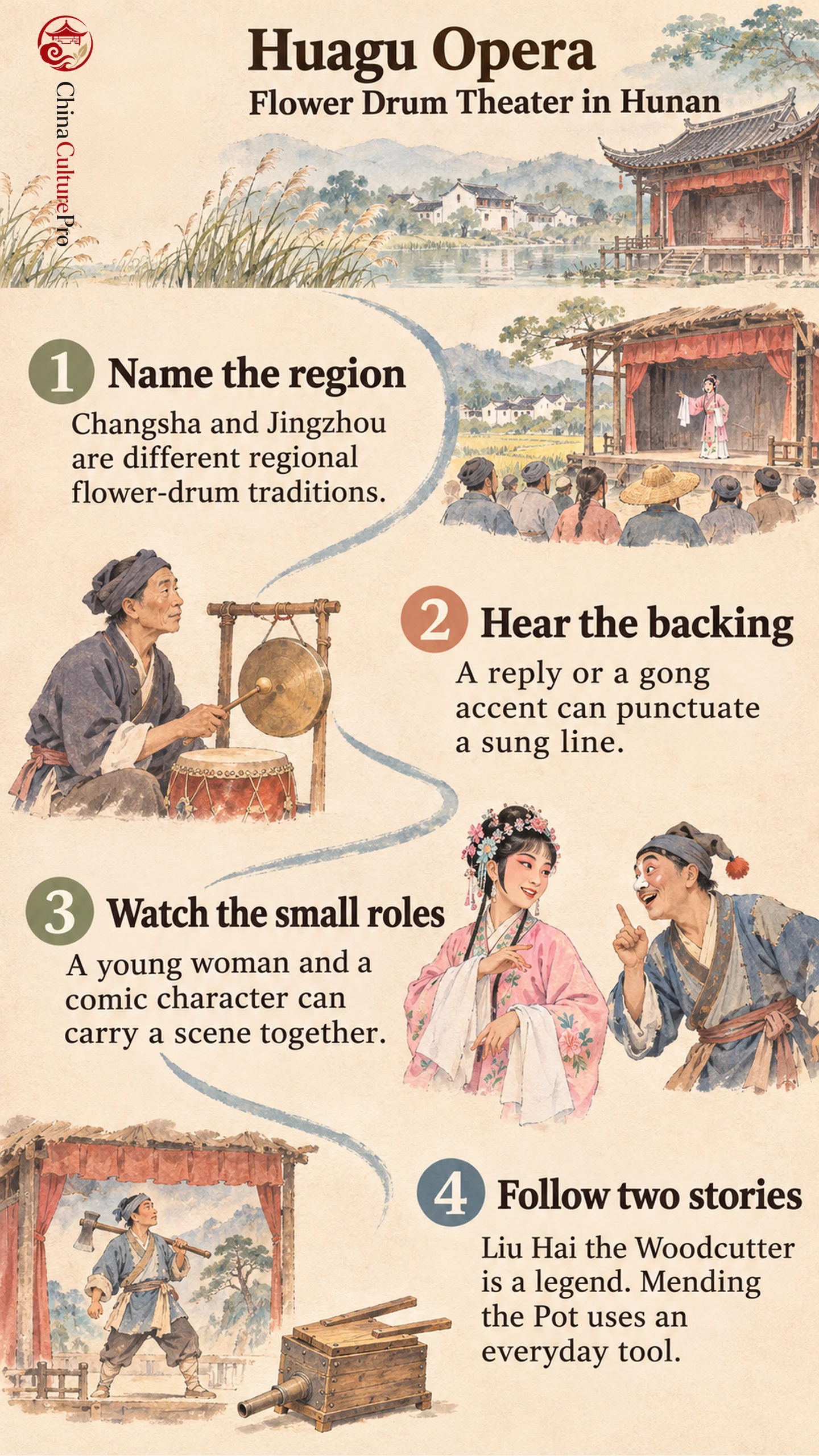
A woodcutter meeting a fox immortal and a worker operating a bellows make very different stage pictures. Both can belong to the Hunan repertory, where a scene can turn on the interaction of only a few people.
Why the Regional Name Matters
Changsha’s form developed during the Qing dynasty and spread through central and eastern Hunan and the area around Dongting Lake. Its stage language moved toward Changsha speech as different local approaches came together in the mid-twentieth century.[2][3]
Within Hunan, local traditions such as Changde and Shaoyang have their own repertories and stage language. Jingzhou Huagu (荆州花鼓戏, Jīngzhōu Huāgǔxì) developed on the Jianghan Plain in Hubei and has its own national heritage entry. Jingzhou’s tune tradition includes gong-accompanied singing and smaller folk tunes.[1][3][9]
What to Listen for in Changsha Huagu
Changsha’s tune groups include chuandiao (川调, chuāndiào), daluoqiang (打锣腔, dǎluóqiāng), named tunes and shorter folk airs. Listen to the time between one sung phrase and the next. A reply, a percussion accent or an instrumental passage can give each phrase a different ending.[2][4]
In Yiyang, some tunes were performed with gongs, drums and a vocal response. Some of that material later took on string accompaniment. The contrast between a struck accent and a bowed phrase can be audible between lines.[4]
How Small Roles Carry a Scene
Traditional Changsha scenes can center on two small roles (两小, liǎng xiǎo), a young female part and a comic part. The combination known as three small roles (三小, sān xiǎo) adds a young male part. The labels draw on a broader opera role vocabulary.[1][2]
In a small cast, a quick reply or change of expression can turn a whole scene. Watch who starts the exchange and which character’s response changes its direction.[1][2]
Two Stories to Watch
In Liu Hai the Woodcutter (刘海砍樵, Liú Hǎi Kǎn Qiáo), Liu Hai and the fox immortal Hu Xiuying (胡秀英, Hú Xiùyīng) become a couple. In the film version, a rival steals the jewel that helps her retain her human form. He Dongbao (何冬保, Hé Dōngbǎo) helped adapt the work and played Liu Hai in a version recognized at the first national Chinese opera performance gathering in 1952.[5][6]
Mending the Pot (补锅, Bǔ Guō) puts a familiar tool at the center of a scene. The movements of operating a bellows become a stylized action the performers can time around a comic exchange.[7]
FAQs About Huagu Opera
Is Huagu opera the same as Fengyang Flower Drums?
Fengyang Flower Drums (凤阳花鼓, Fèngyáng Huāgǔ) is an Anhui song and storytelling tradition that can use a small drum and gong. Huagu opera describes local theater forms with dramatic roles and plays.[1][8]
What language is used in Changsha Huagu opera?
Changsha speech is the main stage language described in the heritage entry. Other Huagu traditions can use other regional speech varieties.[2][3]
Sources
[1] China Intangible Cultural Heritage Network. Flower-Drum Opera
[2] China Intangible Cultural Heritage Network. Changsha Flower-Drum Opera
[3] Hunan Provincial Government. Hunan Flower-Drum Opera
[4] Yiyang Municipal Government. An Introduction to Yiyang Flower-Drum Opera
[5] Hunan Provincial Archives. He Dongbao and Liu Hai the Woodcutter
[6] Hunan Provincial Department of Culture and Tourism. Liu Hai the Woodcutter: Opera Film Synopsis
[7] People’s Daily Overseas Edition. Hunan Flower-Drum Opera on Stage
[8] China Intangible Cultural Heritage Network. Fengyang Flower Drums
[9] China Intangible Cultural Heritage Network. Jingzhou Flower-Drum Opera