


Quick Answer: What Is Wen Zhengming’s Humble Administrator’s Garden Album?
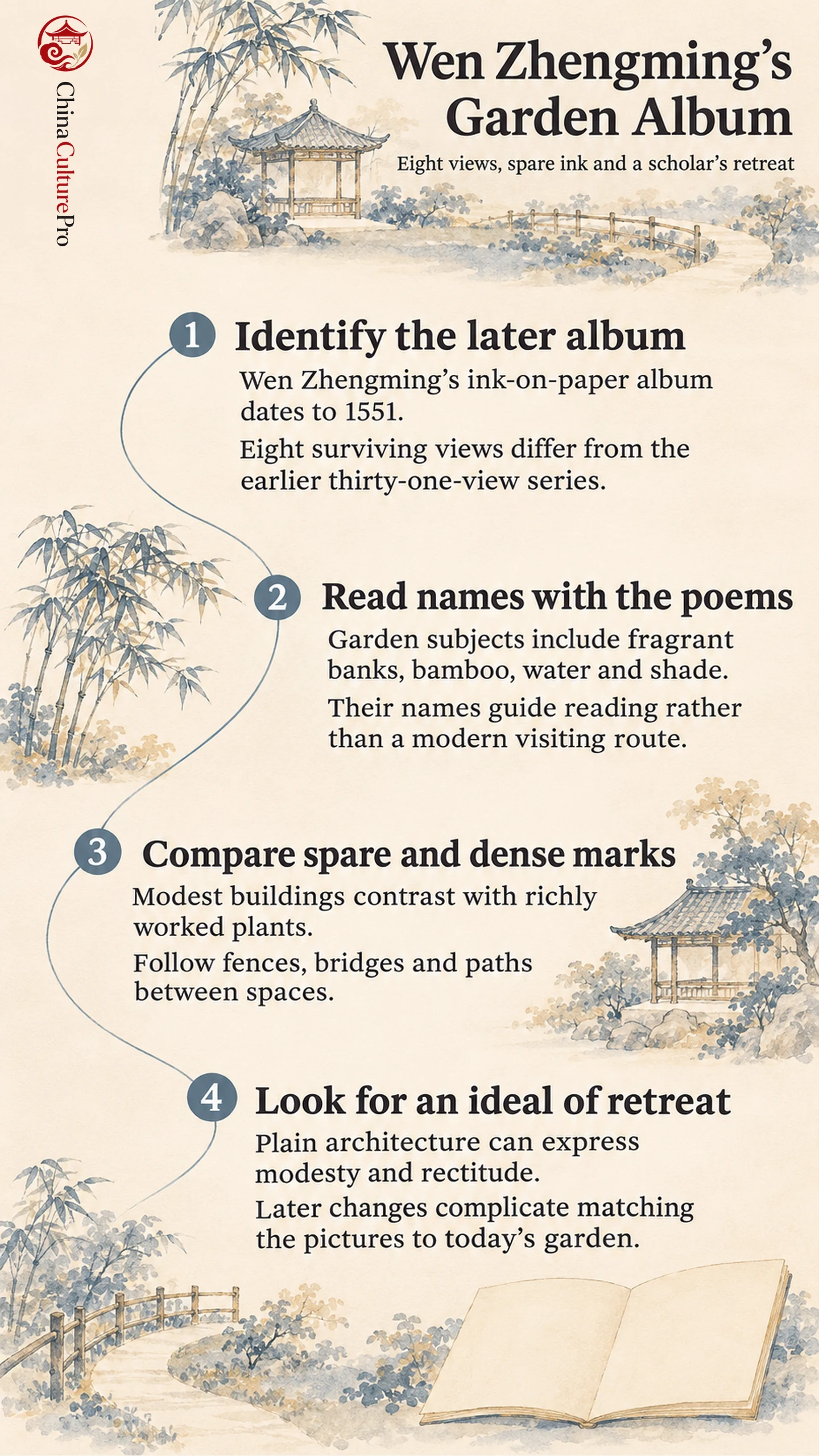
Wen Zhengming (文徵明, Wén Zhēng Míng) made this album of the Humble Administrator’s Garden (拙政园, Zhuō Zhèng Yuán) in 1551. Its eight surviving views are painted in ink on paper and accompanied by poetry and calligraphy.
- Collection: Metropolitan Museum of Art, catalogue number 1979.458.1a–ii.
- Image size: 26.4 × 27.3 cm, distinct from the larger mountings.
- Viewing focus: Compare modest buildings, planted enclosures and water with the garden subjects named in the writing.
This is the later eight-view album, rather than the earlier series of thirty-one views.
A dense stand of bamboo can fill much of a small image, while an open pavilion gives human activity a compact frame. A walkway crosses the foreground on a diagonal, joining rather different visual textures.
Compare the roof with the leaves, the fence with the water, and the small figures with the surrounding plants.
Identify the 1551 Album and Its Garden
The garden belonged to Wang Xianchen (王献臣, Wáng Xiàn Chén), who developed it in Suzhou. Wen had a studio there after returning from Beijing in 1527. [1]
The Suzhou garden-culture guide gives the larger setting for this relationship between garden owner, writer and painter.
Keep the object’s format in mind. A leaf permits a concentrated view, while turning to another leaf starts a new encounter. The album offers a series of selected scenes rather than one uninterrupted panoramic scroll.
The Chinese-painting guide provides context for that choice. The size of an image and the way it is encountered shape what a viewer can compare at one time.
Read Eight Garden Names alongside the Poems
The accompanying texts name the following garden subjects. The English labels below are concise renderings of the historical Chinese names.
| Named subject | Feature named |
|---|---|
| Fragrant Bank (繁香坞, Fán Xiāng Wù) | A named bank of cultivated flowers |
| Bamboo Bank (湘筠坞, Xiāng Yún Wù) | Bamboo as a distinct garden setting |
| Little Canglang (小沧浪, Xiǎo Cāng Láng) | A pavilion associated with water |
| Banana Railing (芭蕉槛, Bā Jiāo Jiàn) | Banana plants beside a balustrade |
| Fishing Rock (钓䂬, Diào Gǒng) | A stone for sitting near water |
| Apple Orchard (来禽囿, Lái Qín Yòu) | A planted fruit orchard |
| Locust Canopy (槐幄, Huái Wò) | The shade of a large locust tree |
| Jade Spring (玉泉, Yù Quán) | A named garden water source |
The historical garden record describes these named features within a larger, thirty-one-part setting. [3]
Use the list to orient your reading of the texts. It is not a route through the present garden, or a claim that every surviving mounted pairing supplies an exact site identification.
The garden names-and-couplets guide develops why a name matters beyond labeling a structure. Names can direct attention toward a plant, a water source or a literary association.
The poems also extend the garden beyond what ink can show directly. Fragrance, shade, sound and remembered experience become part of the reader’s encounter. [1]
The Chinese-poetry guide offers context for that added verbal dimension.
Compare Spare Buildings with Dense Plants
Look first at the pavilion and bamboo in the selected detail. The roof is a broad, quiet shape; the surrounding leaves accumulate through many smaller marks.
Follow the stems downward. Their repeated verticals make a different rhythm from the diagonal walkway crossing the foreground.
The painting-techniques guide helps separate line, wash and repeated texture. All three can contribute without requiring a palette of painted colors.
In another detail, a low fence encloses a pavilion and its planted ground. Across the water, a bridge changes direction as it approaches the enclosure. Compare those clear structural lines with the less regular plant forms.
The garden paths-and-windows guide develops a related viewing task: following how openings, paths and boundaries connect one space to another.
Compare the small figures with the pavilion’s roof and posts. They establish a scale for the buildings while leaving much of the image to water, plants and empty ground.
Look for a Scholarly Ideal rather than a Modern Map
The garden’s name draws on a retirement allusion associated with Pan Yue (潘岳, Pān Yuè). Its modest wording expresses a position toward official life, rather than an objective rating of the owner’s administrative ability. [3]
The spare architectural images have been interpreted as expressions of the owner’s rectitude and modesty. [2]
That interpretation gives the plainness a purpose. A lightly described building can present an ideal of life without inventorying every luxurious feature of an actual property.
Gardens also offered a concentrated version of the larger natural world, experienced through changing views. [4]
The Chinese-gardens guide develops that relationship. The album’s selected scenes invite a similar movement between a small setting and a larger imagined way of living.
Centuries of alteration make the painted scenes difficult to identify in today’s garden. [1]
FAQs About Wen Zhengming’s Humble Administrator’s Garden Album
Is this the earlier thirty-one-view garden album?
No. This guide concerns the 1551 album of eight surviving views.
Was the garden Wen Zhengming’s property?
It belonged to Wang Xianchen; Wen’s relationship included a studio there.
Can the paintings guide a visit to today’s garden?
They offer historical and artistic interpretation, while later changes complicate direct site matching.
Sources
[1] Metropolitan Museum of Art. Wen Zhengming: Garden of the Inept Administrator, 1979.458.1a–ii
[2] Metropolitan Museum of Art. Chinese Gardens: Pavilions, Studios, Retreats, exhibition overview
[3] Wen Zhengming, reproduced by Suzhou Garden and Landscape Administration. Record of Wang’s Humble Administrator’s Garden
[4] Metropolitan Museum of Art, Department of Asian Art. Chinese Gardens and Collectors’ Rocks