

Quick Answer: Who Was Empress Dou?
Empress Dou (窦皇后, Dòu Huánghòu, died 135 BCE) was the wife of Emperor Wen (文帝, Wéndì) of the Western Han (西汉, Xī Hàn). She was the mother of Emperor Jing (景帝, Jǐngdì).[10] She was the grandmother of Emperor Wu (武帝, Wǔdì).[3]
- Rise: She became empress after her elder son was named heir.[2]
- Court learning: She favored Huang-Lao (黄老, Huáng-Lǎo) teachings.[4]
- Political influence: Her position as grand empress dowager remained consequential during Wu’s early reign.[5]
Her influence is visible in arguments over who could give advice and who could receive official reports.
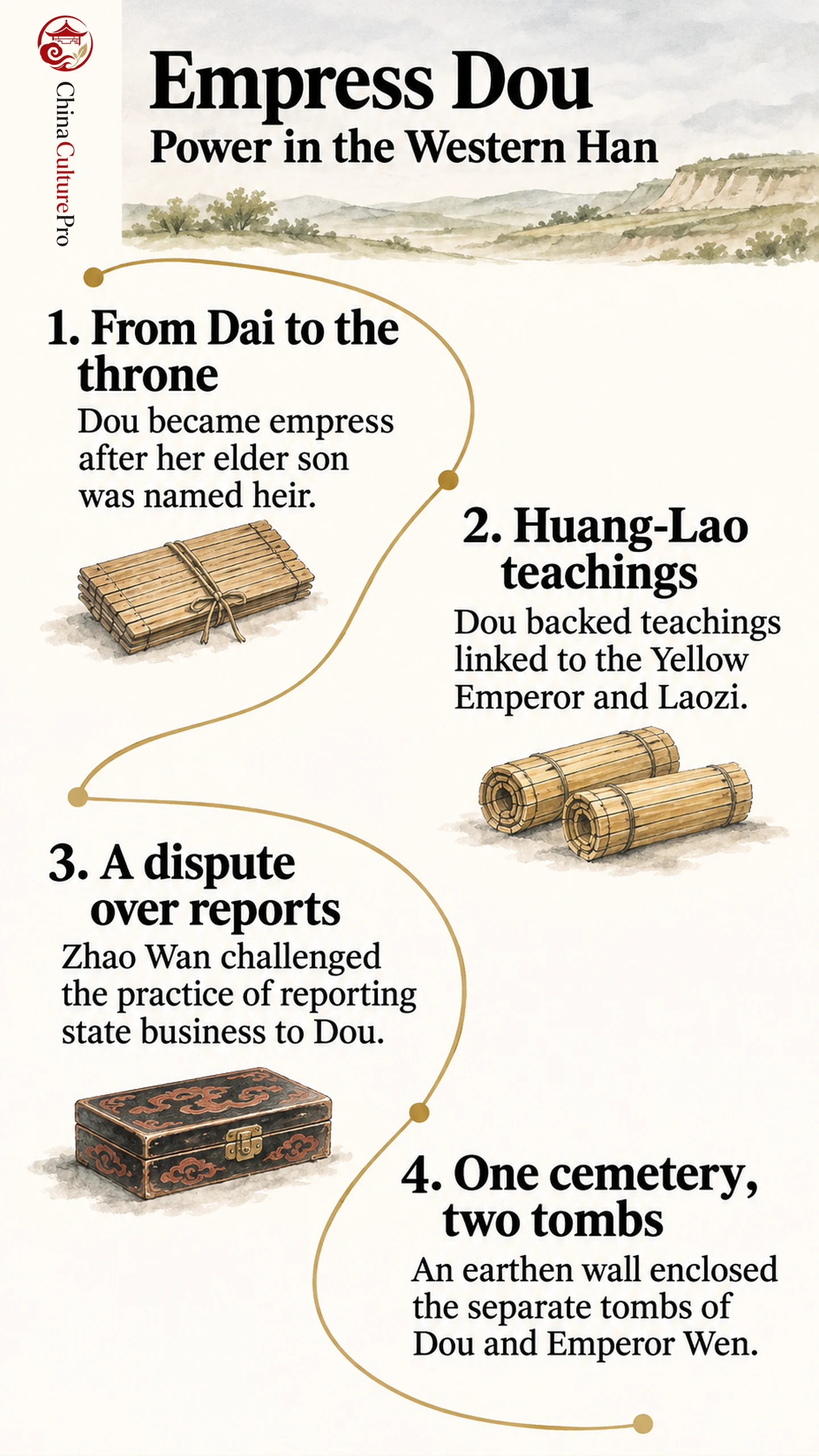
Even after the young Emperor Wu took the throne, his grandmother still received reports on state business. A challenge to that practice brought down two officials and stalled one of his early projects.
From the Palace of Empress Lü to the Court of Emperor Wen
Dou entered the household of Empress Lü (吕后, Lǚ Hòu). In the account preserved by Sima Qian, Dou asked to be sent to Zhao, near her family. The official handling the register assigned her to Dai (代, Dài) by mistake. The King of Dai became Emperor Wen.[1]
Their elder son, Liu Qi (刘启, Liú Qǐ), was chosen as heir after Wen took the throne. Dou then became empress. Their younger son, Liu Wu (刘武, Liú Wǔ), eventually ruled Liang. Their daughter, Liu Piao (刘嫖, Liú Piáo), became Princess Guantao.[2]
What Huang-Lao Meant at Dou’s Court
Huang-Lao takes its name from the Yellow Emperor (黄帝, Huángdì) and Laozi (老子, Lǎozǐ). In the early Han, the label covered a range of ideas and techniques for governing. It could overlap with what historians of the time called Daoist teachings.[4][5]
Sima Qian records that the emperor and members of the Dou family were expected to study these teachings.[1] In another episode, the scholar Yuan Gu (辕固, Yuán Gù) belittles Laozi’s writings and Dou orders him into a pen to face a pig. Emperor Jing gives him a weapon and he survives. The story turns a disagreement about a text into a confrontation over what a scholar could say at court.[4]
A Dispute Over Reports to the Grand Empress Dowager
Dou became empress dowager when Jing succeeded Wen in 157 BCE and grand empress dowager when Wu succeeded Jing in 141 BCE.[2][3]
In 139 BCE, the official Zhao Wan (赵绾, Zhào Wǎn) proposed ending the practice of reporting matters to Dou. Zhao and his colleague Wang Zang (王臧, Wáng Zāng) were jailed and died by suicide. Plans for a ceremonial hall associated with their proposals were dropped.[9]
The Book of Han (汉书, Hànshū) records the creation of scholarly posts for the Five Classics in the year before Dou’s death in 135 BCE.[3] Scholars associated with those texts could gain court support during her lifetime.[5]
What the Tombs at Baling Show
Sima Qian places Dou’s burial with Wen at Baling (霸陵, Bàlíng).[1] In 2021, Chinese authorities identified the Jiangcun Grand Tomb as Wen’s. Archaeologists traced a rammed-earth wall enclosing both tombs, which lie about 800 meters apart. The layout illustrates what a shared burial could mean at a Han imperial cemetery.[6]
FAQs About Empress Dou
Where does the name Dou Yifang come from?
Dou Yifang (窦猗房, Dòu Yīfáng) comes from later commentary. Sima Zhen’s notes to Sima Qian’s history attribute the given name to Huangfu Mi.[1]
Did Empress Dou favor another son as heir?
One account says Dou welcomed Jing’s remark at a banquet about passing the throne to her younger son, the Prince of Liang. Dou Ying (窦婴, Dòu Yīng), her relative, objected.[7]
Which Empress Dou governed for Emperor He?
Empress Zhangde (章德皇后, Zhāngdé Huánghòu) was a later Dou of the Eastern Han. She was the consort of Emperor Zhang and became regent when Emperor He succeeded him.[8]
Sources
[1] Sima Qian, with commentary by Sima Zhen and others. Records of the Grand Historian, chapter 49, hereditary houses of imperial relatives
[2] Ban Gu and others. Book of Han, chapter 97 upper, Empress Xiaowen Dou
[3] Ban Gu and others. Book of Han, chapter 6, Annals of Emperor Wu
[4] Yifan Zheng. Family or Servants? The Ambiguity of Status in Early Chinese Households, pp. 8–10
[5] Sarah A. Queen. Inventories of the Past, Asia Major 14.1, pp. 58–59
[6] Lu Hang. Mausoleum of Emperor Wen of Han identified, Chinese Social Sciences Today
[7] Ban Gu and others. Book of Han, chapter 52, Dou Ying biography
[8] Fan Ye. Book of the Later Han, chapter 10 upper, Empress Zhangde Dou
[9] Sima Guang and others. Zizhi Tongjian, chapter 17, second year of Jianyuan
[10] Michael Loewe. The Former Han Dynasty, The Cambridge History of China, vol. 1, p. 173