


Quick Answer: Who Was Du Shi?
Du Shi (杜诗, Dù Shī, died 38 CE) was an Eastern Han (东汉, Dōng Hàn) official who became governor of Nanyang Commandery (南阳郡, Nányáng Jùn) in 31 CE. His biography credits him with building water-powered bellows (水排, shuǐpái) for casting agricultural tools.[3][7]
- Use: Moving water powered an air supply for the furnace.[7]
- Local work: Du also repaired waterworks and expanded farmland.[1]
- Evidence: The official biography records the use of the device. Later drawings show other designs and cannot tell us exactly what Du built.[3][6]
The short account establishes what the device was used for and what it saved in labor.
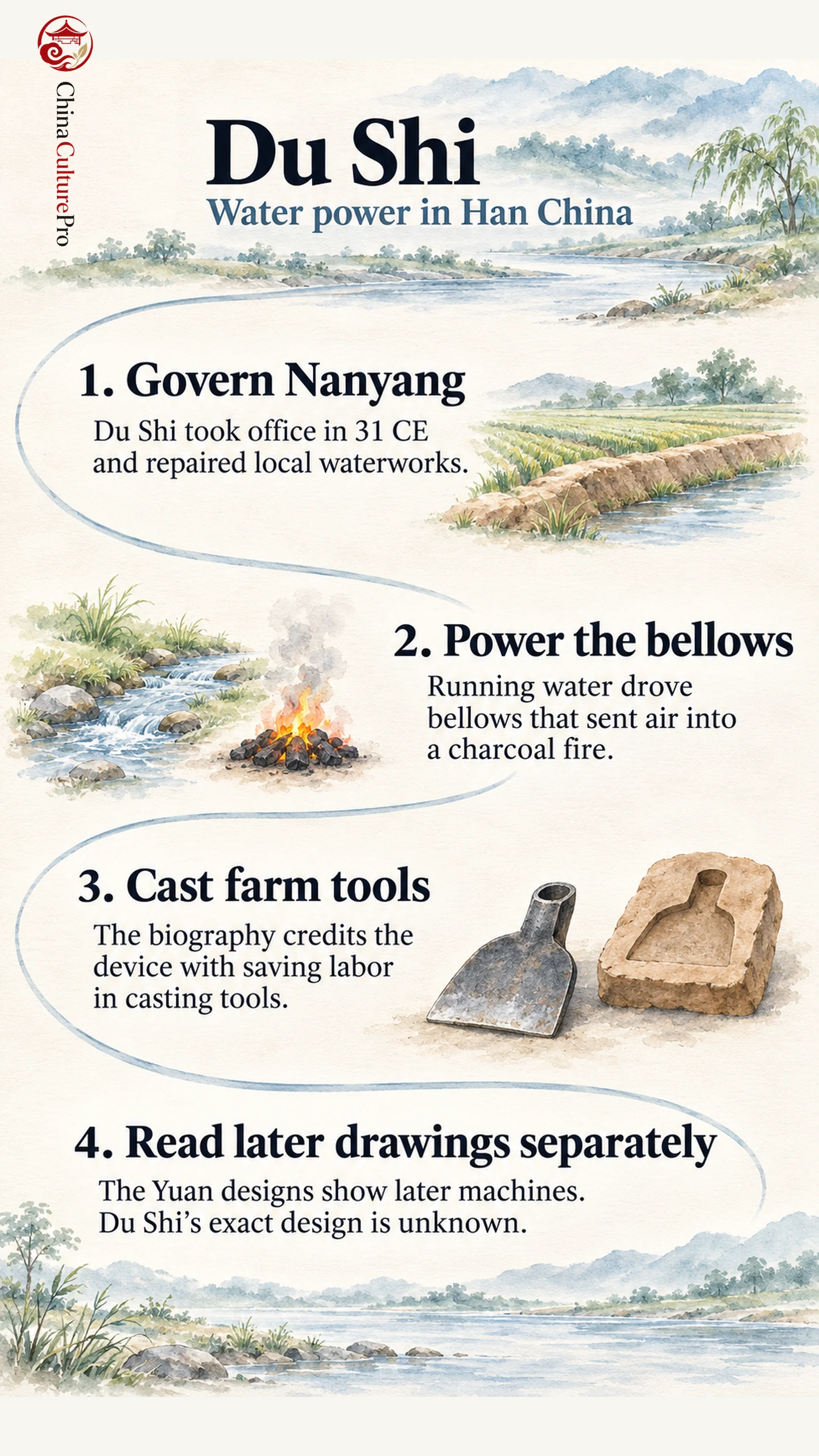
Water ties together two parts of Du Shi’s career. His government repaired works that served fields and used the force of flowing water at a furnace.
Du Shi’s Work in Nanyang
Before Nanyang, Du served in other local posts. The Book of the Later Han (后汉书, Hòu Hànshū) places his appointment in the seventh year of Jianwu (建武, Jiànwǔ). As governor, he had embankments and ponds repaired to expand the area under cultivation. These projects and the farm tools connect his tenure to the history of Chinese agriculture.[1]
The biography compares Du with Shao Xinchen (召信臣, Shào Xìnchén), an earlier governor.[1]
The Book of Han (汉书, Hànshū) records that Shao opened channels and set rules for sharing irrigation water.[4]
What Water Power Did at the Furnace
The biography says the device made it possible to cast farm implements with less labor. A later annotation explains that running water drove a bellows, sending air into the charcoal fire. The water supplied the motion, and the charcoal supplied the heat. A steady blast of air helped keep the furnace hot enough for metalworking.[2][7]
For the history of Chinese iron and steel, the account records a change in how the furnace got its air. It leaves the arrangement and materials of Du’s equipment unclear.[3]
Why Later Bellows Drawings Need Their Own Date
The Records of the Three Kingdoms (三国志, Sānguózhì) describes Han Ji (韩暨, Hán Jì) putting river-powered bellows to work after earlier arrangements used horses or people. It establishes another early use of water power, with no details to show that Han Ji copied Du’s design.[5]
The Yuan (元, Yuán) author Wang Zhen (王祯, Wáng Zhēn) described two arrangements in his 1313 Nong Shu (农书, Nóngshū). One uses a horizontal waterwheel and a transmission that turns rotation into back-and-forth movement. Another uses a vertical wheel and a different linkage. These are examples of later Chinese hydraulic engineering, recorded more than a millennium after Du.[3][6][7]
FAQs About Du Shi
Did Du Shi invent the waterwheel?
The record credits Du with a furnace application of water power. It gives him no claim to inventing the waterwheel. Historian Donald B. Wagner also considers possible earlier uses of water power in metallurgy.[3]
Why is 31 CE often given for the water-powered bellows?
It is the year Du took office in Nanyang. The biography describes the device among his works there and gives no separate date for its construction.[1][7]
What did Du Shi propose about troop orders?
Du urged the court to use matching tiger tallies (虎符, hǔfú) to authenticate mobilization orders. He warned that a sealed letter on its own might be forged. The biography says the court accepted his proposal.[1]
Sources
[1] Fan Ye. Book of the Later Han, chapter 31, Du Shi biography
[2] Fan Ye, with commentary by Li Xian and others. Book of the Later Han, annotated Du Shi passage
[3] Donald B. Wagner. Ferrous Metallurgy, Science and Civilisation in China, volume 5 part 11
[4] Ban Gu and others. Book of Han, chapter 89, Shao Xinchen biography
[5] Chen Shou. Records of the Three Kingdoms, chapter 24, Han Ji biography
[6] Wang Zhen. Nong Shu, Water-powered Bellows
[7] Shi Xiaolei and Zhang Baichun. Water-powered Bellows, Chinese Mechanical Engineering Digital Museum