


Quick Answer: What Is the Dombra in China?
The dombra (冬不拉, dōngbùlā) is a long-necked plucked lute played by Kazakh communities in Xinjiang, including in Ili. It typically has two strings and a fretted neck. A player can perform a solo piece or use the instrument to accompany singing and improvised verse.[1][2][4]
- Build: A narrow neck joins a wooden body that is often pear-shaped.[1][4]
- Sound: Plucked or strummed strings can carry a tune and mark its pulse.[1]
- Use: Dombra playing is documented in solo music, ensembles and Kazakh verse contests.[1][2]
Kazakh dombra traditions are also practiced beyond China.[4][5]
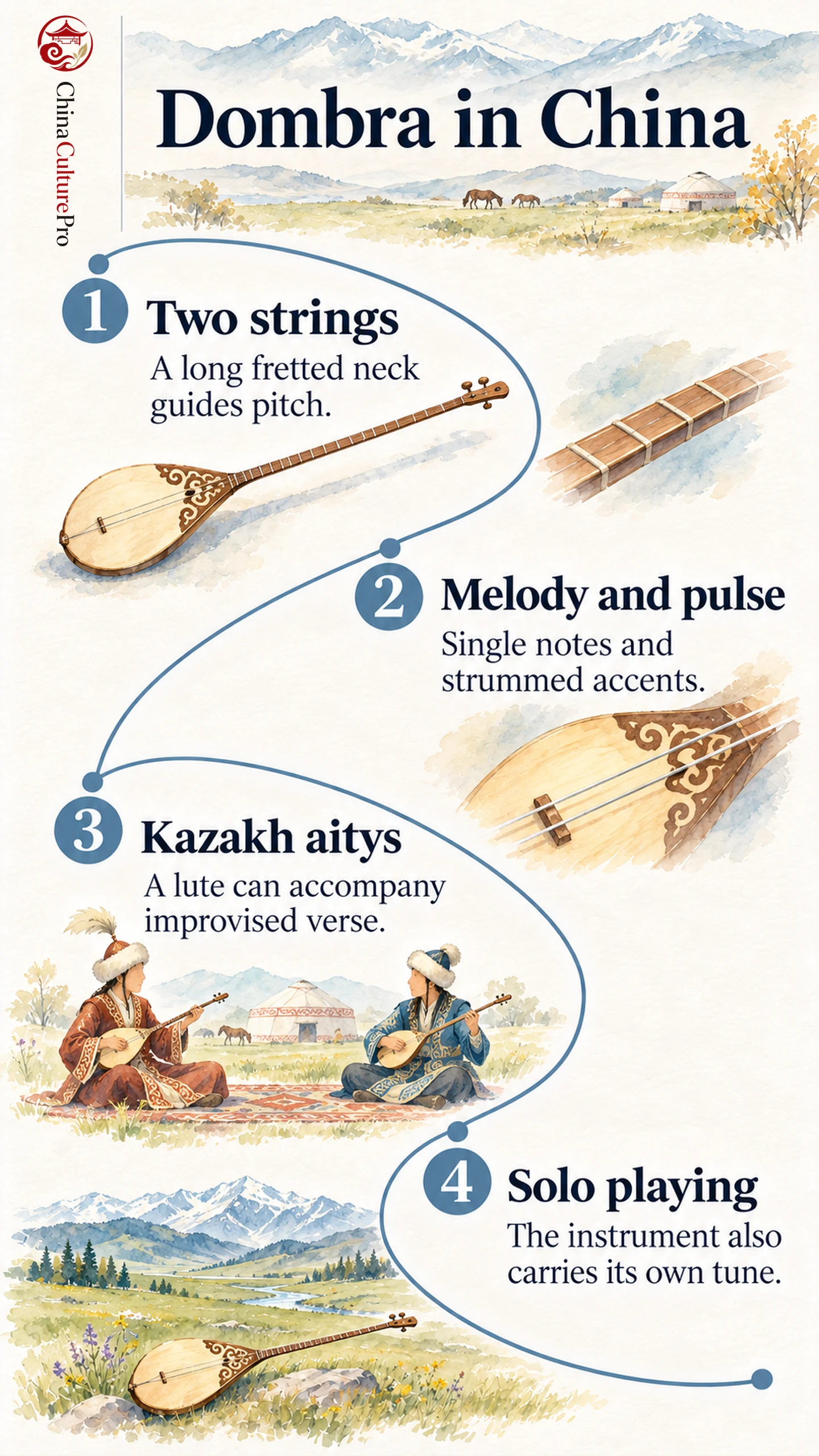
In a verse exchange, a player can use the same instrument to establish the pulse and leave space for a line of poetry. In a solo piece, the listener can follow how the two strings support a tune without a voice.[1][2][4]
How Two Strings Carry Melody and Rhythm
Frets give the player stopping positions along the narrow neck. A plucked string can carry one pitch. A stroke that passes across both strings can sound them together. Listening for the difference between a single note and a two-string accent can help you follow the pattern even before you know the tune.[1][4][5]
The national heritage entry for Ili describes the instrument in music with mixed meters. That gives a reason to listen for where the accents fall instead of assuming every group of beats is the same length. The Memorial Museum of Akyn Sara catalogues a two-string dombra with multiple frets. The fret positions are part of the individual object’s construction.[1][5]
The Dombra in Kazakh Aitys
In Kazakh aitys (阿依特斯, āyītèsī), poets respond to each other in improvised sung verse. The national heritage entry for Ili describes performers commonly playing dombra to accompany themselves. It also documents performances sung without the instrument. The words can shape the timing and melody of the response.[2]
Watch or listen for the point where a player moves from a short instrumental figure into the next line. The dombra can support the singer’s phrasing. The next singer can use a different melodic shape to fit the rhythm of the reply.[2]
Solo Playing and Instrument Making in Ili
The Ili heritage entry covers solo playing and ensemble use alongside song accompaniment. Its profile of the instrument maker Adilihan Abudula records that he first learned to play with his father. At the Ili song and dance troupe, he began studying dombra making in 1960 and learned from makers across several communities. His profile records both playing and building instruments as skills that could be handed down.[1][3]
UNESCO’s Dombra Kuy entry documents a Kazakh solo tradition nominated by Kazakhstan. That listing describes short instrumental compositions. The national entries from Ili provide evidence about dombra making and performance among Kazakh communities in China.[1][2][4]
Xinjiang is also home to the dutar, another long-necked lute associated with Uyghur music. In an unlabeled photograph, string count alone can leave the instrument’s identity uncertain.
FAQs About the Dombra in China
Is the dombra played only in China?
Kazakh communities play it in China and elsewhere. Ili’s national heritage listing and Kazakhstan’s UNESCO listing document related traditions in different places.[1][4]
Is the dombra the same as the dutar?
The dombra discussed here is a Kazakh lute. The dutar is a different long-necked lute found in several Central Asian traditions, including Uyghur music in Xinjiang.
Sources
[1] China Intangible Cultural Heritage Digital Museum. Kazakh Dombra Art in Ili
[2] China Intangible Cultural Heritage Digital Museum. Kazakh Aitys in Ili
[3] China Intangible Cultural Heritage Digital Museum. Adilihan Abudula
[4] UNESCO Intangible Cultural Heritage. Kazakh Traditional Art of Dombra Kuy
[5] Kazakhstan e-Museum, Memorial Museum of Akyn Sara. Dombra