
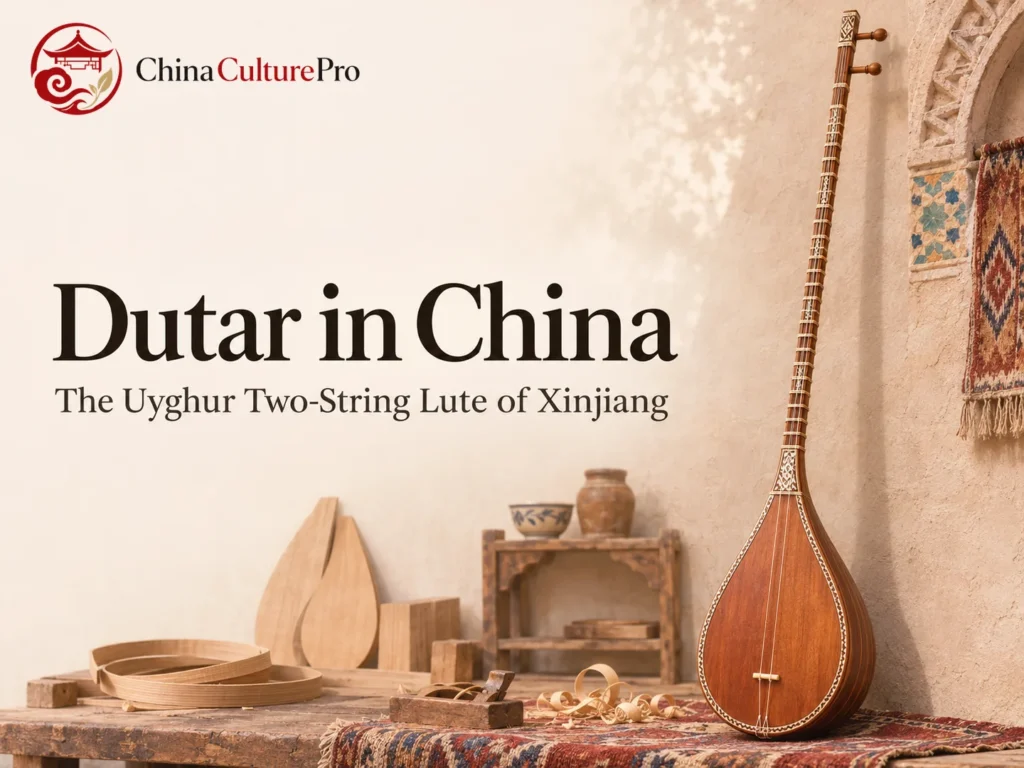

Quick Answer: What Is the Dutar in China?
The dutar (都塔尔, dūtǎ’ěr) is a long-necked, two-string lute used in Uyghur music in Xinjiang. Its fretted neck lets the player change pitch, and the strings can be plucked or strummed. It can support a singer or play alongside other instruments in Muqam.[1][3][5]
- Build: A long narrow neck joins a rounded wooden body.[1][2][3]
- Sound: Finger strokes give the two strings a clear attack.[1][3]
- Use: The lute accompanies folk song and can serve as a supporting instrument in Muqam.[3][5]
Dutar is also used for related two-string lutes in other Central Asian traditions.[3]

The most useful clue in a recording is often the attack of the string. The dutar sounds in plucks and short strums. A bowed string in the same performance can hold a note under the singer.[3][4]
A Long Neck and a Carved Wooden Body
A Kashgar prefectural account describes dutars made with mulberry or apricot wood and measuring about 120 to 130 centimeters in length. Most of that length is in the neck, giving room for a series of frets above the body. A workshop report from the same prefecture follows maker Yiming Wushouer as he hollows mulberry to form the instrument’s bowl-like body.[1][2]
The Wende Museum describes an example with about fifteen frets and strings of silk or gut. Its display also presents two tunings. That gives a useful reference for the instrument’s construction while leaving room for individual players and makers to make different choices.[6]
The Smithsonian Folkways instrument notes describe horn or bone inlay on the Uyghur form. Inlay is one clue to workmanship, while the long fretted neck and two strings help identify the instrument itself. The Kazakh dombra also has two strings. A maker’s label or a performance context helps identify which lute you are looking at.[1][3]
Listen to a Dutar With Voice and Satar
On the Smithsonian Folkways recording Bidering (The Only Pain), Sanubar Tursun is credited with singing and playing dutar. Hesenjan Tursun plays satar, a bowed lute. In this performance the singer and the dutar player are the same person, so the plucked accompaniment can be heard in relation to her vocal phrasing.[3][4]
Try following the short plucked attacks while the voice continues over them. The bowed sound can continue through a pluck and into the next note. The Wende Museum’s instrument exhibit also links to a separate dutar sound sample. Compare it with the Folkways performance to hear the plucked sound first on its own, then in relation to the singer and bowed lute.[3][4][6]
The Dutar in Uyghur Muqam
UNESCO describes Uyghur Muqam as a range of practices that can include song, dance and instrumental music. Smithsonian Folkways notes the dutar’s supporting role in Muqam. A dap frame drum can make the rhythmic cycle audible while a plucked lute carries a string line. An ensemble in one Muqam setting can differ from another. Use the credits when comparing a folk-song recording with a larger performance.[3][5]
FAQs About the Dutar in China
Is every dutar an Uyghur dutar?
The name covers several two-string lutes in Central Asia. The Uyghur form discussed here is one documented tradition within that wider group.[3]
Is the dutar bowed or plucked?
The Uyghur dutar is plucked and strummed. The satar is a separate instrument played with a bow.[1][3][4]
Sources
[1] Kashgar Prefectural Government. Uyghur Musical Instruments
[2] Kashgar Prefectural Government. Instrument Making in a Kashgar Workshop
[3] Smithsonian Folkways. Uyghur Music Recording Notes and Instrument Glossary
[4] Smithsonian Folkways. Bidering (The Only Pain)
[5] UNESCO Intangible Cultural Heritage. Uyghur Muqam of Xinjiang
[6] Wende Museum. Traditional Central Asian Musical Instruments from the Collection of Ian Price