


Quick Answer: What Is a Dihu?
The dihu (低胡, dīhú) is a low-register Chinese bowed fiddle based on the erhu type. It has two strings and is held upright. It appears in records of twentieth-century ensembles that developed distinct high, middle and low parts for bowed instruments.[1][2][3]
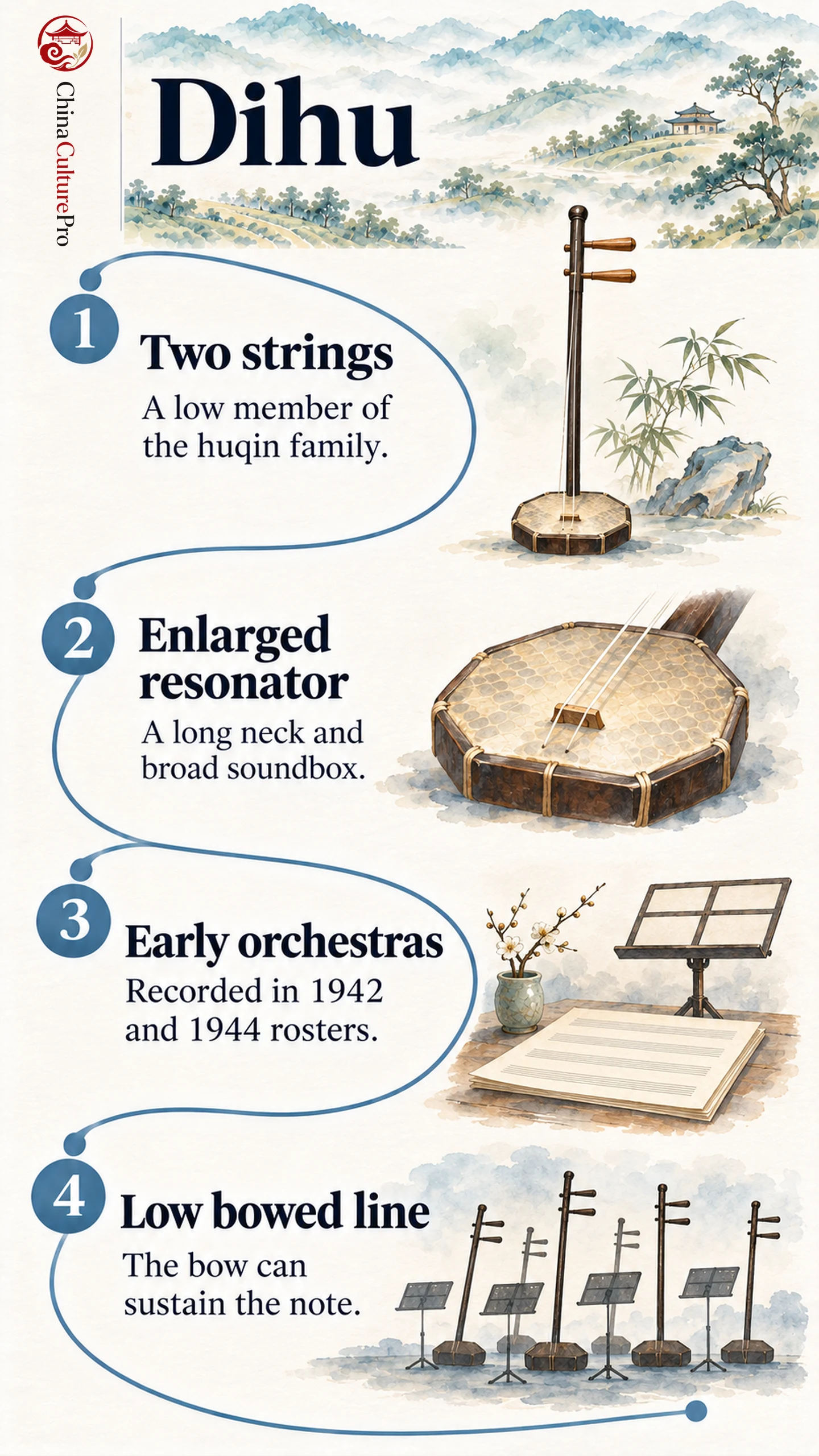
- Build: A long neck and enlarged resonator retain the outline of a Chinese spike fiddle.[1][4]
- Bowing: The hair passes between the two strings.[3][4]
- Role: The lower pitch allows the instrument to carry a bowed line below higher fiddles.[1][2]
The label belongs to one line of low-instrument development in the modern Chinese orchestra.[1][2]
In an ensemble photograph, a tall upright fiddle may resemble an erhu until you compare the scale of its body and strings. A program or a player demonstration can confirm whether the instrument is a dihu.
A Larger Form of the Two-String Huqin
The dihu uses the basic erhu layout. A long neck meets a resonator at its lower end. The player’s bow hair runs between the two strings, which are supported by a bridge on the resonator. The hand on the neck changes the vibrating length of the string. Bowing keeps the string moving so a low note can continue under a higher line.[1][3][4]
A recorded demonstration opens with a dihu made by a Tianjin instrument factory, then presents two instruments labeled dahu (大胡, dàhú). Those labels let you relate the sound to the individual instrument on screen. A listener can also compare sustained notes and changes in register.[4]
Where the Dihu Appears in Early Orchestra Records
A Texas Christian University study traces a dihu developed by musicians in the Central Radio Station Chinese Music Ensemble to 1936. A historical account from a Shanghai Conservatory-affiliated school gives a later roster for the ensemble at its 1942 peak. It lists one dihu and two dahu, alongside four erhu, two zhonghu and two gaohu.[1][2]
The same account records four dihu in a 1944 performance by the Fujian music school ensemble. The roster places those four instruments alongside six banhu and six erhu, showing a different distribution of bowed parts. They also give a date and institution to check when looking up a specific use of the instrument name.[2]
How to Tell a Dihu From a Gehu
The gehu (革胡, géhú) followed a separate design. The Hong Kong Music Office guide explains that the gehu and bass gehu use cello-like and double-bass-like tuning and playing methods. The two-string dihu retains the between-string bow layout of the erhu.[1][3]
The search for a lower section continued beyond the dihu. The TCU study traces later experiments with the gehu and other bowed basses, alongside use of the Western double bass. Which instrument takes a low part depends on the ensemble and its arrangement.[1] A side view of the bow and strings is a better clue to the construction than the instrument’s size alone.[1][3][4]
FAQs About the Dihu
Do dihu and dahu always mean the same thing?
The 1942 radio ensemble roster lists dihu and dahu separately. Read the label together with the instrument or ensemble description.[2][4]
Is a dihu a Chinese double bass?
It can serve a low bowed part. Its construction is that of an enlarged two-string huqin. The double bass and bass gehu use different layouts and playing methods.[1][3]
Sources
[1] Texas Christian University Repository. Research on Chinese Bass Bowed Instruments
[2] Shanghai Conservatory Affiliated Anshi Experimental School. Early Chinese Orchestra Ensembles and Instrumentation
[3] Hong Kong Music Office. Meet Music: Chinese Bowed Strings
[4] YouTube. Demonstration of Chinese Dihu and Dahu