

Quick Answer: What Is a Daruan?
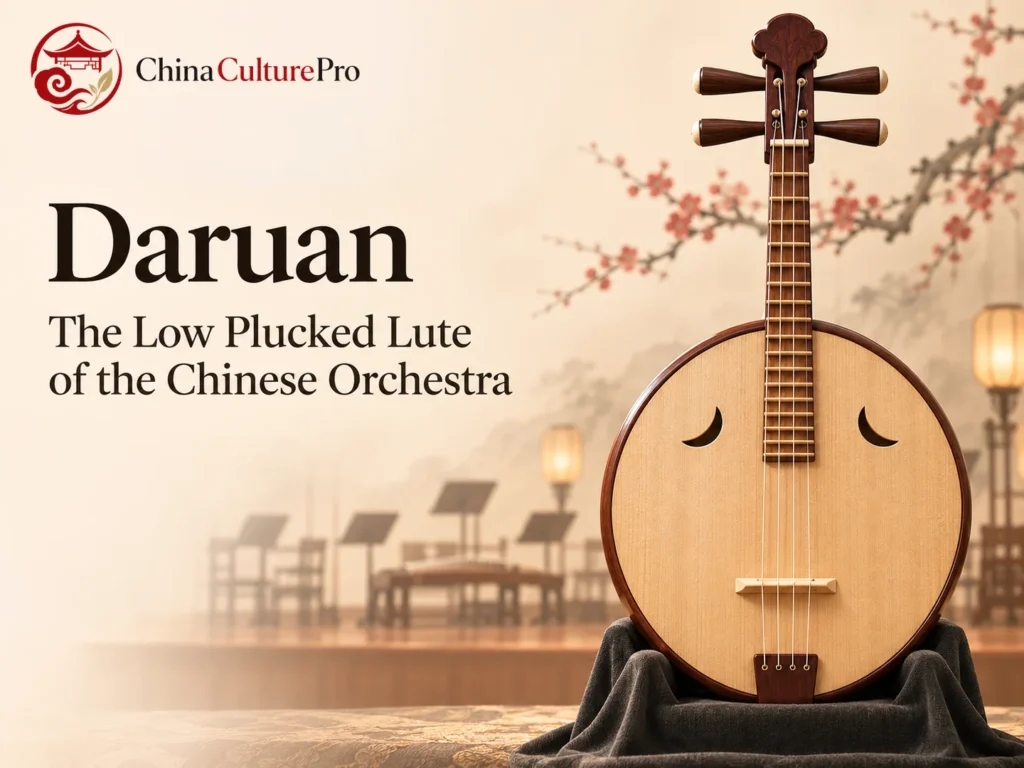
A daruan (大阮, dàruǎn) is a large, low-register lute in the Chinese ruan family. It usually has a round wooden body, a long fretted neck and four strings. In a Chinese orchestra, it can give the plucked-string section low notes with a clear attack.[1][2][3]
- Shape: The soundboard has a round outline.[1]
- Playing: The player plucks the strings and stops them against the frets.[1][2]
- Role: It supplies a lower voice among plucked strings.[1][2][4]
The instrument’s size and place in the score help distinguish it from related ruan.[1][2]

A low note can start with a distinct pluck and fade while the melody continues. That shape gives a daruan a different presence in an ensemble from an instrument that can hold a note under the bow.
How a Round Four-String Lute Sounds
The ruan has a wooden soundboard on a round resonating body. A string starts the sound, and the bridge transfers vibration to the body. Frets along the neck give the player a series of stopping positions. In the larger daruan, the lower strings can make a round, clearly defined attack when plucked.[1][2][4]
Body shape helps when several lutes appear in a photograph. A pipa has a pear-shaped outline. A ruan has a circular one. The guide to the ruan family explains other features that these fretted lutes share.[1]
An instrumental guide to the Chinese orchestra describes playing the ruan with a plectrum or artificial nails. It also notes that an instrument can sound more than one string at a time, producing a chord. A short low chord can have a distinct attack even when upper voices are already sounding.[5]
Daruan and Zhongruan in an Orchestra
The Singapore National Youth Chinese Orchestra places the revival of the ruan in the twentieth century, when orchestras were looking for lower plucked voices. It calls the daruan a bass ruan and the zhongruan (中阮, zhōngruǎn) an alto ruan. The zhongruan generally supplies a middle voice in the plucked section.[1][2]
The same instrumental guide gives an example daruan tuning of D, A, D and A, from the thickest string upward. In its zhongruan example, the lowest string is G above the daruan’s low D. The ranges overlap, so the note being played is only one clue to which lute is sounding.[5]
A Hong Kong Chinese Orchestra performance roster lists two daruan and four zhongruan. These are separate parts of that performance’s plucked-string group. The list is a record of one performance. It shows that a single orchestra can use both sizes together.[3]
How to Hear the Low Plucked Line
Listen first for the start of each low note. A plucked string starts with a brief contact and then fades. A bowed instrument such as a gehu can continue to feed energy into the string. Listen for which low sounds seem to keep going and which begin as a distinct pulse.[1][2][3]
The low line may be clearest against a higher plucked instrument such as the liuqin, a small pear-shaped lute. A daruan can also reinforce a low accent when several strings play together. If you can see the players, match those low attacks to the right hands of the larger round-bodied instruments.
FAQs About the Daruan
Is every ruan a daruan?
Ruan names the instrument family. The daruan is a larger, lower member of that family, alongside other sizes such as zhongruan and xiaoruan.[1][2]
Is the daruan the orchestra’s only bass instrument?
It is a lower plucked instrument. The same orchestra can use bowed bass instruments and other low voices in separate parts.[2][3]
Sources
[1] Middle Tennessee State University, Center for Chinese Music and Culture. Instrument Gallery
[2] Singapore National Youth Chinese Orchestra. Ruan
[3] Hong Kong Chinese Orchestra. Performance Roster
[4] B.C. Chinese Music Association. Ruan
[5] INTERMUSIC, Lithuanian Academy of Music and Theatre. An Instrumental Guide to the Chinese Orchestra