

Quick Answer: What Is Daur Beikuo?
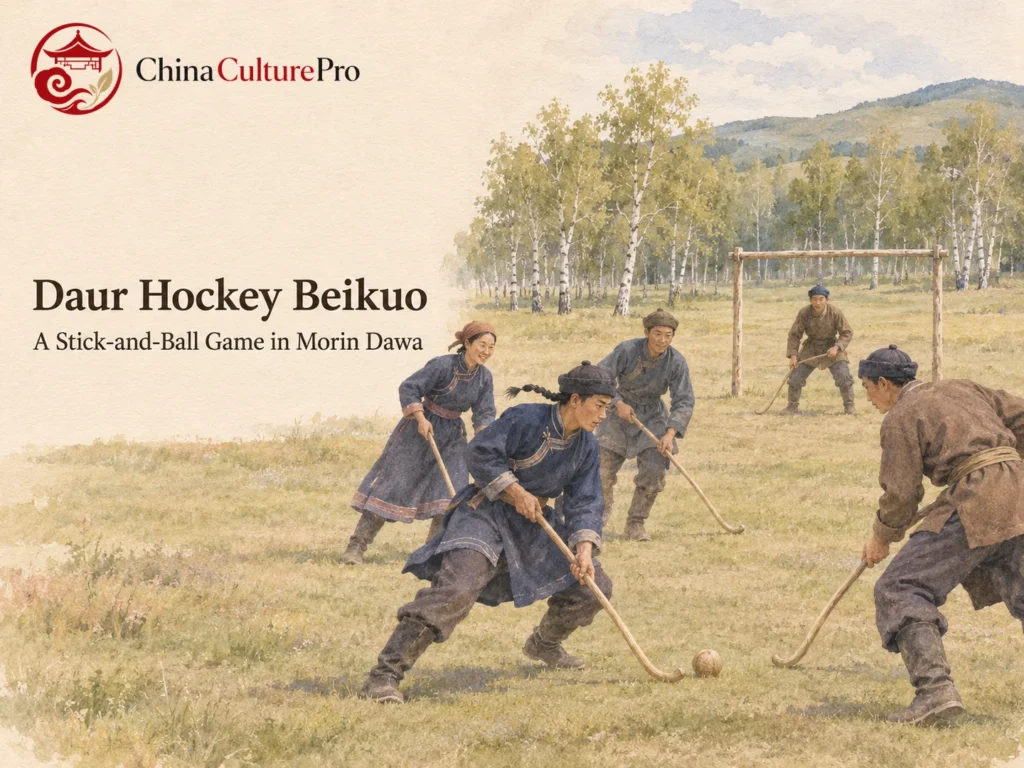
Beikuo (贝阔, bèikuò) is the name for the curved stick in a traditional Daur (达斡尔族, Dáwò’ěrzú) game often called Daur hockey. The game is documented in Morin Dawa (莫力达瓦, Mòlìdáwǎ) Daur Autonomous Banner in Inner Mongolia. Two sides try to send a ball through the other side’s goal.[1][2]
- The longer Daur name for the game includes the term for the stick.[2]
- Traditional balls include wooden and felted-hair forms.[1]
- Morin Dawa has also developed players for modern field hockey.[4]
The name connects the traditional sport to its most recognizable piece of equipment.

A curved stick and two goals give the game a resemblance to field hockey. How teams are formed and the kinds of balls they use bring the village tradition into focus.
The Stick and the Ball
A traditional stick has a straight shaft and a curved lower end. Documented ball types include wood and compacted animal hair. Accounts also describe a historical luminous ball for night play.[1]
How a Traditional Match Is Played
Teams were formed by villages or clans for gatherings and festivals. The recorded rules call for equal numbers on the two sides, with goals at each end of an open space. A match can be played on level ground without the fixed dimensions of a modern field. The higher score wins.[1]
From the Village Game to Field Hockey
Hasen (哈森, Hāsēn), a Daur representative practitioner from Morin Dawa, worked as a coach and referee. She drew on traditional play and international rules and helped organize a women’s field hockey team in 1980. The banner continued to contribute players to the national sport, including at the 2008 Olympics.[3][4]
How the Game Is Recognized
Traditional Daur hockey is part of the first national list of Chinese intangible cultural heritage, issued in 2006. It is a sporting tradition within wider Daur culture.[1] Other historical ball games include cuju.
FAQs About Daur Beikuo
What does beikuo mean?
It refers to the curved stick and forms part of the longer Daur name for the game.[2]
Where is the traditional game best documented?
The national entry comes from Morin Dawa Daur Autonomous Banner in Inner Mongolia.[1]
Is the village game played on a standard-size field?
The heritage description records open fields of varying sizes, with a goal at each end.[1]
Sources
[1] China Intangible Cultural Heritage Digital Museum. Traditional Daur hockey
[2] China Intangible Cultural Heritage Digital Museum. Traditional sports and other heritage among ethnic communities
[3] China Intangible Cultural Heritage Digital Museum. Hasen
[4] Hockey Western Australia. WA’s elite to take on Inner Mongolia in six-game series