

Quick Answer: Which Chinese Wedding Taboos Matter?
Chinese wedding taboos are family and community expectations about auspicious behavior, gifts, dates and participation. Their meaning and strictness vary; a rule observed in one household may be absent in another.
- Confirm the hosts’ clothing and gift preferences before choosing an outfit or present.
- Discuss date restrictions and ceremonial roles before making bookings or inviting participants.
- Treat claims about misfortune as beliefs, not predictions or evidence that a person causes harm.
The most useful question is which custom this particular family wants to observe, at which part of the wedding.
A guest may be told to avoid black, then see a groom in a black suit. A couple may hear that four is unlucky while relatives discuss a four-piece gold gift. These apparent contradictions become clearer when the object, occasion and community are specified.
This guide places taboos within wider Chinese wedding traditions. Use it to understand a concern and discuss it calmly, rather than turn an online list into new obligations for everyone attending.
Colors: Check the Outfit and the Occasion
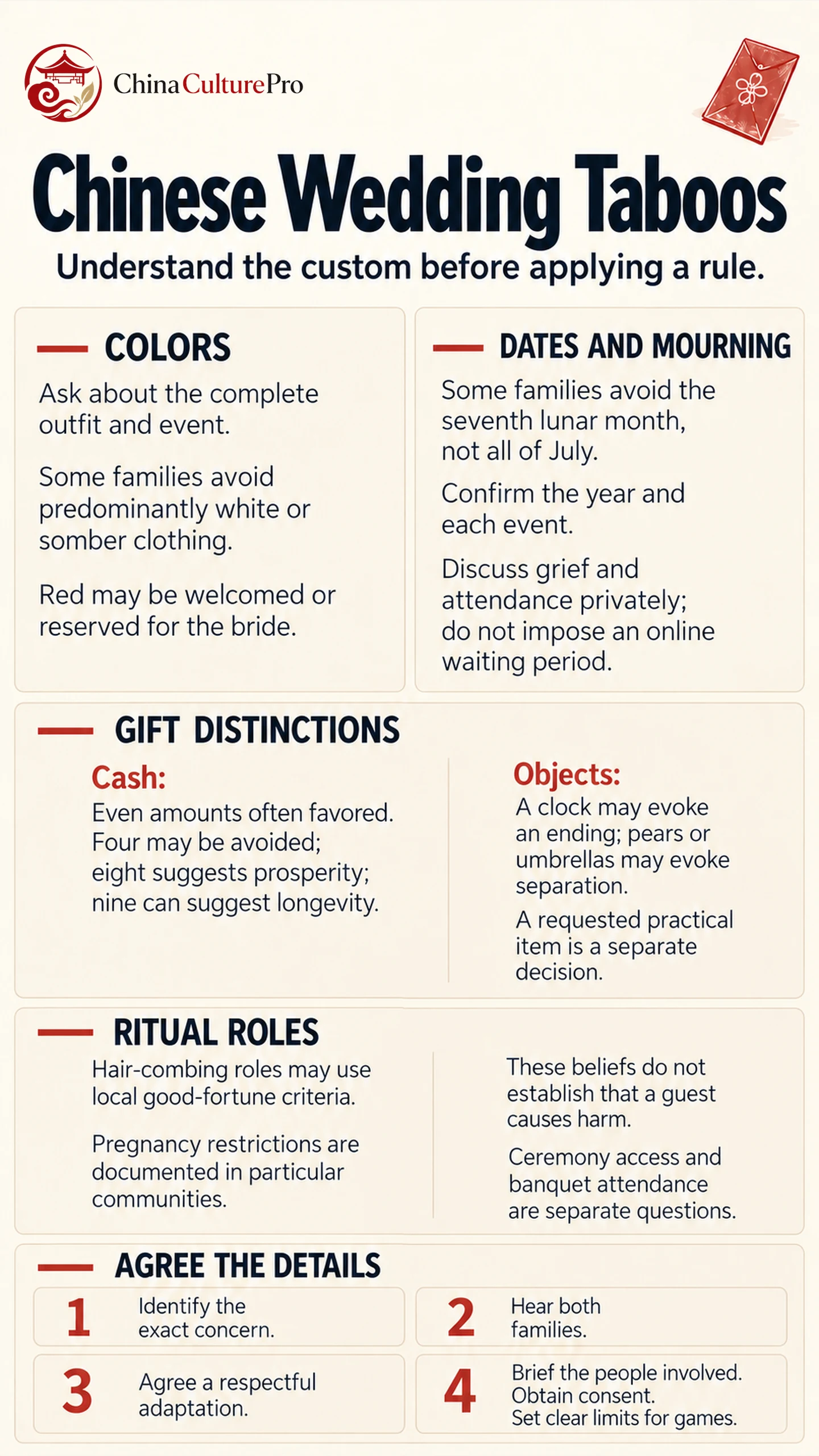
Some families associate predominantly white or very somber clothing with mourning and prefer celebratory colors. A local account from Huaihua specifically records a white-clothing taboo at Dong weddings; that is a community example, not a dress code for every Chinese wedding.[1]
Red can also raise a different concern: whether a guest’s outfit resembles or competes with the bride’s ceremonial clothing. Ask about the complete outfit and event. A red accessory, a long red bridal-style dress and a red shirt are not interchangeable choices.
For guests, a useful message is: “Would this outfit suit the ceremony and dinner?” Send a photo if the color or formality is uncertain. Follow an explicit invitation dress code and check any ambiguity with the couple or their designated helper. The guest etiquette guide covers the wider arrival and reception questions.
Do not infer a guest rule from the bride’s ceremonial dress. Ask about your own role and outfit.
Numbers and Gifts: Symbolism Needs Context
Hongbao (红包, hóngbāo), money given in a red packet, carries wishes of goodwill. In Singapore Chinese practice, even denominations are commonly favored, four may be avoided because of its association with death, and eight is considered auspicious. Nine is a documented exception to the simple “even numbers only” slogan because it can suggest longevity.[2]
These associations do not establish a compulsory amount. Choose an affordable gift and ask what is customary in the hosts’ circle; consult the wedding gift guide and the explanation of red packet etiquette for the different roles of money gifts.
| Concern | Why context matters | What to confirm |
|---|---|---|
| A gift amount containing four | A number preference concerns the amount, not every set of objects | Whether the hosts have a preferred convention |
| A clock as a surprise present | Its name can evoke an unwelcome end-of-life association | Whether a different or specifically requested gift is better |
| Pears or an umbrella as a romantic gift | Their names can evoke separation | Whether the item is a symbolic present or an ordinary practical object |
The clock and separation associations are documented gift-giving beliefs, and even the guidance recording them allows practical exceptions, such as a requested watch or an umbrella offered in rain.[3][4] A requested household item should therefore be discussed on its own terms.
Likewise, a Teochew four-piece set of wedding gold jewelry is itself a documented gift tradition.[7] It should not be rejected solely because an online list says to avoid four. The role and name of a customary set differ from the digits chosen for a cash gift.
Dates and Mourning: Ask Before Booking
Some families avoid weddings during the seventh lunar month. A Singapore community handbook records that preference among Chinese wedding customs.[5] It refers to a month in the traditional calendar, whose Gregorian dates change from year to year, rather than all of July.
Ask about this before paying a venue deposit. Separate the ceremony date, banquet date and any earlier home rituals so that a concern about one does not automatically move every event. Put the agreed dates and times into the wedding timeline.
If a family is grieving, ask privately whether attendance or a ceremonial role would feel comfortable. Do not assume that a recently bereaved person is unwelcome, or impose a fixed waiting period found online. A conversation about the family’s wishes and the person’s own readiness is more helpful than publicly labeling someone inauspicious.
Ritual Roles and Participation Beliefs
Shang tou (上头, shàng tóu), the hair-combing ceremony, can include choosing a person considered fortunate to lead it. One Hong Kong practitioner account describes criteria involving a harmonious marriage, a living spouse and children; it also describes modern simplifications.[6] These are ritual ideals in that account, not a judgment of the worth of single, childless or bereaved relatives.
For an actual ceremony, confirm the chosen person’s role, consent and practical needs using the hair-combing guide. Avoid announcing a relative’s private circumstances as an explanation for selecting someone else.
Pregnancy-related participation taboos also appear in specific local traditions. The Huaihua account distinguishes Dong restrictions concerning the bridal chamber from a Tujia belief about observing a wedding.[1] Such records establish that a belief exists locally. They do not establish that pregnancy causes misfortune or that all Chinese families exclude pregnant guests.
If a household wants a restricted ceremonial space, discuss it privately and agree a considerate arrangement with the people affected. A particular bed-setting ritual and an invitation to the banquet are separate matters. Do not infer one decision from the other.
Objects can change meaning by role too: the Hong Kong hair-combing account includes scissors among its ceremonial supplies.[6] A warning about a symbolic gift cannot become a blanket ban on the same object appearing anywhere at the wedding.
How to Resolve Different Family Expectations
Differences between households need an explicit agreement, especially when the families draw on different regional wedding traditions. This process helps turn a general warning into a decision:
- Identify the exact concern. Ask which event, object, date or participant the family custom concerns.
- Hear both families separately. Establish what each household observes and which elements matter most to them.
- Agree a respectful adaptation. Choose the arrangement together and obtain the consent of the people taking part.
- Brief the people involved. Record the agreed details and share them privately with the relevant guests and helpers.
For example, a family may want a particular elder to lead a home ritual while welcoming everyone at the reception. Record that distinction in the running order so helpers do not improvise exclusions at the door.
Keep practical boundaries clear. No belief requires a guest to accept humiliation, unwanted touching or pressure to drink. Discuss consent and limits for wedding door games in advance, and give one trusted helper authority to stop an activity if someone is uncomfortable.
FAQs About Chinese Wedding Taboos
Can guests wear red to a Chinese wedding?
Ask the hosts. Some welcome festive red, while others prefer guests to avoid an outfit resembling the bride’s ceremonial dress. The garment and occasion matter more than a blanket color rule.
Is the seventh lunar month the same as July?
No. Lunar months do not correspond exactly to Gregorian months. If a family avoids the seventh lunar month, confirm the actual dates for the wedding year.
Does breaking a wedding taboo mean bad luck will follow?
A taboo records a belief or social expectation; it does not demonstrate that an action causes misfortune. If someone is upset, acknowledge the concern and discuss a practical adjustment without blaming a guest.
Should guests ask about every taboo they find online?
No. Confirm the invitation details, outfit, gifts and any role assigned to you. Let the hosts explain additional expectations rather than introduce an unfamiliar checklist.
Sources
[1] Huaihua Municipal Government. Taboos of local ethnic groups
[2] Sun Yat Sen Nanyang Memorial Hall. Red packets (Hongbao)
[3] Ministry of Culture and Tourism cultural portal. Culture Insider: Taboos in gift-giving — clocks
[4] Ministry of Culture and Tourism cultural portal. Culture Insider: Taboos in gift-giving — umbrellas and pears
[5] National Integration Council, Singapore. Who’s Your Neighbour?
[6] Family and Women Portal, Hong Kong. Dai Kam Jie Explains the Contemporary Take on Traditional Weddings
[7] Singapore Federation of Chinese Clan Associations. Culture — Rituals